
Why does a bottle of generic ibuprofen cost pennies while the brand-name version demands dollars? The answer isn't just marketing hype or fancy packaging. It’s buried in the complex world of pharmaceutical manufacturing, specifically in how labor is used and paid. When you look at the raw numbers, the difference in labor cost differences between generic and brand-name production is stark, but it’s not as simple as one paying workers less than the other. It’s about scale, complexity, regulation, and where the factories are located.
If you’ve ever wondered why your pharmacy bill drops so significantly when you switch from a brand to a generic, this breakdown explains the economic machinery behind that price tag. We’re going to look past the shelf price and into the factory floor to see exactly where the money goes.
The Real Cost Breakdown: Where Does the Money Go?
To understand labor costs, we first have to look at the total pie. You can’t judge the size of the labor slice without seeing the whole cake. For brand-name drugs, the biggest expense isn’t making the pill; it’s inventing it. Developing a new molecular entity costs approximately $2.6 billion on average and takes 10 to 15 years from discovery to market approval. This massive upfront investment means brand manufacturers must charge high prices to recoup their losses and make a profit. Labor in this phase involves highly specialized researchers, clinical trial coordinators, and regulatory experts who command top-tier salaries.
Generic manufacturers don’t pay this R&D bill. They only need to prove their product is bioequivalent to the brand. This changes everything. According to Prosperous America’s 2023 analysis, only $36 of every $100 spent on generics goes to actual production and manufacturing. Of that $36, just $18 covers direct production costs like active ingredients and packaging. The rest is gross profit for the manufacturer to cover overhead, compliance, and yes, labor. In contrast, brand-name drugs often command prices 80-85% higher than generics despite having similar production costs for the active ingredients themselves.
| Cost Component | Generic Drugs | Brand-Name Drugs |
|---|---|---|
| R&D Investment | $0 (No new discovery) | ~$2.6 Billion per drug |
| Production % of Price | ~36% | Variable (High markup) |
| Labor Share of Manufacturing | 15-25% | 30-40% |
| Primary Labor Focus | Quality Control & Compliance | Innovation & Clinical Trials |
Labor Intensity: Quality Control vs. Innovation
So, if generics are cheaper, do they cut corners on labor? Not necessarily. In fact, the type of labor required is different. For brand-name drugs during initial production phases, labor constitutes 30-40% of total manufacturing costs. This includes the high-paid scientists and engineers managing complex, novel formulations.
For generics, labor makes up a smaller slice-approximately 15-25% of total manufacturing costs. However, the nature of this labor is heavily skewed toward quality control. A 2023 analysis by DrugPatentWatch reveals that quality control processes alone account for more than 20% of total generic drug production costs. This is a major labor-intensive component. Workers aren’t just mixing powders; they are rigorously testing raw materials, monitoring in-process materials, and testing final products. They also handle meticulous documentation for batch traceability, which is a legal requirement.
This regulatory compliance burden is expensive. A 2017 FDA analysis noted that medium-sized firms spend approximately $184,000 annually just to maintain compliance systems. That’s money going to salaried compliance officers, quality assurance managers, and document controllers. So, while the percentage of labor cost is lower for generics, the absolute amount spent on ensuring safety and consistency remains significant because the margin for error is zero.
The Scale Factor: How Volume Drives Down Labor Costs
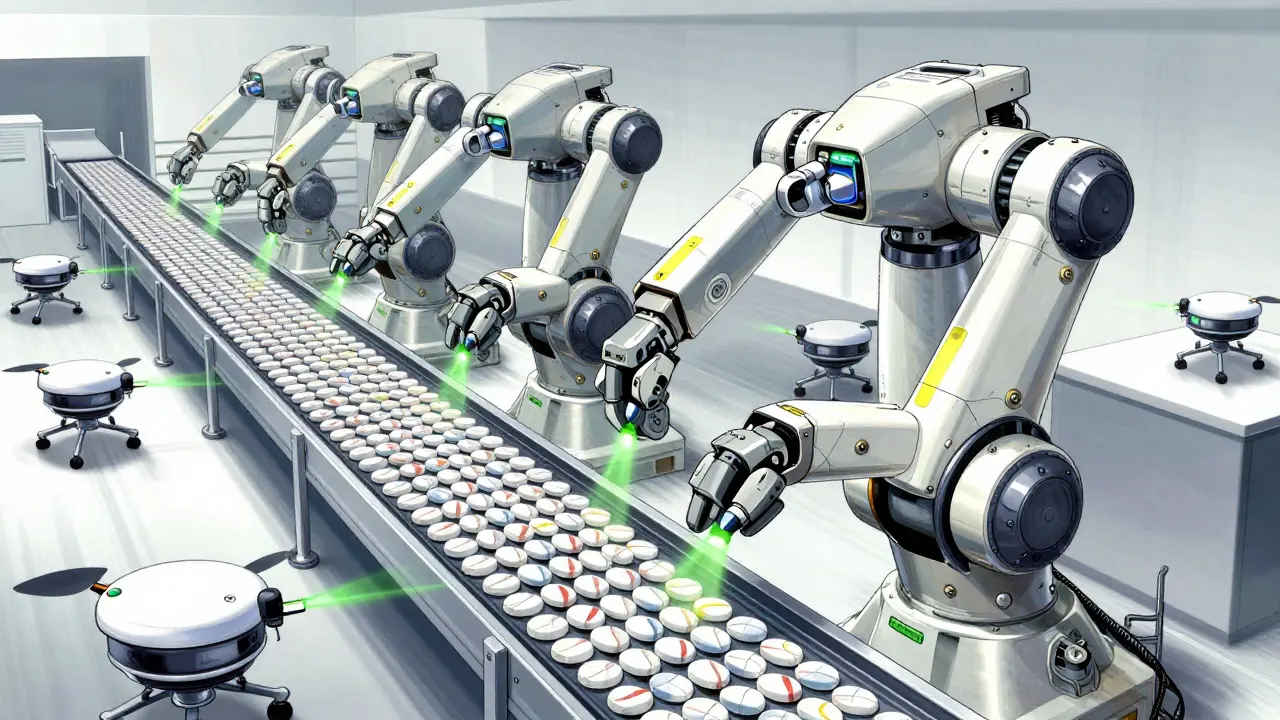
The single biggest reason generic labor costs are lower per unit is volume. Nine out of 10 prescriptions filled in the U.S. are for generic drugs. This massive demand allows manufacturers to produce millions of identical pills on automated lines. When you produce at that scale, you need fewer people per pill produced.
A benchmark study by BCG in 2019 highlighted this efficiency. Generic small-molecule drug manufacturers achieve a 27% unit cost reduction every time volume per manufacturing site doubles. Compare that to biopharma companies, which see only a 17% reduction. This means labor productivity in generic manufacturing scales exceptionally well. As volume increases, the fixed labor costs (like supervision and quality management) are spread over a much larger number of units, driving down the cost per tablet. Brand-name drugs, especially newer ones, often start with lower volumes and more complex, less automated processes, keeping their per-unit labor costs high.
Geography Matters: The Global Labor Arbitrage
Where the drug is made matters just as much as how it’s made. Geographic production strategies significantly impact labor cost differentials. Many generic manufacturers source their Active Pharmaceutical Ingredients (APIs) from India and China. According to Prosperous America’s 2023 analysis, API production in these regions is approximately 42% cheaper than in U.S. facilities.
This cost advantage applies to the production slice of total generic drug costs. While this isn’t purely a “labor” issue-it also involves energy and material costs-the lower wage structures in these countries play a huge role. The HHS Office of the Assistant Secretary for Planning and Evaluation documented in 2021 that these international cost advantages often reflect subsidies and different labor standards rather than just greater efficiency. For a U.S.-based generic company, outsourcing API production allows them to bypass high domestic labor costs entirely, passing those savings down to the consumer.
The Pressure Cooker: Competition and Supply Risks
Here is the catch. Because generics are cheap, competition is fierce. The FDA’s 2023 report on generic competition confirms that as more competitors enter the market, prices drop significantly. But this pressure trickles down to the factory floor. Manufacturers feel intense pressure to lower their costs further to stay profitable. This can lead to strategies that reduce manufacturing costs, such as hiring less experienced personnel or reducing staffing levels in quality control.
This creates a risk. The FDA has noted increasing attention on whether the lower cost of generic drugs may place pressure on companies to adopt strategies that compromise quality, potentially leading to supply disruptions and shortages. If a company cuts labor costs too deeply, they might miss a contamination issue or a potency variance, leading to costly recalls or shutdowns. Smart manufacturers know that investing in prevention-training staff well and maintaining robust QC teams-actually lowers total costs in the long run by avoiding rework and scrap. It’s a delicate balance between saving money today and staying in business tomorrow.

Outsourcing Labor: The Rise of Contract Manufacturers
To manage these volatile labor costs, many generic manufacturers are shifting their strategy. Instead of owning factories and employing large permanent workforces, they are increasingly relying on Contract Manufacturing Organizations (CMOs). The BCG study noted that biosimilar business units spend 42% of their Cost of Goods Sold on CMOs, compared to 28% for small-molecule units.
This shift transforms fixed labor costs into variable expenses. If demand spikes, the CMO handles it. If demand drops, the generic company doesn’t have to lay off hundreds of workers. This flexibility helps stabilize financial performance but also means the direct labor footprint of the generic brand owner shrinks even further. They become more of a manager of relationships and less of a direct employer of production line workers.
Summary: The Economic Reality
The labor cost difference between generic and brand production isn’t about one side working harder or smarter in isolation. It’s a structural difference. Brand names pay for innovation and carry the risk of R&D failure, requiring high-skilled, high-cost labor early on. Generics pay for efficiency, scale, and rigorous quality control. By leveraging global supply chains, massive production volumes, and streamlined processes, generics keep their labor share of costs low-around 15-25% versus 30-40% for brands. This efficiency is what allows you to save money at the pharmacy counter, though it comes with ongoing challenges in maintaining quality amidst fierce price competition.
Do generic drugs use cheaper labor than brand-name drugs?
Not necessarily "cheaper" in terms of skill, but the structure is different. Brand-name labor costs are higher (30-40% of manufacturing costs) due to complex innovation and R&D support. Generic labor costs are lower (15-25%) because they rely on economies of scale and standardized processes. However, generics spend heavily on quality control labor to ensure safety, which is a significant portion of their budget.
Why are generic drugs so much cheaper to produce?
Generics avoid the ~$2.6 billion R&D cost associated with brand-new drugs. They also benefit from massive production volumes, which drive down per-unit labor and material costs. Additionally, many generics source ingredients from countries with lower labor and production costs, such as India and China, further reducing expenses.
Does lower labor cost mean lower quality for generics?
No. Generic drugs must be bioequivalent to brand-name drugs, meaning they perform the same way in the body. Quality control is a major labor cost for generics (over 20% of production costs), involving rigorous testing and documentation. While price pressure exists, regulatory requirements ensure that safety and efficacy standards remain high.
How does production volume affect labor costs in pharma?
Higher volume dramatically reduces per-unit labor costs. A BCG study found that generic manufacturers see a 27% unit cost reduction every time volume doubles. This is because fixed labor costs (like management and quality assurance) are spread across millions of units, making each individual pill cheaper to produce in terms of human effort.
What is the role of Contract Manufacturing Organizations (CMOs)?
CMOs allow generic manufacturers to outsource production. This shifts labor costs from fixed (permanent employees) to variable (paying for what you need). This flexibility helps companies manage costs during fluctuating demand and reduces the need for large internal workforces, contributing to lower overall operational expenses.

the labor arbitrage mentioned here is clearly a smokescreen for deeper systemic exploitation that the mainstream narrative refuses to acknowledge. when you look at the supply chains, it becomes obvious that the 'savings' are derived from externalizing costs onto vulnerable populations in developing nations. this isn't just economics; it's a calculated mechanism of control disguised as efficiency. the data presented ignores the human cost entirely, focusing instead on cold metrics that benefit only the corporate elite. one must question why such disparities are allowed to persist under the guise of market forces. it suggests a level of complicity that is disturbingly high among regulatory bodies who claim to protect public health while enabling these structures. the so-called quality control measures are merely performative gestures to placate an anxious populace. we are being fed a sanitized version of reality where profit margins dictate moral worth. the silence on this issue is deafening and indicative of a broader cultural amnesia regarding justice. it is imperative that we dismantle these narratives before they further erode our collective understanding of value.
This is actually a really clear breakdown! It’s fascinating how much the R&D costs impact the final price tag compared to the actual manufacturing labor. The point about economies of scale is spot on too!
they dont want you to know that the generic drugs are laced with trace elements that alter behavior over time. the cheap labor is a cover for the real agenda which is population control through pharmaceutical dependency. look at the dates of the FDA reports they always coincide with political shifts. its not about money its about power. the west imports from china because they have no choice anymore. the supply chain is weaponized against us. wake up people.
One cannot help but observe the rather pedestrian nature of this analysis, which reduces the sublime complexity of pharmaceutical economics to mere arithmetic. While the figures are ostensibly correct, they fail to capture the ontological weight of innovation versus replication. The brand-name entity represents a triumph of human intellect, a beacon of scientific aspiration, whereas the generic is merely a shadow, a pale imitation devoid of the creative spark that birthed the original molecule. To equate them solely through the lens of labor cost is to misunderstand the very essence of value creation. We are discussing the commodification of hope itself, reduced to pennies on the dollar by those who lack the vision to appreciate the monumental effort required to pioneer new therapeutic frontiers. The elitist perspective might be harsh, yet it remains the only honest one: quality has a price, and that price is paid in genius, not just wages.
I mean, personally, I think it's great that we can save money, but let's not pretend that outsourcing everything to foreign entities is a long-term strategy for American strength. We need to bring those jobs back home, even if it costs a bit more initially. Our sovereignty matters more than a few extra dollars at the pharmacy counter. Plus, knowing exactly who made your medicine gives you peace of mind, doesn't it? It's about trust and community, not just bottom lines. Let's support local industry and keep our standards high right here in the US.
The moral implications of prioritizing cost-cutting over robust domestic employment opportunities are profound and troubling. When corporations choose to outsource production to regions with lax labor standards, they are effectively participating in a global race to the bottom that undermines the dignity of work everywhere. This is not merely an economic decision; it is an ethical failure that reflects a societal shift towards valuing convenience over community welfare. The argument that generics are cheaper due to labor arbitrage is a justification for exploitation, plain and simple. We must demand accountability from these entities and refuse to accept a system that profits from the disenfranchisement of workers in both developed and developing nations. True sustainability requires fair wages and safe conditions, regardless of geography.
its absolutely disgusting how the rich get richer while the rest of us suffer. the whole system is rigged against the little guy. they talk about quality control but what about the quality of life for the people making these pills? its all about greed and power. stop pretending this is fair. its a scam.
It seems we are witnessing a fundamental deconstruction of the traditional value proposition in healthcare. The dichotomy between brand and generic serves as a microcosm for larger philosophical debates regarding originality versus utility. If the end result is functionally identical, does the provenance truly matter? Or are we clinging to the myth of inherent superiority in branded goods as a psychological crutch? The reduction of labor costs through automation and outsourcing challenges our notions of what constitutes 'value-added' work in the modern economy. Perhaps the true cost is not monetary, but existential, as we delegate more aspects of our well-being to impersonal, globalized systems.
You're missing the key metric here which is the ROI on clinical trials versus bioequivalence studies. The delta in labor intensity is negligible when you factor in the regulatory overhead for ANDA submissions versus NDA approvals. Most people don't understand that the QC burden is actually higher for generics because of the batch-to-batch variability issues inherent in older APIs. It's not just about 'cheap labor'; it's about risk mitigation strategies employed by CMOs to hedge against supply chain volatility. The data shows a clear correlation between volume doubling and unit cost reduction, but that's standard learning curve theory, nothing revolutionary. Stop oversimplifying complex pharmacoeconomic models into soundbites.
While the article attempts to provide a comprehensive overview, it unfortunately falls short of addressing the nuanced geopolitical dynamics that influence these cost structures. One must consider that the disparity in labor costs is not merely a function of efficiency but also of historical inequities and colonial legacies that continue to shape global trade relations. The notion that generic manufacturers simply 'benefit' from lower wages overlooks the structural dependencies that force many developing nations into this role. Furthermore, the emphasis on quality control as a primary labor cost for generics is somewhat misleading, as it fails to account for the immense intellectual property barriers that brand-name companies erect to maintain their monopolies. A truly sophisticated analysis would delve into the intersection of international law, economic policy, and pharmaceutical ethics, rather than resting on superficial comparisons of percentage points. It is essential to recognize that the current system perpetuates a form of neo-colonialism where knowledge and capital remain concentrated in the Global North, while production and associated risks are exported to the Global South.
I've been thinking about this for a while now. Does anyone else feel like the rise of CMOs changes the entire landscape of accountability?