
When your liver starts storing too much fat-not because you drink alcohol, but because of what you eat and how you live-it’s called nonalcoholic fatty liver disease, or NAFLD. Now, doctors are calling it MASLD (metabolic dysfunction-associated steatotic liver disease) to show it’s not just about the liver, but about your whole metabolism. And here’s the thing: your gut is deeply involved. In fact, about 90% of people with NAFLD have a damaged gut lining that lets bad bacteria and toxins leak into the liver, sparking inflammation. This isn’t just a theory. It’s backed by real data from over 40 studies. If you’re trying to fix your liver, you can’t ignore your gut.
What’s Really Going On Between Your Gut and Liver?
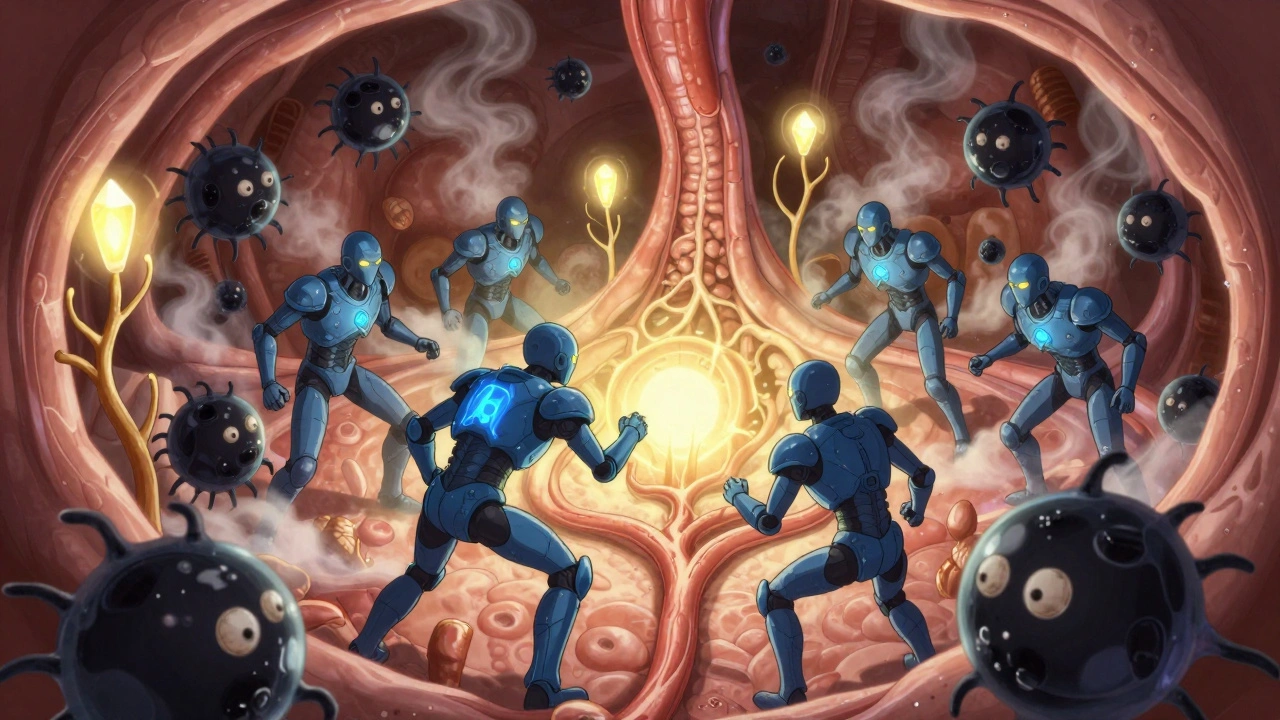
Your liver and gut are connected by a direct pipeline-the portal vein. Every time you eat, nutrients, bacteria, and their byproducts travel from your intestines straight to your liver. Normally, your gut lining acts like a gatekeeper, letting good stuff through and blocking the rest. But in NAFLD, that gate gets leaky. Studies show people with NAFLD have 2.3 times more endotoxins like LPS in their blood than healthy people. That’s not a small difference. That’s enough to turn your liver into a war zone.
Meanwhile, your gut bacteria are out of balance. Healthy guts have lots of different microbes working together. NAFLD patients often have less diversity-fewer types of bacteria, and the wrong ones taking over. Some studies point to too much Lachnospiraceae and Barnesiella, and not enough Bacteroides vulgatus. These changes aren’t random. They directly affect how your body handles fat, sugar, and inflammation. For example, healthy gut bacteria make short-chain fatty acids like butyrate, which keeps your gut lining strong and tells your liver to stop storing fat. But NAFLD patients have 58% less butyrate than healthy people. That’s not a coincidence-it’s a cause.
Diet Is the Most Powerful Tool You Have
If you want to reverse fatty liver, losing weight is non-negotiable. But not just any weight loss. It’s about how you lose it. The best evidence points to the Mediterranean diet-not because it’s trendy, but because it works. A 6-month trial with 70 NAFLD patients showed a 32% drop in liver fat just by eating more olive oil, vegetables, nuts, and whole grains, and cutting back on sugar and processed foods. Adding 30 grams of walnuts a day (about 4 whole nuts) boosted the effect even more.
Here’s what the diet actually looks like:
- 25-30 grams of fiber daily (from oats, beans, broccoli, apples-not supplements)
- 25-35% of calories from healthy fats (olive oil, avocados, fatty fish)
- Less than 25 grams of fructose per day (that’s about one apple or one can of soda)
- No sugary drinks, no white bread, no pastries
And the calorie target? A 500-750 calorie deficit per day. That’s not starvation. It’s about swapping out chips for almonds, soda for sparkling water, and dessert for berries. Slow and steady wins. Losing 0.5 to 1 kg per week gives your liver time to heal without triggering more stress.
Weight Loss Isn’t Just About the Scale
Doctors don’t just say “lose weight.” They say lose 5-7% of your body weight to improve fat buildup, and 10% to actually reverse inflammation and scarring. That might sound like a lot, but if you weigh 90 kg, 10% is just 9 kg. And the results? In one 2023 meta-analysis, 81% of people saw less liver fat after losing 5-7%. Nearly half of those who lost 10% saw their NASH (the dangerous form) disappear completely.
But here’s the catch: people who lose weight on their own often gain it back. A Mayo Clinic study found that those who followed a structured program-with diet, exercise, and counseling-kept off the weight in 68% of cases two years later. Those who tried alone? Only 29% kept it off. That’s why support matters. It’s not about willpower. It’s about systems.
Probiotics and Prebiotics: Helpful, But Not Magic
Probiotics aren’t a cure, but they can help. A 24-week double-blind trial with 100 NAFLD patients showed a 23% drop in liver fat and a 31% drop in liver enzymes (ALT) after taking a daily mix of Lactobacillus rhamnosus GG, Bifidobacterium longum, and Streptococcus thermophilus. That’s as good as some medications-but without the side effects.
Prebiotics-food for good bacteria-are even more promising. Taking 10 grams of inulin daily (found in chicory root, garlic, onions) increased butyrate levels by 47% and reduced liver stiffness in 12 weeks. That’s a direct sign of less scarring.
But not all probiotics work. The strains matter. The dose matters. You need at least 10^9 CFU per day, taken consistently for 12 weeks or more. And don’t expect miracles. Probiotics work best when paired with diet and weight loss. As one expert put it: “Microbiome therapies are like adding fuel to a fire that’s already burning. If the fire’s out, the fuel won’t help.”
What Doesn’t Work (And Why)
Intermittent fasting gets a lot of buzz on Reddit. Many people swear by the 5:2 method-eating normally five days, cutting calories two days. Some users report less bloating and more energy. But there’s no strong evidence yet that it reverses liver fat better than daily calorie control. And for some, it triggers binge eating or stress, which makes things worse.
Fecal microbiota transplants (FMT) sound sci-fi, but they’re still experimental. One small study showed minor liver enzyme improvements, but no change in liver tissue. And the cost? Around $5,000 per treatment-with no insurance coverage.
And don’t fall for “liver detox” teas or supplements. They’re not regulated. They don’t fix gut leaks. They don’t lower liver fat. At best, they’re a waste of money. At worst, they can harm your liver more.

Real People, Real Results
In a European trial, 78% of NAFLD patients said their digestion improved within four weeks of starting probiotics and a fiber-rich diet. But 22% quit because of gas or bloating-common at first. That’s normal. Your gut is adjusting.
One woman in Bristol, 52, had NAFLD after years of eating takeout and sugary snacks. She started eating lentils, broccoli, and olive oil daily. She swapped soda for sparkling water with lemon. She walked 30 minutes after dinner. In six months, she lost 11% of her body weight. Her liver enzymes dropped from 120 to 38. Her doctor said her liver looked “normal” on ultrasound. She didn’t take a single pill.
Another man, 48, tried a $60-a-month probiotic without changing his diet. After three months, nothing changed. He started eating real food, lost 8%, and his ALT dropped by 40%. The probiotic helped-but only after he fixed his diet.
The Bottom Line
NAFLD isn’t a liver problem. It’s a metabolic problem with gut roots. You can’t fix it with pills, teas, or quick fixes. You fix it by changing how you eat, moving more, and losing weight slowly but surely. The gut-liver connection means what you do for your gut helps your liver-and vice versa.
Start here:
- Drop sugar and processed carbs. That’s step one.
- Get 25-30g of fiber daily from whole foods.
- Use olive oil, not seed oils.
- Walk 30 minutes a day. No gym needed.
- Target 5-10% weight loss over 6-12 months.
- If you want to try probiotics, pick one with Lactobacillus and Bifidobacterium, 10^9 CFU or more, and take it for at least 3 months.
It’s not about perfection. It’s about consistency. Your liver doesn’t care if you ate kale today. It cares if you’ve been eating it every day for six months.
Frequently Asked Questions
Can NAFLD be reversed without losing weight?
No. Weight loss is the only proven way to reverse fatty liver. Even if you take probiotics or eat only healthy foods, without losing 5-10% of your body weight, liver fat won’t significantly decrease. Studies show people who don’t lose weight see no improvement in liver inflammation or fibrosis, no matter how clean their diet is.
Are probiotics worth taking for NAFLD?
Yes-but only as a helper, not a main treatment. A good multi-strain probiotic (like Lactobacillus rhamnosus GG and Bifidobacterium longum) at 10^9-10^10 CFU daily for at least 12 weeks can reduce liver fat and enzymes by 20-30%. But if you don’t change your diet, the benefits fade once you stop. Probiotics work best when paired with fiber, reduced sugar, and weight loss.
How long does it take to see results from a NAFLD diet?
You can see changes in liver enzymes (ALT) in as little as 6-8 weeks with consistent diet and moderate weight loss. Liver fat reduction shows up on ultrasound or MRI after 3-6 months. Full reversal of NASH usually takes 12-24 months. Patience matters. This isn’t a 30-day challenge-it’s a lifestyle shift.
Does alcohol make NAFLD worse?
Even small amounts of alcohol can worsen liver damage in NAFLD. While the diagnosis excludes heavy drinking, there’s no safe threshold for people with fatty liver. Alcohol increases gut leakiness and liver inflammation. Most doctors recommend avoiding alcohol completely until the liver is fully healed.
Can I eat fruit if I have NAFLD?
Yes, but limit fructose. Whole fruits like berries, apples, and oranges are fine in moderation (2-3 servings per day) because they come with fiber, which slows sugar absorption. Avoid fruit juices, dried fruits, and smoothies-they concentrate fructose without the fiber. One apple is okay. A glass of apple juice is not.
What foods should I avoid with NAFLD?
Avoid: sugary drinks (soda, juice, sweet tea), processed snacks (chips, cookies, pastries), refined carbs (white bread, white rice, pasta), fried foods, and foods with high-fructose corn syrup. Also limit red meat and butter. Focus on whole, unprocessed foods instead.

Okay, but have we considered that the gut-liver axis might just be a symptom, not the cause? Like, maybe metabolic dysfunction comes first-insulin resistance, chronic inflammation-and the gut leakiness is just the body’s way of screaming for help? We’re treating the symptom like it’s the disease. What if we’re missing the forest for the trees?
Of course the pharmaceutical companies don’t want you to know this. They’ve been pushing liver pills for decades while the real fix-diet, sleep, stress reduction-is free. And now they’re rebranding NAFLD as MASLD to sell more tests and supplements. Wake up. This isn’t medicine. It’s marketing.
So let me get this straight-you’re telling me I have to give up pizza and soda for six months to fix my liver? And I’m supposed to believe this isn’t just another wellness cult? I’ve tried this before. I lost 5 lbs, gained it back, and now my anxiety is worse. Thanks for the guilt trip.
lol i just ate a bag of cheetos and drank a coke and now im scared. like. why does everything have to be so hard? cant i just take a pill??
omg this is so relatable!! i started eating more veggies and now my tummy dont bloat as much!! its not perfect but i feel better :) keep going girl!!
You state that 'weight loss is the only proven way to reverse fatty liver.' This is an absolute claim, unsupported by the entirety of the literature. Multiple longitudinal studies-including the 2021 NEJM meta-analysis-demonstrate that metabolic improvement can occur independently of weight loss, particularly when insulin sensitivity improves via low-glycemic dietary interventions. Your oversimplification misleads the public. Fix your rhetoric.
There’s something deeply poetic about this, honestly. The gut and liver-two organs that never talk, but always listen. The gut eats the world, and the liver cleans up the mess. But when the gut stops trusting the liver, when it starts leaking secrets… the liver doesn’t know what to do. It just tries harder. And then it breaks. We’re not treating a disease. We’re repairing a relationship. And relationships take time, patience, and real food-not supplements.
I’m from Nigeria, and here, we don’t have access to olive oil or walnuts. But we do have bitter leaf soup, millet, and fermented locust beans. My uncle reversed his fatty liver with those, no pills. Maybe the solution isn’t just Mediterranean-it’s ancestral. What if we stop copying Western diets and start honoring our own food wisdom?
I’ve been reading this for 20 minutes and I’m already crying. I didn’t realize how much I hated myself for eating sugar. I’ve been doing this wrong for years. I’m not lazy-I’m scared. Scared I’ll fail again. But… maybe I’ll try the broccoli. Just… one day at a time.
...So you're saying... if I just... stop eating... carbs... I'll be fine? ...And that's it? ...No pills? ...No magic? ...No secret protocol? ...This is the most depressing thing I've read all week.