
When you’re managing type 2 diabetes, finding a medication that lowers blood sugar, protects your heart, and helps your kidneys is a win. That’s why SGLT2 inhibitors became so popular. Drugs like empagliflozin (Jardiance), dapagliflozin (Farxiga), and canagliflozin (Invokana) work by making your kidneys flush out extra glucose through urine. It’s a clever trick-no insulin needed. But behind the benefits lies a quiet, dangerous risk: diabetic ketoacidosis-and not the kind you expect.
What’s Different About This DKA?
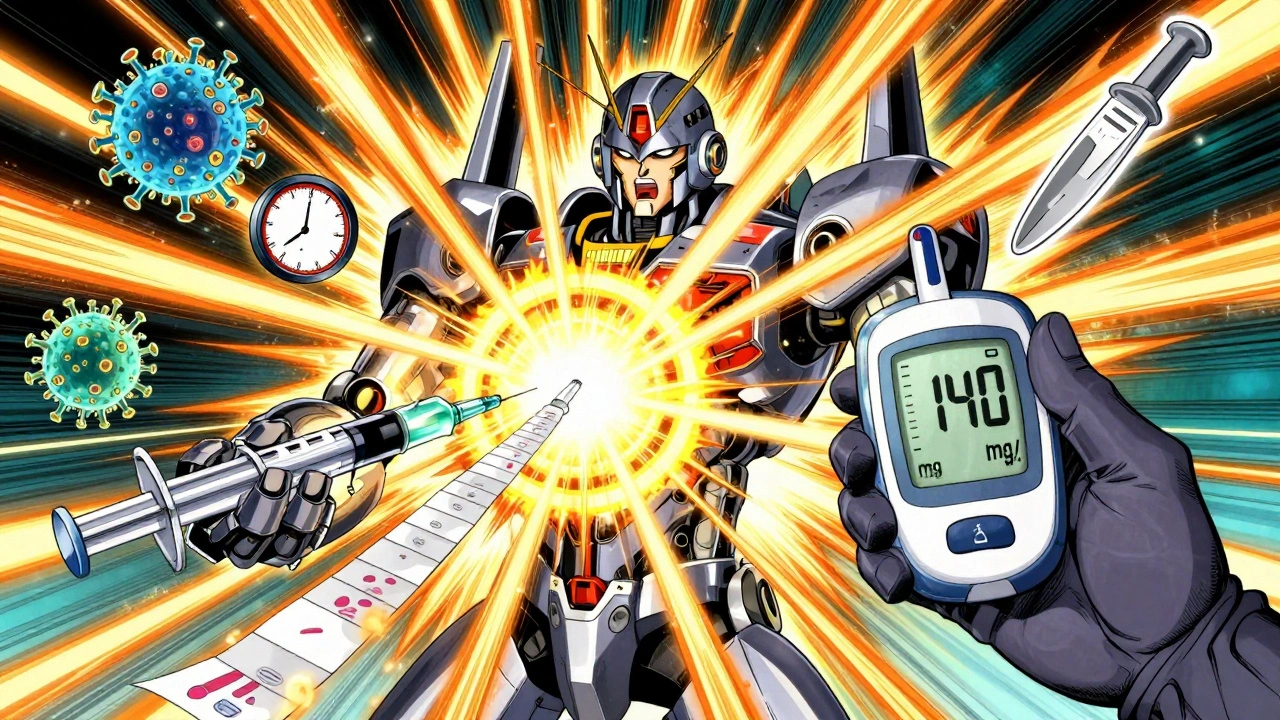
Most people think of diabetic ketoacidosis (DKA) as a crisis with blood sugar over 250 mg/dL, extreme thirst, fruity breath, and confusion. That’s the classic version, usually seen in type 1 diabetes when insulin is missing. But with SGLT2 inhibitors, something unusual happens. Many patients develop what’s called euglycemic DKA-or euDKA. Their blood sugar? Often below 200 mg/dL. Sometimes even under 150 mg/dL. That’s not high enough to trigger alarm bells in most patients or even some doctors.This is the problem. If your glucose isn’t sky-high, you might not realize you’re in danger. You might feel nauseous, tired, or have stomach pain and assume it’s the flu. But your body is burning fat for fuel, flooding your blood with ketones, and your blood is turning acidic. Without quick treatment, this can lead to coma or death.
Studies show euDKA makes up nearly 40% of all DKA cases in people taking SGLT2 inhibitors. The European Medicines Agency (EMA) confirmed this in 2023 after reviewing thousands of reports. The FDA warned about it back in 2015. Yet, many patients still don’t know the signs.
Who’s Most at Risk?
Not everyone on an SGLT2 inhibitor will get euDKA. But certain situations make it much more likely:- Illness-Infections like pneumonia, flu, or even a bad cold can trigger it. Your body goes into stress mode, releases hormones that raise ketones, and the drug keeps pushing glucose out, making it worse.
- Reduced food intake-Skipping meals, fasting for surgery, or going on a very low-carb diet cuts off your body’s main fuel source. With less glucose available, your body turns to fat even faster.
- Surgery or major procedures-Even minor surgeries require fasting. If you keep taking your SGLT2 inhibitor, your risk spikes. Guidelines now say to stop the drug at least 3 days before any procedure.
- Insulin dose reduction-Some people with type 2 diabetes who are on insulin may reduce their dose because their blood sugar seems under control thanks to the SGLT2 drug. That’s dangerous. The drug doesn’t replace insulin-it just helps it work better.
- Alcohol binge drinking-Alcohol interferes with liver glucose production and increases ketone formation. Combine that with an SGLT2 inhibitor? High risk.
There’s also a biological factor: low C-peptide levels. C-peptide tells you how much insulin your body is still making. If it’s below 1.0 ng/mL, your pancreas is nearly out of juice. One study found people with low C-peptide had a 4 times higher chance of euDKA than those with normal levels. That’s why doctors are now being more careful before prescribing these drugs to people who’ve had diabetes a long time or show signs of insulin deficiency.
How Often Does This Happen?
The numbers sound small, but they matter. In the general population of type 2 diabetes patients not on SGLT2 inhibitors, DKA happens in about 0.03 to 0.1 cases per 100 people per year. With SGLT2 inhibitors, that jumps to 0.1 to 0.5 cases per 100 people per year. That’s a 3 to 5 times higher risk.But here’s the twist: some large studies say the risk isn’t much higher than placebo. Why the contradiction? Because many trials are short, exclude high-risk patients, or don’t check ketones unless glucose is high. Real-world data tells a different story. A 2023 analysis of FDA reports found 1,247 cases of DKA linked to SGLT2 inhibitors over 9 years. Nearly half of them-48.7%-were euDKA. The median time to onset? Just 28 weeks after starting the drug. Most cases happen in the first year.
And the death rate? Higher than classic DKA. One study showed 4.3% of euDKA cases ended in death, compared to 2.1% for traditional DKA. Why? Because doctors didn’t suspect it. Patients didn’t know to check ketones. Treatment was delayed.
What Should You Do If You’re on One of These Drugs?
If you’re taking an SGLT2 inhibitor, you need a clear plan. Don’t wait for symptoms to get bad.- Know the symptoms: Nausea, vomiting, stomach pain, unusual fatigue, trouble breathing, confusion, or a fruity smell to your breath. These are red flags-even if your blood sugar is normal.
- Check ketones when you’re sick: Use urine strips or a blood ketone meter. Don’t wait for your glucose to rise. If ketones are moderate or high (1.6 mmol/L or more), call your doctor or go to the ER. Don’t delay.
- Stop the drug if you’re ill: If you have an infection, are vomiting, or can’t eat, stop your SGLT2 inhibitor until you’re better. Talk to your doctor about when to restart.
- Never skip insulin: If you’re on insulin, keep taking it. Don’t reduce your dose just because your blood sugar looks good.
- Stop before surgery: Your doctor should tell you to stop the drug 3 days before any procedure. If they don’t, ask.
A 2022 study in Diabetes Care showed that when patients were educated on ketone testing and symptoms, DKA cases dropped by 67%. Knowledge saves lives.
Who Shouldn’t Take These Drugs?
Some people shouldn’t start SGLT2 inhibitors at all:- People with type 1 diabetes-unless under strict supervision with insulin and ketone monitoring.
- Those who’ve had DKA before.
- Patients with very low insulin production (low C-peptide).
- People with chronic alcohol use or eating disorders.
- Those with conditions that cause dehydration-like kidney disease or heart failure-unless closely monitored.
Guidelines from the American Diabetes Association and the Endocrine Society now recommend screening for insulin deficiency before starting these drugs. If your body doesn’t make enough insulin, this class of medication isn’t safe for you.

What’s Being Done to Fix This?
Regulators aren’t ignoring this. The EMA updated labels in 2023 to include clear warnings about euDKA. The FDA now requires all new SGLT2 inhibitor trials to monitor for euDKA specifically. Pharmaceutical companies are working on new versions-like dual SGLT1/SGLT2 inhibitors-that may carry less risk. One drug, licogliflozin, is in phase 3 trials and could be available by 2027.There’s also new tech. A 2024 study in Lancet Digital Health built a machine learning model that predicts who’s likely to develop euDKA. It uses 15 factors-like age, kidney function, insulin use, and recent infections-and predicts risk with 87% accuracy. Doctors may soon use this tool before prescribing SGLT2 inhibitors.
Is the Risk Worth It?
This is the big question. SGLT2 inhibitors aren’t just sugar-lowering pills. They’ve been proven in massive studies to reduce heart attacks, hospitalizations for heart failure, and slow kidney disease progression. For someone with heart disease or early kidney damage, these drugs can be life-changing.The trade-off? A small but serious risk of euDKA. But that risk is avoidable-with awareness, ketone testing, and smart timing. The 2025 Diabetologia review summed it up best: for most people with type 2 diabetes, the benefits outweigh the risks-if you know how to prevent the danger.
It’s not about avoiding these drugs. It’s about using them wisely. If you’re on one, talk to your doctor. Get a ketone test kit. Know the symptoms. Don’t wait for your glucose to spike. Your life might depend on catching it early.

So i just found out my cousin was hospitalized last month with euDKA and she was on Farxiga. She thought she had the flu. No high sugar, just nausea and exhaustion. Her doctor didn't even check ketones until she passed out. This needs to be screamed from the rooftops. Why aren't pharmacies handing out ketone strips with these prescriptions??
Look i get the benefits but this is wild how doctors just push these drugs like candy. I'm a med student in India and we're taught to check C-peptide before prescribing SGLT2i but in the US they just see HbA1c and go nuts. People are dying because of lazy prescribing and zero patient education. Stop treating diabetes like a spreadsheet
I'm so angry right now. My mom died from this. She was on Jardiance for 6 months. She got a cold, kept taking it, didn't check ketones because her sugar was 'fine'. She went to the ER and they told her to drink more water. She was dead 12 hours later. Why does no one talk about this? Why aren't we being warned? I feel so alone in this grief.
Wow so the drug companies made a pill that makes you die quietly instead of the classic screaming-diabetic way. Real innovative. Guess they figured if you don't look like a textbook diabetic emergency, you don't deserve to be saved. Classic pharma
just got my first ketone strips from my doc after reading this. i was on canagliflozin for 8 months and never knew i needed to check for this. my sugar was always under 160 so i thought i was golden. turns out i was just one bad cold away from the ER. thanks for the heads up
Look at the data bro. The absolute risk increase is 0.4% per year. That's less than getting hit by lightning. Meanwhile SGLT2i cut heart failure hospitalizations by 30%. You're panicking over a 1 in 250 chance while ignoring the 1 in 3 chance you'll die of a heart attack if you don't take it. Also ketone strips cost 2 bucks. Just test when you're sick. Stop being dramatic
Oh wow so the FDA warned about this in 2015 and yet here we are in 2024 and patients still don't know? Guess the pharma marketing budget was bigger than the patient education budget. Typical. Also why are we still using urine strips? Blood ketones are 10x more accurate. But sure, let's keep doing medicine like it's 1998
As a clinical pharmacist, I can confirm that 90% of patients on SGLT2i don't know what ketones are. We have a duty to educate. But when the script is written in 3 minutes during a 10-minute visit? Good luck. Also, why do we still call it 'euglycemic DKA'? It's just DKA. The glucose level doesn't make it less real. Stop minimizing it with semantics
my doc gave me a canagliflozin script and i asked if i needed to check ketones. he looked at me like i asked if i should wear a helmet to the grocery store. i had to google it myself. now i keep strips in my purse. if you're on one of these drugs and your doctor doesn't mention ketones, fire them. it's not that hard
This is such an important post. I've been working with elderly patients with long-standing type 2 diabetes and low C-peptide levels, and it's heartbreaking how often they're prescribed SGLT2 inhibitors without proper screening. We need standardized pre-prescription protocols: C-peptide test, ketone education, and a signed consent form. This isn't just a medication-it's a risk management protocol. Let's treat it like one.
People are dying because doctors are too lazy to learn. I'm tired of hearing 'it's rare'-rare doesn't mean it doesn't happen to you. And why are we still letting patients take these drugs before surgery? That's not a gray area-it's a red flag. If you're not stopping it 72 hours pre-op, you're not a doctor, you're a liability. Someone needs to sue the FDA for not mandating mandatory patient handouts.
Let's be honest: this is just another example of how the medical-industrial complex prioritizes profit over safety. SGLT2 inhibitors are expensive. They're patent-protected. They're aggressively marketed. And now we're seeing the human cost. If this were a cheap generic, no one would care. But because it's a $300/month pill with a sexy brand name? We ignore the fine print. Welcome to modern medicine.
It's fascinating how we've created a medical paradigm where we're more afraid of high glucose than high ketones. We've normalized hyperglycemia as 'manageable' but treat ketosis as a moral failure. Yet ketones are a natural fuel. The problem isn't ketosis-it's acidosis. We need to reframe the conversation from 'avoid ketones' to 'prevent metabolic collapse.' The science is there. The culture isn't.
I had a patient last week-72, type 2 for 20 years, C-peptide 0.8, on Jardiance. Got a UTI, kept taking the drug, didn't check ketones. Ended up in ICU. He asked me, 'Doc, isn't this just sugar stuff?' I told him: 'No. This is your body eating itself alive because you thought a pill replaced your pancreas.' He cried. I cried. We need better tools. And better conversations.