
When you take a pill, you probably don’t think about where it was made. But if you’re a patient relying on life-saving medicine, the factory that produced it matters more than you realize. Two countries - China and India - supply most of the world’s generic drugs and active pharmaceutical ingredients (APIs). But their manufacturing systems, regulatory track records, and risks to drug safety are wildly different. The U.S. Food and Drug Administration (FDA) knows this. And it’s monitoring them in very different ways.
Why FDA Monitoring Matters More Than You Think
The FDA doesn’t just approve drugs. It inspects the factories that make them. A single inspection can mean the difference between a medicine reaching your pharmacy or being blocked at the border. Between 2020 and 2023, FDA inspections revealed a clear pattern: Indian facilities received 30% fewer Form 483 observations - the official notices of violations - than Chinese ones. That’s not a small gap. It’s a signal that India’s manufacturing processes are more consistent, better documented, and more aligned with U.S. standards. This isn’t random. India has over 100 FDA-approved manufacturing plants as of 2022. China has only 28. That’s more than three times as many approved sites in India. Why? Because Indian companies built their business model around compliance. They know that to sell to the U.S. and Europe, they must meet strict rules. Many have invested in digital systems to track every step of production - from raw materials to finished pills - to cut human error. That’s not just good practice. It’s survival.China’s Scale vs. China’s Risk
China produces about 80% of the world’s generic APIs. That’s not a typo. Eight out of every ten active ingredients in your medications likely came from China. It’s cheap. It’s efficient. And it’s growing. But scale doesn’t equal safety. In 2023, 37% of Chinese pharmaceutical facilities faced FDA import alerts - meaning the FDA had reason to believe their products were unsafe or poorly made. That’s nearly double the rate for Indian facilities, which stood at 18%. These alerts can halt shipments for months. Some companies never recover. The problem isn’t just one bad factory. It’s a fragmented system. Thousands of small manufacturers operate with minimal oversight. Even if a big company like Sinopharm meets standards, a tiny supplier might not. And the FDA can’t inspect them all. China has improved. It now follows ISO, CE, and RoHS standards. But quality isn’t consistent. One batch might pass. The next might contain impurities, contamination, or incorrect dosages. That’s why the FDA has ramped up inspections in China. It’s not just about drugs anymore. It’s about trust.India’s Secret Weapon: Compliance Culture
India didn’t get here by accident. After its 1970 Patents Act allowed local production of generic drugs, the country built a whole industry around making affordable medicines. But to sell abroad, it had to prove it could make them safely. That meant learning FDA rules inside and out. Today, Indian manufacturers don’t just follow regulations - they design their factories around them. Over 50% of Asia-Pacific contract research organizations (CROs) are based in India. That’s not just outsourcing. It’s expertise. Indian engineers, quality control staff, and regulatory teams speak English, understand U.S. guidelines like 21 CFR Part 211, and have spent decades working with Western clients. Companies like Alembic and Sun Pharma don’t just talk about compliance. They bake it into their operations. Bain & Company’s 2024 report found Indian firms using digital tools to eliminate manual errors - real-time sensors, automated batch records, AI-driven analytics. These aren’t flashy tech demos. They’re everyday tools that prevent mistakes before they happen.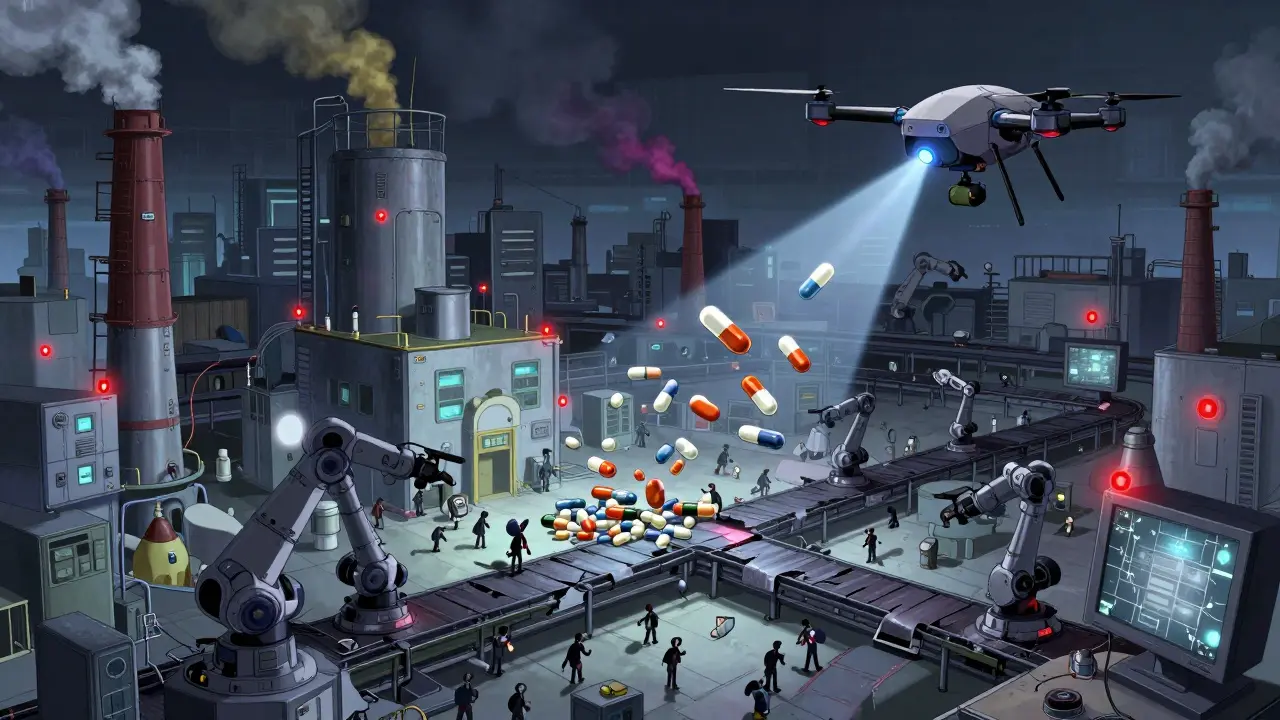
The Hidden Weakness: India’s Dependence on China
Here’s the twist: India can’t make its own APIs at scale anymore. In 2024, 72% of India’s bulk drug ingredients came from China. That’s up from 66% just two years earlier. So while India makes the final pills, China makes the essential building blocks. That creates a dangerous bottleneck. If China cuts off supply - whether due to trade tensions, a factory shutdown, or a natural disaster - India’s entire drug production could stall. A senior sourcing executive at a major U.S. pharma company told Bain & Company: “The 72% import dependency on China for bulk drugs creates a single point of failure in our supply chain.” The Indian government knows this. That’s why it launched the “Make in India” program with nearly $3 billion in incentives to build domestic API production. But scaling up takes time. Building a chemical plant isn’t like opening a call center. It takes years, billions in investment, and skilled labor. Meanwhile, China keeps lowering its prices and tightening its grip on the API market.What the FDA Is Doing Differently
The FDA doesn’t treat China and India the same. It can’t. It has limited inspectors. So it focuses where the risk is highest. For China, the FDA conducts more unannounced inspections, sends more warning letters, and issues more import alerts. It’s playing defense - trying to catch problems before they reach U.S. shelves. For India, the FDA works more like a partner. It runs training workshops, shares inspection checklists, and gives feedback to help companies improve. Why? Because Indian firms are already mostly compliant. The goal isn’t to catch them breaking rules - it’s to help them stay ahead of them. This difference in approach isn’t arbitrary. It’s based on data. Indian facilities have fewer deviations. Their documentation is cleaner. Their quality systems are more mature. The FDA trusts them more - and that trust translates into faster approvals and fewer delays.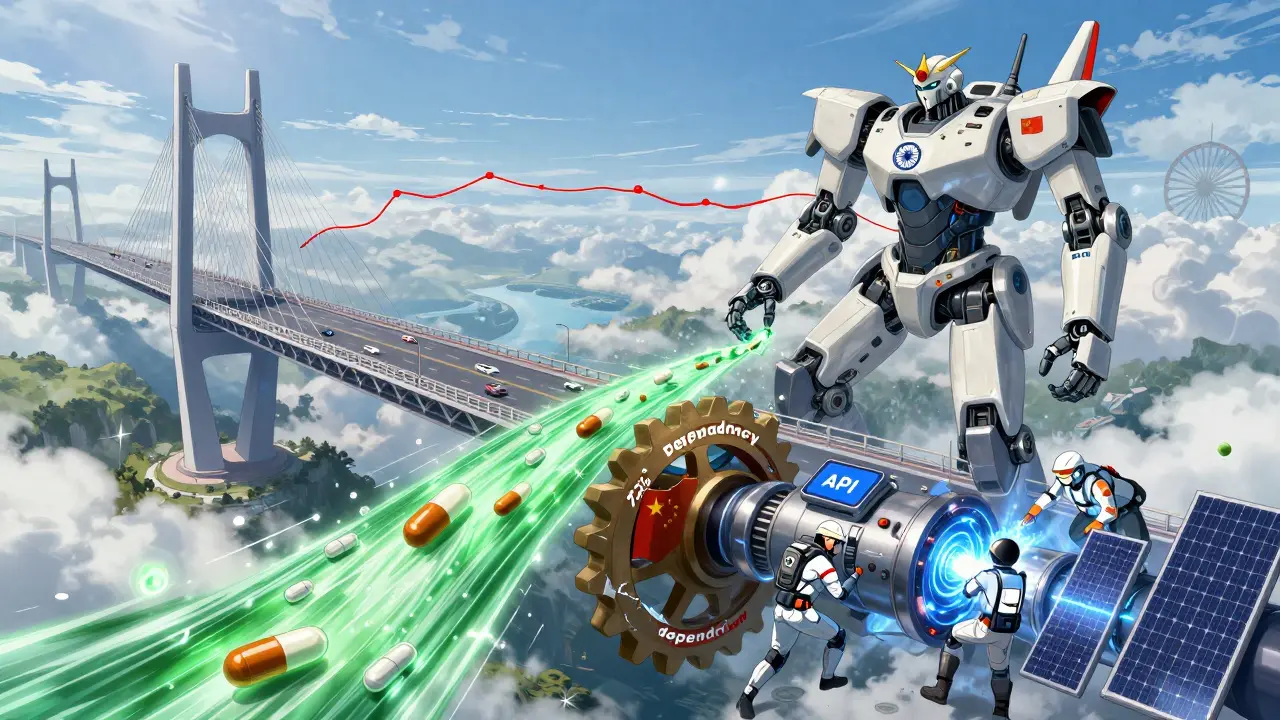
The Future: Who Wins?
The global pharmaceutical market is shifting. Companies are moving away from putting all their eggs in one basket. That’s the “China+1” strategy: source from China, but have a backup in India. India is winning this race. Its pharmaceutical exports are projected to grow 10 to 15 times by 2047, reaching nearly $350 billion. Its manufacturing competitiveness ranking is expected to jump from 11th to 5th globally. China’s share of the outsourced market is expected to drop from 9% to 15% by 2030 - not because it’s shrinking, but because others are growing faster. But India’s future depends on one thing: breaking its addiction to Chinese APIs. If it succeeds, it could become the world’s most trusted source for generic medicines. If it doesn’t, it risks becoming a middleman - making pills from someone else’s ingredients, with no control over the foundation. China, meanwhile, is betting big on biologics and advanced therapies. Its biopharmaceutical market is growing at 19.3% per year - faster than India’s 22% CAGR in biosimilars, but from a much smaller base. China isn’t giving up. It’s upgrading. But upgrading doesn’t fix a broken reputation. And right now, the FDA doesn’t trust China the way it trusts India.What This Means for You
If you’re a patient, this shouldn’t scare you. The FDA still ensures most drugs are safe. But it also means your medication’s safety isn’t just about the formula. It’s about where it was made, who made it, and whether they followed the rules. If you’re a healthcare provider, know that Indian-made generics are more likely to meet U.S. standards. That’s why hospitals and insurers often prefer them. If you’re a policymaker or investor, the message is clear: compliance beats cost. Scale without control is a ticking time bomb. India’s model - quality first, volume second - is the future. China’s model - volume first, quality sometimes - is the past. The next time you pick up a prescription, look at the label. If it says “Manufactured in India,” you’re getting a product that passed a tougher test. If it says “Manufactured in China,” it’s still safe - but the path to safety was riskier, longer, and less certain.Why does the FDA inspect drug factories in China and India?
The FDA inspects foreign drug factories to ensure medicines sold in the U.S. meet safety, quality, and labeling standards. Even though drugs are made overseas, the FDA has legal authority to check their manufacturing conditions. A single contaminated batch or mislabeled pill can harm patients, so inspections are critical to prevent unsafe products from reaching American consumers.
Is medicine from India safer than medicine from China?
Based on FDA inspection data, medicines made in India are statistically more likely to meet U.S. standards. Indian facilities receive fewer violations (Form 483s), have higher approval rates, and maintain more consistent quality systems. That doesn’t mean every Chinese-made drug is unsafe - many are perfectly fine. But overall, India’s regulatory culture and infrastructure make it a more reliable source for FDA-approved products.
Why does India rely on China for drug ingredients?
India stopped producing many basic APIs domestically because it was cheaper to import them from China. Over time, China became the dominant, low-cost supplier. India focused on finishing pills and packaging, not making the raw chemicals. Now, 72% of India’s API supply comes from China. This creates a vulnerability - if China restricts exports, India’s drug production could slow down or stop.
What is the "China+1" strategy in pharma manufacturing?
The "China+1" strategy means sourcing critical drug ingredients or finished products from China, but also having a second supplier in another country - usually India - as a backup. Companies use this to reduce risk. If a factory in China shuts down due to inspections, trade issues, or natural disasters, they can switch to India without disrupting supply. It’s about resilience, not replacing China.
Are Indian-made drugs cheaper than Chinese-made ones?
Generally, Chinese-made drugs are cheaper because of lower labor and production costs. But when you factor in the risk of delays, recalls, or failed inspections, Indian-made drugs often end up being more cost-effective in the long run. Companies pay more upfront for Indian products, but they save money by avoiding regulatory headaches, shipment holds, and lost sales.
Can the U.S. stop importing drugs from China?
No, not right now. China produces 80% of the world’s generic APIs. Replacing that supply would take decades and trillions of dollars. Even if the U.S. wanted to, there aren’t enough factories in other countries to fill the gap. The goal isn’t to cut off China - it’s to reduce dependence by building up alternatives like India and investing in domestic production.

Wow, this is such a needed convo. I work in med logistics and seeing those FDA stats blew my mind. Indian plants just… *get it*. They don’t cut corners. Even their paperwork is cleaner than my last Airbnb.
India’s not perfect, but they built a culture around compliance like it’s yoga - daily, intentional, and kinda spiritual 😌
China’s got the factories, India’s got the *soul*. And honestly? The soul matters when your life depends on that pill.
India is just a middleman with fancy labels. 72% of their APIs come from China. So stop acting like they’re some pharmaceutical saints. They’re just packaging our medicine with a better PR team.
Bro I just took a generic ibuprofen today and now I’m questioning EVERYTHING. Like… is my headache cure made by some guy in a basement in Shandong? 😅
Also why does India get all the hype when their factories smell like burnt sugar and regret?
The FDA’s differential regulatory approach reflects a risk-based allocation of finite inspectional resources. Indian facilities demonstrate higher process capability indices and lower defect rates per 1000 batches, per 2023 FDA Quality Metrics Report. China’s fragmentation necessitates higher inspectional density to achieve equivalent risk mitigation.
India? Please. Their entire pharma industry is built on exploiting Chinese inputs while pretending they’re the heroes. We in South Africa know real manufacturing. We don’t outsource our soul to someone else’s factory and call it ‘compliance culture’.
Let’s be real - India’s ‘compliance culture’ is just a fancy way of saying they learned how to lie to inspectors better than China. I’ve seen the audits. The digital systems? Mostly for show. The real work is still done by 3 guys with clipboards and a prayer.
And yeah, China’s got issues - but they’re scaling like a goddamn dragon. India’s just… polishing a paper tiger.
Don’t get me wrong, I want India to win. But sugarcoating their dependency on China? That’s not optimism. That’s delusion. And now they’re asking for billions to build plants they can’t even staff properly. Good luck with that.
Meanwhile, China’s building biologics labs that make Pfizer look like a high school chem lab. They’re not losing. They’re upgrading. While we’re over here debating who’s ‘more trustworthy,’ they’re making mRNA vaccines in 14 days.
Also - who here remembers when the FDA shut down 12 Indian plants in 2018? Yeah. The same ones that are now ‘model facilities.’ The system’s flawed. We’re all just playing whack-a-mole with a global supply chain.
And before you say ‘but India speaks English!’ - so does every call center in Bangalore. That doesn’t make them better. Just louder.
So… we’re trusting a country that exports 72% of its core ingredients from a country we’re supposedly trying to ‘decouple’ from? That’s not a supply chain. That’s a Russian nesting doll of existential dread.
India’s ‘compliance culture’ is just capitalism with a nice smile. They don’t care about your safety - they care about your dollars. And China? They don’t care at all. But they make it cheap. So we keep buying.
Meanwhile, the FDA’s just the bouncer at a club where everyone’s drunk and the bouncer’s tired.
China’s the villain. India’s the hero. End of story. Why are we even having this conversation? We know who the real bad guy is. It’s not the people. It’s the system. And the system is Chinese.
Let’s not pretend India’s some ethical beacon. They’re just better at PR. The FDA doesn’t ‘trust’ them - they just have fewer scandals because they’re smaller. Bigger factories = more things to hide. China’s just bigger. That’s it.
I’m just glad I can still get my blood pressure meds without thinking about geopolitics. But… yeah, this is wild. I never realized my 99-cent pill had a whole international drama behind it.
As an Indian, I feel proud of our pharma industry - but also terrified. We built something incredible from nothing. But now we’re hooked on China like a junkie on cheap heroin. We’re making pills, but they’re built on someone else’s foundation.
Our government’s throwing money at API plants like confetti, but no one’s talking about the engineers we lost to Silicon Valley. Or the water pollution in Hyderabad where half the API plants are. Or how our ‘compliance culture’ is still just a few good auditors holding back chaos.
China’s not evil. They’re just… efficient. And we’re not evil either. We’re just trying to survive. But if we don’t fix this dependency, we’ll become the world’s most expensive pharmacy technician.
And yes, I’ve seen the FDA reports. Yes, India has fewer violations. But I’ve also seen the batch logs. And sometimes, the numbers don’t lie - but the people who enter them do.
We need to stop pretending this is a moral story. It’s an engineering problem. And we’re still learning how to build the machine.
My grandma takes her pills from India. She says they work better. I believe her.