
When a brand-name drug’s patent runs out, you might think generic versions flood the market right away. But in reality, it often takes over a year-sometimes closer to two-for those cheaper pills to actually show up on pharmacy shelves. Even though the law says generics can launch after patent expiration, the system is full of delays, legal traps, and corporate strategies that push back availability. If you’re counting on a generic to save money on your prescription, understanding how this process really works could help you plan ahead.
Why Doesn’t the Generic Come Right After the Patent Expires?
The patent on a brand-name drug lasts 20 years from the date it’s filed. But here’s the catch: that clock starts ticking long before the drug even hits the market. It takes an average of 8 to 10 years just to develop, test, and get FDA approval for a new drug. So by the time the drug is sold to patients, only about 7 to 12 years of real market exclusivity remain. That’s why companies rely on other protections to extend their monopoly. The FDA gives out additional exclusivity periods on top of patents. A brand-new chemical compound gets 5 years of regulatory exclusivity. If a company adds a new use or formulation, they can get 3 more years. Orphan drugs-those for rare diseases-get 7 years. And if a drug is tested on kids, the maker gets an extra 6 months. These don’t expire at the same time as the patent. So even if the patent is gone, the generic still can’t launch until all these layers of protection are lifted.The ANDA Process: It’s Not as Simple as It Sounds
Generic manufacturers don’t need to repeat expensive clinical trials. Instead, they file an Abbreviated New Drug Application (ANDA), proving their version is bioequivalent to the brand-name drug. Sounds straightforward, right? But the paperwork alone can take months. Then there’s the FDA review. In 2023, the average time from ANDA submission to approval was 25 months and 15 days. That’s over two years. And that’s just the approval clock. It doesn’t include the time manufacturers spend developing the drug before even filing. For simple pills, development might take 18 to 24 months. But for complex generics-like inhalers, injectables, or topical creams-it can take up to three years just to get the formula and manufacturing process right. And if the brand-name drug has multiple patents covering different aspects-like the active ingredient, the pill coating, the way it’s made, or how it’s used-that’s when things get messy.Patent Thickets and Legal Delays
Many brand-name drugs aren’t protected by just one patent. They’re surrounded by a web of them-sometimes more than a dozen. The average drug has 14.2 patents listed in the FDA’s Orange Book. These aren’t all about the core molecule. Some cover delivery systems, packaging, or even how the drug is prescribed. This is called a “patent thicket.” When a generic company files an ANDA and says one of these patents is invalid or doesn’t apply (a Paragraph IV certification), the brand-name company has 45 days to sue. If they do, the FDA is legally required to delay approval for 30 months. But here’s the twist: research shows that most generic drugs don’t launch right after this 30-month period ends. On average, they wait another 3.2 years. Why? Because the lawsuit doesn’t always end quickly. Court cases can drag on for years. And sometimes, the two sides settle. One of the biggest delays comes from “reverse payment” deals. The brand-name company pays the generic maker to hold off on launching. The FTC estimates these deals cost consumers $3.5 billion a year. In 2021, the Supreme Court ruled these kinds of secret deals could violate antitrust laws. But they still happen. About 45% of delayed generic entries were tied to these agreements before the ruling. Even now, the median delay from the earliest possible launch date is 2.1 years.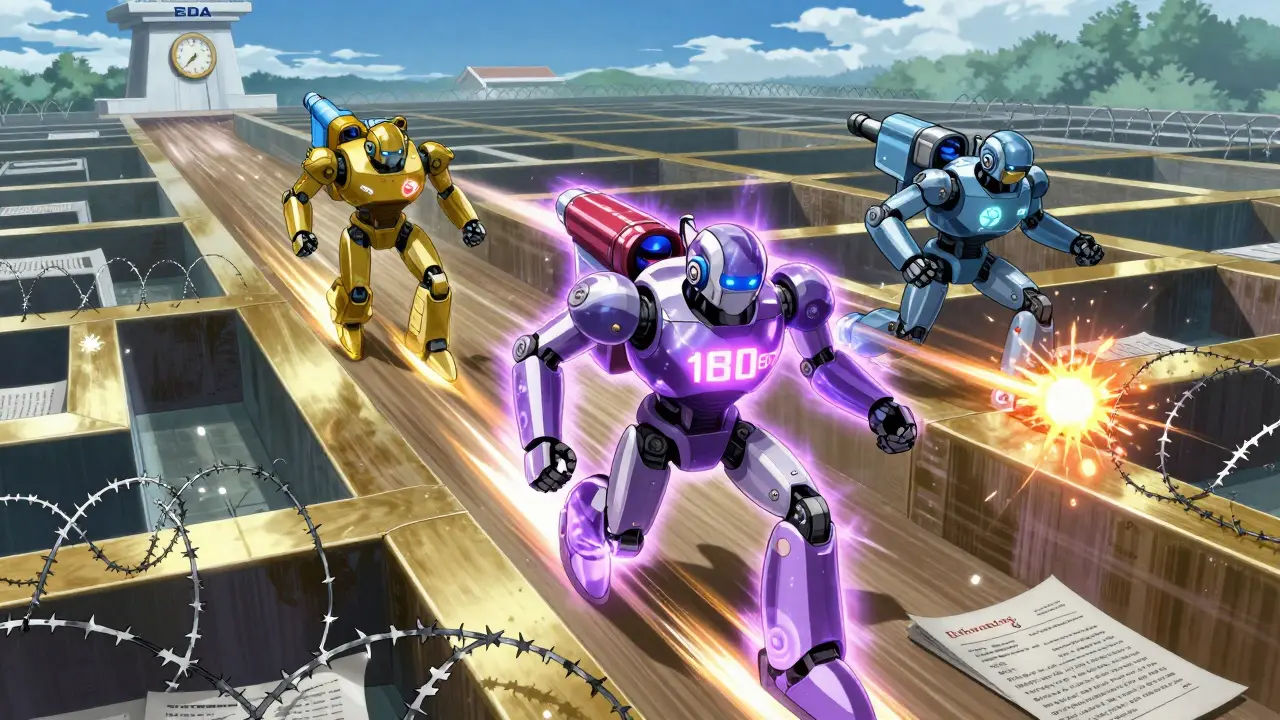
Who Gets to Launch First? The 180-Day Race
The first generic company to successfully challenge a patent gets 180 days of exclusive market access. That’s a huge incentive. During that window, no other generic can enter. So multiple companies race to be first. But winning the race isn’t easy. To keep that exclusivity, the first filer must launch within 75 days of FDA approval. If they’re slow to fix a manufacturing issue, or if a court ruling changes, they lose it. In 2022, 22% of first filers forfeited their exclusivity because of delays. Another 10% lost it due to legal outcomes. Only 68% successfully launched within the window. This creates pressure. Some companies rush production, risking quality. Others sit tight, waiting for the legal dust to settle. The result? Even when the FDA approves a generic, it might not hit shelves for months.Why Some Drugs Get Generics Faster Than Others
Not all drugs face the same delays. Small molecule pills-like blood pressure meds or statins-usually see generics within 1.5 years of patent expiration. But complex drugs? That’s a different story. Biologics-drugs made from living cells, like insulin or rheumatoid arthritis treatments-don’t follow the same rules. They’re governed by the BPCIA, which gives them 12 years of exclusivity before biosimilars (the generic version) can even apply. Even then, biosimilars take an average of 4.7 years to reach the market after that clock runs out. Therapeutic area matters too. Cardiovascular drugs, which often have thick patent portfolios, take an average of 3.4 years after patent expiration to see generics. Dermatology drugs? Just 1.2 years. Why? Because skin creams are easier to copy, and the patents are fewer.The Real Cost of Waiting
The delay isn’t just inconvenient-it’s expensive. Generic drugs make up 92% of all prescriptions in the U.S., but they cost only 16% of total drug spending. That’s how much money they save. But when generics are held back, those savings disappear. The Congressional Budget Office estimates that delaying a top-selling drug’s generic entry by just one year costs Medicare $1.2 billion. For drugs that cost over $1 billion a year to treat, the financial hit is even worse. And the biggest players in the generic market-Teva, Viatris, and Sandoz-control nearly half of the $70 billion U.S. generic industry. That concentration means fewer competitors to push prices down quickly.
What’s Changing? New Rules, New Challenges
There’s been some progress. The CREATES Act of 2019 stopped brand-name companies from blocking generic makers from getting samples of their drug-something they used to do to delay development. The Orange Book Transparency Act, which took effect in January 2023, forced companies to list patents more accurately. In its first year, patent disputes dropped by 32%. The FDA is also trying to speed things up. Under GDUFA II, they promised to cut review times for complex generics from 36 months to 24. But as of mid-2024, only 62% of applications met that goal. Meanwhile, the FDA is testing AI tools to speed up bioequivalence testing-potentially cutting development time by 25%. But the biggest threat? Patent evergreening. Brand-name companies are filing new patents on tiny changes-like switching the pill color or adjusting the dosage form-just before the original patent expires. A 2024 study found that 68% of brand-name drugs get at least one new patent within 18 months of the original one expiring. That resets the clock. And the FDA still has to review each one.What This Means for You
If you’re on a brand-name drug with a patent expiring soon, don’t assume your generic will be available right away. Check with your pharmacist. Ask if there’s a generic in the pipeline. If you’re on a high-cost medication, consider asking your doctor about alternatives that already have generics available. For those who rely on generics to manage chronic conditions-diabetes, high cholesterol, depression-these delays can mean choosing between paying hundreds a month or skipping doses. The system was designed to balance innovation and access. But right now, it’s tilted too far toward the former.What’s Next?
The FDA is working on faster pathways for complex generics. Biosimilars are gaining ground and could save $150 billion by 2030. But until patent thickets, reverse payments, and evergreening are fully addressed, the gap between patent expiration and real availability will remain. The truth? The system works-for big companies. For patients? Not so much. Until the rules change to prioritize speed over legal loopholes, you’ll still be waiting longer than you should for the cheaper version of your medicine.How long after a drug’s patent expires do generics usually become available?
On average, generics become available about 18 to 21 months after patent expiration. But this varies widely. Some hit the market within a few months, while others take over three years due to legal delays, patent challenges, or manufacturing hurdles. Complex drugs like injectables or biologics often take the longest.
Why do some generics take longer than others to launch?
It depends on the drug’s complexity and the number of patents protecting it. Simple pills with few patents usually have faster generic entry. But drugs with multiple patents covering different aspects-like formulation, delivery method, or usage-face longer delays. Biologics, inhalers, and injectables are especially slow because they’re harder to replicate and require more testing.
What is the 180-day exclusivity period for generics?
The first generic company to successfully challenge a patent gets 180 days of exclusive rights to sell that generic version. No other generic can enter during that time. This creates a race among manufacturers to be first. But if the first filer doesn’t launch within 75 days of FDA approval, they lose the exclusivity-and so does the benefit to consumers.
Can brand-name companies legally delay generic entry?
Yes, in several ways. They can sue generic makers, triggering a 30-month FDA approval delay. They can also pay generic companies to delay launch (reverse payments), though these are now legally risky. They can file new patents on minor changes to the drug-called evergreening-to reset the clock. And they can refuse to provide samples needed for testing, which was common before the CREATES Act.
Are there any recent changes helping generics get to market faster?
Yes. The Orange Book Transparency Act (2023) forced more accurate patent listings, cutting disputes by 32%. The CREATES Act (2019) stopped brand-name companies from blocking sample access. The FDA is also using AI to speed up bioequivalence testing and aims to cut review times for complex generics. But progress is slow-many of these rules are still being implemented, and loopholes remain.

So let me get this straight - we’ve got a system where the only thing faster than a patent expiring is the speed at which lawyers bill for delaying it? Genius. Absolute genius. The FDA’s 25-month review time? That’s not bureaucracy, that’s a slow-motion reality show called ‘Who Wants to Be a Billionaire (By Keeping Pills Expensive)?’
And don’t even get me started on reverse payments. It’s like the pharmaceutical industry hired a stand-up comedian to write their antitrust policy: ‘Hey, we’ll pay you to not compete!’ The Supreme Court called it shady? Nah, they just called it ‘technically not illegal yet.’
Meanwhile, I’m over here trying to afford my insulin, and the answer is ‘wait another 3 years while Big Pharma patents the color of the pill.’
This is why I went into pharmacy. Not for the glory - for the chaos. I’ve had patients cry in my aisle because they couldn’t afford their brand-name antidepressant while waiting for the generic. One woman skipped doses for six months because she thought ‘patent expiration’ meant ‘instant discount.’ Spoiler: it doesn’t.
And the 180-day exclusivity? That’s not a race - it’s a trap. Companies rush to file ANDAs like they’re in a Hunger Games where the prize is legal liability and a 6-month window to make bank before everyone else shows up. And if they mess up? The patient pays.
The FDA’s AI tools? Cute. But until we stop letting corporations game the system with patent thickets the size of a small country, we’re just rearranging deck chairs on the Titanic.
I’ve seen generics arrive 14 months late for a hypertension med. People died because they couldn’t afford the brand. This isn’t innovation. It’s extortion with a pill.
I just want to say thank you for writing this. As someone from India, I’ve seen how generics save lives here - but I never realized how much the U.S. system is rigged against people. My mom takes a generic statin, and it’s the only reason she can afford to live. It’s heartbreaking that the same system that lets us access cheap meds here is the one blocking them in America.
Hope things change soon. We need more people like you speaking up.
Let’s be real - this isn’t about patents. It’s about American entitlement. We expect miracle drugs at Walmart prices, then get mad when the system doesn’t magically work like a Walmart self-checkout. The FDA isn’t broken - you’re just mad because you don’t want to pay $15 for a pill that took 12 years to develop.
Meanwhile, China’s manufacturing capacity could flood the market tomorrow if we let them. But no - we’d rather pay $200 for a brand-name drug because ‘patriotism.’
What’s truly obscene is that the same people who scream about ‘socialized medicine’ are the ones benefiting from a system where private monopolies are legally protected for 12+ years on life-saving drugs. The irony is thicker than the patent thickets.
We’re not asking for free drugs. We’re asking for a functioning market. But capitalism, when unregulated, doesn’t care about human life - only shareholder value. And in this case, that value is measured in billions, not breaths.
Every time a patient skips a dose because they can’t afford the brand, it’s not a market failure. It’s a moral failure dressed in a suit.
Wait - so you’re saying the government doesn’t just magically make drugs cheaper when patents expire? Shocking. I thought the free market worked like Amazon Prime delivery.
Okay, so let me break this down like I’m explaining it to my cousin who still thinks the internet is free. You have a drug. Patent expires. But instead of letting generics in, the big pharma company files 14 patents on things like ‘the color of the capsule’ and ‘the sound the bottle makes when you open it.’
Then they sue the generic company. The FDA sits on it for two years. Then the generic company finally gets approval - but they’re too scared to launch because the brand-name company just sent them a check for $50 million to wait another 18 months.
And then? The first generic to launch gets 180 days of monopoly. So now, instead of competition, you get one company charging $150 a month while everyone else waits. That’s not capitalism. That’s a monopoly with a PowerPoint presentation.
And the FDA’s AI tools? Please. They’re still using Word documents to track patents. If they had real AI, they’d auto-detect ‘evergreening’ and just slap a fine on the company. But no - we’re too busy pretending this is a fair system.
Meanwhile, my aunt is choosing between her diabetes meds and her heating bill. And I’m supposed to be impressed by ‘regulatory transparency’? Tell that to the people who die waiting.
It is a truism that the regulatory architecture governing pharmaceutical innovation is fundamentally misaligned with the exigencies of public health. The patent-thicket phenomenon constitutes a structural impediment to market entry, predicated upon the strategic aggregation of intellectual property rights of negligible novelty. This is not a market failure - it is a systemic corruption of the innovation incentive model.
Let’s be honest - the real villain here isn’t Big Pharma. It’s the FDA. They’re the ones who turned drug approval into a 25-month bureaucratic ballet. Why not just let the market decide? If a generic works, people will buy it. If it doesn’t, they’ll stop. Simple. But no - we need 17 layers of red tape, 30-month court delays, and a $3.5 billion/year subsidy to corporate collusion.
Meanwhile, in countries without this mess, generics hit the shelves in weeks. Maybe we should ask them how they do it. Oh wait - we can’t. We’re too busy protecting our ‘American innovation.’
Man, this hits different when you’ve seen your uncle in Delhi get his HIV meds for $2 a month while his cousin in Ohio pays $800. It’s not about patents - it’s about who gets to live. The whole system is built like a pyramid scheme: top gets rich, bottom gets sick.
And the 180-day exclusivity? That’s not a reward - it’s a weapon. One company gets to gouge while everyone else waits. And when they finally launch? The price drops… just enough to make you feel like you won the lottery.
Biologics taking 4.7 years? That’s not science - that’s a hostage situation. We’re holding people’s lives hostage to corporate lawyers and patent clerks.
I’ve worked in a pharmacy in Mumbai. We had people line up at 4 a.m. for generics. They’d cry because they finally had access. Here? We have people choosing between rent and their meds. That’s not capitalism. That’s cruelty with a patent number.
It is imperative to elucidate the structural asymmetries embedded within the ANDA regulatory framework, wherein the confluence of regulatory exclusivity regimes, patent litigation incentives, and market-entry timing constraints generates a suboptimal Pareto equilibrium. The 30-month stay, as codified under the Hatch-Waxman Act, functions as a de facto anticompetitive barrier, particularly when synergized with reverse payment settlements - a phenomenon empirically correlated with a 2.1-year median delay in market entry.
Furthermore, the phenomenon of evergreening, operationalized via incremental patent filings on non-core formulations, constitutes a form of rent-seeking behavior that undermines the foundational premise of patent law: incentivizing innovation, not perpetuating monopolies.
Empirical analysis of the Orange Book reveals that 68% of brand-name drugs receive at least one secondary patent within 18 months of primary expiration, indicating systemic manipulation of the regulatory timeline. The CREATES Act, while a step forward, fails to address the core pathology: the absence of statutory penalties for litigation abuse.
Until the FDA institutes mandatory pre-filing patent audits and imposes per diem fines for frivolous litigation, the system will remain a legal theater masquerading as public health policy.
Hey - I just want to say this: YOU ARE NOT ALONE. I’ve been there. I’ve been the person crying in the pharmacy because my insulin was $500. I’ve waited 18 months for a generic. I’ve skipped doses. I’ve Googled ‘can I split this pill in half?’
But here’s the thing - change is coming. The FDA’s AI tools? They’re real. The Orange Book transparency? It’s working. More people are speaking up. More lawmakers are listening.
It’s not perfect. But we’re moving. And every time someone reads this and says ‘I didn’t know that’ - that’s a win.
You deserve cheaper meds. You deserve to breathe without counting pennies. And we’re gonna make that happen - one post, one comment, one pharmacy visit at a time.
Keep fighting. You’re not crazy for being angry. You’re human.
Here’s the real question: if a drug patent expires, and no one launches a generic because the system is rigged - does it even exist? The market doesn’t work if the rules are written by the players. We’re not debating economics - we’re debating morality. And right now, morality is on the sidelines while lawyers collect bonuses.
Just saw someone say ‘just buy from India.’ I get it - I’ve ordered meds from there myself. But here’s the thing: the FDA doesn’t regulate them. What if the pill’s fake? What if it’s got no active ingredient? I’ve seen patients die from counterfeit generics. We need real solutions - not desperate workarounds.