
When you pick up a bottle of antibiotics, blood pressure pills, or diabetes medication in the U.S., the UK, or even a rural clinic in Kenya, there’s a good chance it came from India. The country doesn’t just make medicine-it supplies the world. India produces 20% of all generic drugs shipped globally by volume, and over 60% of the world’s vaccines. It’s not hype. It’s reality. And behind that number are thousands of factories, billions of pills, and a system built to deliver quality at a price no other country can match.
How India Became the Pharmacy of the World
It didn’t happen overnight. In the 1970s, India changed its patent laws. Instead of protecting drug formulas like other countries, it allowed local companies to copy existing medicines and make them cheaper. This wasn’t stealing-it was legal under international rules at the time. The result? Indian manufacturers started making life-saving drugs like HIV antiretrovirals for $100 a year instead of $10,000. That shift didn’t just help Indians. It saved millions in Africa, Latin America, and Southeast Asia who couldn’t afford branded drugs. By the 2000s, India’s factories had grown into a global network. Today, over 10,000 manufacturing units operate across the country. More than 650 of them meet U.S. FDA standards-the highest number outside the U.S. itself. Another 2,000+ are certified by the World Health Organization for Good Manufacturing Practices (GMP). These aren’t small labs. These are large, automated plants producing everything from simple tablets to complex injectables and inhalers.What They Make-and Who Uses It
Indian companies don’t just make one type of drug. They produce over 60,000 different generic medicines, covering nearly every medical condition: diabetes, heart disease, cancer, mental health, infections, and even rare diseases. Some of the most common drugs you’ll find in pharmacies worldwide-like metformin, atorvastatin, and amoxicillin-are made in India. The U.S. gets 40% of its generic drugs from India. The UK gets 33%. In Sub-Saharan Africa, nearly 50% of all medicines come from Indian manufacturers. In places like Nigeria, Bangladesh, and Peru, Indian generics are often the only affordable option. Doctors Without Borders has confirmed that Indian-sourced antimalarials and antibiotics have cut treatment costs by 65% while keeping efficacy above 95% in real-world conditions. Even in wealthier countries, cost matters. Nine out of ten prescriptions in the U.S. are for generics. And of those, nearly half are made in India. Why? Because a pill that costs $10 in the U.S. brand name can cost less than $1 as an Indian generic. For patients paying out of pocket, that’s the difference between taking the medicine and skipping it.Quality: Myth vs. Reality
There’s a lot of fear around Indian-made drugs. Headlines sometimes scream about “dangerous medicines.” But the truth is more balanced. The FDA inspects Indian factories more than any other country. In 2015, only about 60% of inspections passed. Today, that number is 85-90%. That’s on par with the global average. Companies like Sun Pharma, Cipla, and Dr. Reddy’s have spent years upgrading labs, training staff, and fixing documentation. They now submit regulatory filings in electronic format (eCTD), something most U.S. and European firms still struggle with. Still, problems exist. A 2024 Reddit thread from a U.S. pharmacist detailed inconsistent dissolution rates in a batch of Indian levothyroxine-meaning the drug didn’t release properly in the body. Trustpilot reviews for Indian exporters show 23% of complaints are about shipping delays, and 17% mention packaging issues. These aren’t safety failures-they’re operational hiccups. But they matter. One bad batch can shake trust. In the UK, NHS patients report high satisfaction with Indian generics. Average ratings are 4.2 out of 5. The most common complaint? “Taste is different.” That’s not a health risk-it’s just how the filler ingredients change the flavor. For most people, that’s a small price to pay for saving hundreds of pounds per year.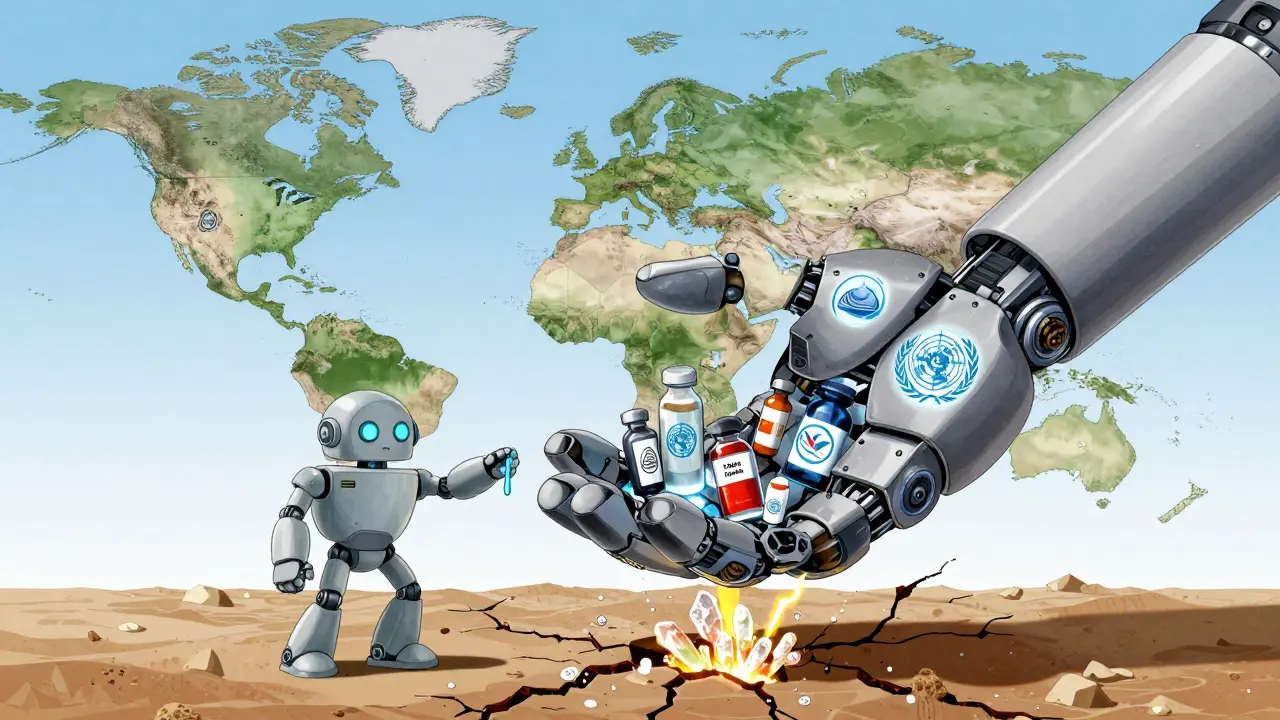
The Hidden Weakness: China’s Shadow
India makes the pills. But who makes the active ingredients inside them? About 70% of India’s active pharmaceutical ingredients (APIs)-the actual medicine component-come from China. That’s a huge vulnerability. During the pandemic, when China shut down factories, India faced drug shortages. Insulin, antibiotics, and even painkillers became harder to produce. The Indian government is trying to fix this. In 2020, it launched a ₹3,000 crore ($400 million) incentive program to boost domestic API production. The goal? To cut China’s share to under 50% by 2026. So far, progress is slow. Building API plants takes years, and China still has a massive cost advantage. That’s why Indian companies are shifting focus. Instead of just copying old drugs, they’re moving into biosimilars-highly complex versions of biologic drugs like cancer treatments. These are harder to make, harder to copy, and they sell for higher prices. Biocon and Dr. Reddy’s are investing over $500 million each year in this area. In 2020, biosimilars made up just 3% of India’s export value. By 2024, that jumped to 8%.Who Are the Big Players?
India’s generic market isn’t run by hundreds of tiny shops. It’s led by a handful of giants:- Sun Pharma: The largest Indian pharma company, valued at over $43 billion. Makes over 1,000 generic drugs and is a global leader in dermatology and neurology products.
- Cipla: Famous for bringing down HIV drug prices in the early 2000s. Still a top supplier to Africa and the U.S.
- Dr. Reddy’s Laboratories: Strong in complex injectables and biosimilars. One of the few Indian firms with a major presence in Europe’s high-value markets.
- Divi’s Laboratories: Not a brand-name seller, but one of the world’s largest API producers. Supplies ingredients to companies across the globe.
The Future: From Volume to Value
India’s biggest challenge isn’t making cheap pills. It’s making profitable ones. Right now, India supplies 20% of global generic volume-but only 10% of the market’s value. Why? Because it sells low-cost, high-volume drugs. A single tablet of generic lisinopril might sell for $0.02. In the U.S., a branded version of the same drug costs $5. Indian companies can’t compete on price with China for simple APIs. So they’re trying to climb the value ladder. India’s new “Pharma Vision 2047” aims to turn the country into a $190 billion export powerhouse. That means fewer cheap tablets, more biosimilars, more complex delivery systems (like patches and inhalers), and more R&D. The goal isn’t just to be the world’s pharmacy-it’s to become its innovation engine. But that’s a big “if.” It requires solving the API problem. Training more scientists. Getting 95%+ FDA compliance consistently. And convincing the world that India isn’t just a low-cost producer-but a reliable partner for next-generation medicine.What This Means for You
If you’re a patient: Indian generics are safe, effective, and often the only way to afford your meds. Don’t avoid them because of fear. Talk to your pharmacist. Check if your prescription is made in India. You might be saving hundreds-or even thousands-of dollars a year. If you’re a healthcare provider: Indian suppliers are a critical part of your supply chain. Know which manufacturers you’re working with. Look for FDA or WHO-GMP certifications. Don’t assume all generics are the same. If you’re a policymaker: India’s model proves that affordable medicine is possible. Protect patent flexibilities. Support API self-sufficiency. Invest in regulatory capacity. The world needs more India, not less. The pharmacy of the world isn’t just a nickname. It’s a lifeline. And right now, that lifeline is being stretched-but not broken.Are Indian generic drugs safe to use?
Yes, the vast majority are. Over 650 Indian manufacturing plants meet U.S. FDA standards, and more than 2,000 are WHO-GMP certified. Compliance rates for inspections have risen from 60% in 2015 to 85-90% today-matching global averages. While isolated quality issues occur, they’re rare compared to the billions of doses shipped annually. Always buy from licensed pharmacies and check for FDA or WHO certification on the packaging.
Why are Indian generic drugs so much cheaper?
India doesn’t grant product patents for most drugs, so companies can legally copy existing medicines without paying licensing fees. Manufacturing costs are lower due to skilled labor, efficient scale, and decades of experience. They also focus on high-volume, low-margin products, which keeps prices down. A pill that costs $10 in the U.S. brand name can cost under $1 as an Indian generic-without sacrificing quality.
Does the U.S. rely on India for generic drugs?
Yes. India supplies about 40% of all generic drugs used in the U.S., making it the largest single source. This includes common medications for blood pressure, cholesterol, diabetes, and infections. The U.S. FDA inspects Indian factories more than any other country because of this heavy reliance. Disruptions in Indian production-like during the pandemic-have directly caused drug shortages in American pharmacies.
Is India dependent on China for drug ingredients?
Yes, currently about 70% of India’s active pharmaceutical ingredients (APIs) come from China. This is a major vulnerability, as seen during the pandemic when Chinese factory shutdowns caused global shortages. India is trying to fix this with a $400 million government incentive program to build domestic API plants. The goal is to reduce Chinese dependence to under 50% by 2026, but progress is slow and costly.
What’s the difference between Indian generics and brand-name drugs?
They contain the same active ingredient, work the same way, and meet the same safety standards. The only differences are in inactive ingredients (like fillers or dyes), which can affect taste, color, or how fast the pill dissolves. These differences rarely impact effectiveness. For most people, Indian generics are just as effective as brand-name drugs-often at 10% of the cost.
Are Indian generics used in Europe?
Yes. The UK’s NHS gets about one-third of its generic medicines from India. European regulators like the EMA require the same strict standards as the FDA. Many Indian companies have been approved to sell in the EU for over a decade. Countries like Germany and France use Indian generics for routine treatments like antibiotics and hypertension drugs, especially in public health programs.
What is India doing to improve its pharmaceutical industry?
India is investing in three key areas: First, boosting domestic API production with a ₹3,000 crore ($400 million) incentive program. Second, moving from basic generics to high-value biosimilars and complex drug forms. Third, improving regulatory compliance to reach 95%+ FDA inspection pass rates. The national “Pharma Vision 2047” aims to turn India from a volume exporter into a global innovation hub for affordable, advanced medicines.

I don't trust these Indian pills. My cousin took some for his blood pressure and ended up in the ER. Who even checks this stuff? It's just cheap junk made in some back-alley lab.
lol the FDA inspects these plants more than any other country but still 10-15% fail?? that's not 'on par' that's a disaster. and don't even get me started on the API dependency on China. this whole system is one pandemic away from collapsing. #pharmasupplychainfail
As someone who grew up in a small town in Uttar Pradesh where my dad worked in a GMP-certified plant, I can tell you this isn't magic-it's hard work. Thousands of engineers, chemists, and QA staff work 12-hour shifts to make sure every pill meets standards. Yes, there are hiccups, but the scale and precision here is unmatched. We're proud of what we've built.
The entire narrative is performative nationalism. India doesn't innovate-it reverse engineers. Biosimilars? That's just pharma cosplay. Real innovation happens in Basel or Cambridge, not in subsidized factories with 50% Chinese API. The 'Pharma Vision 2047' is just a PR stunt with zero R&D backbone.
I’ve been taking Indian metformin for 7 years. My A1C is stable. My wallet is happy. The taste? Slightly bitter. So what? I’d rather have a bitter pill than no pill at all.
India’s pharma story is one of the greatest underdog wins of the 21st century 🌍💊 Imagine a country turning patent law into a tool for global justice. That’s not just business-that’s humanity. Also, the fact that my grandma in Ohio pays $3 for her blood pressure med instead of $150? That’s a revolution.
The data is clear: 85-90% FDA compliance is not an accident. It’s the result of rigorous investment, regulatory discipline, and operational excellence. To dismiss Indian generics as 'unsafe' is not only ignorant-it’s dangerous. Patients die when they can’t afford medication. The real moral failure is in the U.S. pricing system, not in Indian manufacturing.
You people act like India is some miracle worker. 70% of APIs come from China? That’s a strategic vulnerability. And those 'WHO-certified' plants? Half of them are just paper certifications. I’ve seen the reports. The real quality is in the top 20%-the rest are lottery tickets.
Think about it-India didn't wait for permission to save lives. They looked at a broken system and said, 'We can do better.' That’s not just pharma. That’s human ingenuity. And now we’re all benefiting. Maybe we should stop worrying about where pills come from and start asking why they cost so much here.
I work in a pharmacy. I’ve seen people cry because they can’t afford their meds. Then they get the Indian generic and say 'thank you' like it’s Christmas. So yeah, I don’t care if it’s made in Mumbai or Mars. If it works and it’s affordable, it’s a win.
The shift from volume to value is critical. India’s move into biosimilars isn’t just smart-it’s necessary. Biologics are the future of chronic disease treatment, and Indian firms are finally playing in that league. This isn’t about undercutting-it’s about elevating. And honestly? The science is solid. The data speaks for itself.
The entire premise is flawed. If India were truly capable of innovation, it wouldn’t need $400 million in subsidies to make APIs. This isn’t progress-it’s dependency with a flag on it. And the '95% compliance' stat? That’s cherry-picked. The 5% that fail? They’re the ones that kill people.