
Walk into any local pharmacy, and you’ll see a counterintuitive reality. The expensive brand-name drugs that dominate the news headlines actually generate very little profit for the pharmacist behind the counter. Instead, it is the cheap, white generic pills-the ones costing pennies to manufacture-that keep the lights on. This paradox lies at the heart of pharmacy margin economics, a complex web of reimbursements, middlemen markups, and supply chain dynamics that determines whether a pharmacy thrives or closes its doors.
If you think pharmacies make money by simply marking up the cost of medication, you are looking at an outdated model. Today, the system is dominated by Pharmacy Benefit Managers (PBMs), who sit between insurance companies and pharmacies, controlling the flow of cash and data. Understanding how generics affect profits requires peeling back these layers to see where the money actually goes-and why many independent pharmacies are struggling to survive despite high prescription volumes.
The Generic Profit Paradox
It seems backward, but generic drugs are the financial backbone of retail pharmacy operations. According to data from the Commonwealth Fund, generic medications account for approximately 90% of all prescriptions dispensed in the United States. Yet, they represent only about 25% of total spending on prescription drugs. Brand-name drugs, while fewer in number, consume roughly 75% of that spending due to their high list prices.
So, why do pharmacies rely so heavily on generics? It comes down to margins. While the absolute dollar amount earned per generic pill is small, the percentage markup is significantly higher than that of brand-name drugs. A study by the Schaeffer Center at USC revealed that pharmacies capture about $32 of every $100 spent on generics. In contrast, they earn only about $3 for every $100 spent on brand-name drugs. This means that while brand drugs drive revenue volume, generics drive actual profitability. For a typical pharmacy, nearly 96% of their estimated retail margin comes from generic prescriptions, even though those prescriptions make up a smaller share of total sales value.
How the Supply Chain Splits the Money
To understand pharmacy profits, you have to look at the entire pharmaceutical distribution system. It is not just the pharmacy and the manufacturer; there are wholesalers, PBMs, and insurers all taking a cut. The way this pie is sliced changes dramatically depending on whether the drug is generic or branded.
| Entity | Generic Drug Gross Margin | Brand Drug Gross Margin | Key Insight |
|---|---|---|---|
| Manufacturers | 49.8% | 76.3% | Manufacturers make significantly more profit on brand drugs due to patent protection and R&D costs. |
| Wholesalers | Low single digits | Very low | Wholesalers operate on thin margins, relying on high volume rather than high percentages. |
| PBMs | High relative share | Moderate | PBMs make four times as much on generic drugs compared to brands through administrative fees and spreads. |
| Retail Pharmacies | 42.7% | 3.5% | Pharmacies depend on generics because the gross margin percentage is vastly higher, offsetting the lower price point. |
This table highlights a critical shift in value. In the branded market, manufacturers capture the lion’s share of the value. In the generic market, that value shifts downstream to the pharmacies and PBMs. However, "gross margin" is not the same as "net profit." After paying for staff, rent, utilities, and inventory, the net profit for a pharmacy on an average retail prescription is often just around 2%. This razor-thin margin leaves little room for error, making every reimbursement decision critical.
The PBM Problem: Spread Pricing and Clawbacks
For independent pharmacy owners, the biggest threat to their bottom line is not the cost of the drug itself, but the opacity of the reimbursement process. PBMs act as intermediaries, negotiating rebates with manufacturers and setting the reimbursement rates for pharmacies. But this process is often fraught with practices that squeeze pharmacy profits.
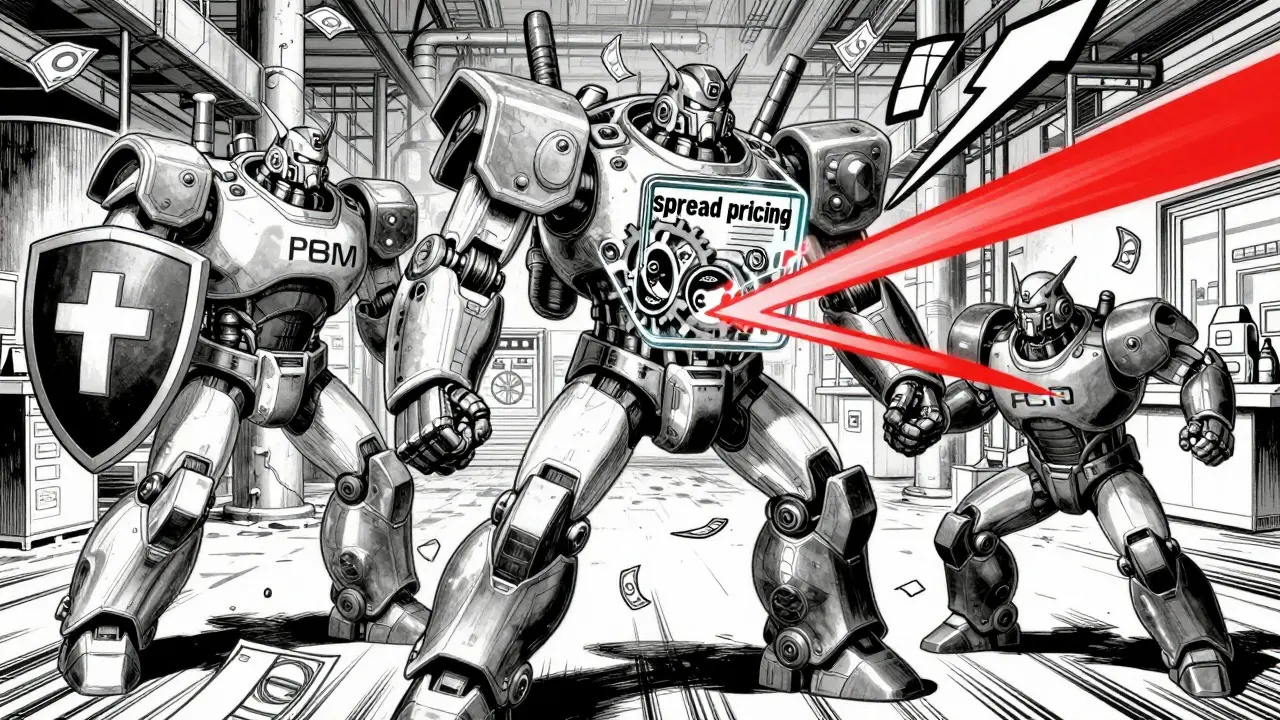
One major issue is spread pricing. This occurs when a PBM charges an employer or health plan more for a medication than it reimburses the pharmacy for dispensing it. The PBM keeps the difference as profit. For example, if a pharmacy is reimbursed $10 for a generic drug, the PBM might charge the insurer $15. That extra $5 disappears into the PBM’s pocket, leaving the pharmacy with less than it needs to cover its operational costs. According to Prosperous America, 64% of what Americans spend on prescriptions reflects middleman markups, spreads, and overhead rather than actual drug production costs.
Another hidden drain is clawbacks. Sometimes, a pharmacy is reimbursed at one rate initially, only to be audited months later and forced to refund money to the PBM because the initial payment was deemed too high. These retroactive adjustments create cash flow nightmares for small businesses. A survey by the National Community Pharmacists Association (NCPA) found that 68% of independent pharmacy owners identified declining generic drug reimbursement as their top business threat. Many report that their net profit on generics has dropped from 8-10% five years ago to barely 2% today, while overhead costs have risen by over 30%.
Independent vs. Chain vs. Mail-Order
Not all pharmacies face the same economic pressures. The structure of the market favors larger entities that can negotiate better terms or absorb lower margins through scale. Independent pharmacies, which represent about 40% of U.S. pharmacies but fill only 11% of prescriptions, are particularly vulnerable. Between 2018 and 2023, approximately 3,000 independent pharmacies closed their doors, largely due to unsustainable reimbursement rates.
In contrast, large chains like CVS, Walgreens, and Walmart benefit from vertical integration. Many of these chains own their own PBMs or have strong partnerships, allowing them to internalize some of the profits that would otherwise go to third-party managers. They also have the leverage to demand higher reimbursement rates from PBMs.
Then there is the rise of mail-order pharmacies. Data from Washington state analyzed by 3Axis Advisors shows that mail-order channels enjoy significantly higher margins than retail stores. For generic drugs, average markups in the mail-order channel are more than four times those yielded by grocery store pharmacies. For certain brand drugs lacking pricing visibility, mail-order pharmacies can make roughly 20 times more margin relative to the underlying drug cost. This disparity creates an uneven playing field, pushing patients toward mail-order options that may offer convenience but lack the personalized care of a local community pharmacist.

Strategies for Survival and Profitability
Facing these headwinds, savvy pharmacy operators are adopting new strategies to protect their margins. One approach is diversification beyond traditional dispensing. Medication Therapy Management (MTM) services allow pharmacists to bill for clinical consultations, providing a stable revenue stream that is not tied to PBM reimbursement formulas. Specialty pharmacy designations also help, as complex medications often come with more favorable reimbursement structures and patient support programs.
Another growing trend is direct contracting. Some independent pharmacies are bypassing PBMs entirely by negotiating directly with employers or self-insured groups. By offering transparent pricing and competitive rates, they can secure better margins and build loyalty with local businesses. Similarly, cash-pay models for select medications are gaining traction. Initiatives like Mark Cuban’s Cost Plus Drug Company, which charges a transparent markup plus a dispensing fee, highlight consumer demand for clear pricing and have pressured traditional players to reconsider their models.
Technology also plays a role. Tools that track reimbursement trends and automate prior authorizations can reduce administrative burdens and minimize errors that lead to clawbacks. The NCPA’s Rebuttal Academy, for instance, has trained thousands of pharmacy staff in challenging unfair PBM decisions, helping pharmacies recover lost revenue. According to industry analysis, pharmacies implementing these proactive strategies have reported net margins that are 3-5% higher than those relying solely on traditional PBM relationships.
Future Outlook: Regulation and Market Shifts
The landscape of pharmacy margin economics is likely to change in the coming years. Regulatory scrutiny is increasing, with the Federal Trade Commission (FTC) examining PBM practices for anti-competitive behavior. Several states, including California, Texas, and Illinois, have passed laws requiring greater transparency in PBM reimbursement calculations. These measures aim to eliminate spread pricing and ensure pharmacies receive fair compensation.
Federal policies also play a part. The Inflation Reduction Act includes provisions for Medicare drug price negotiations, which could indirectly affect generic margins by reducing overall drug spending pressure. Additionally, the FDA continues to approve new generic drugs, fostering competition that drives down manufacturing costs. However, consolidation among generic manufacturers has raised concerns about supply stability and potential price spikes in non-competitive markets.
Despite these challenges, the demand for accessible healthcare remains strong. Pharmacies that adapt by leveraging technology, diversifying services, and advocating for transparent pricing will be best positioned to thrive. The key takeaway is clear: in the world of pharmacy economics, volume alone does not equal success. Strategic management of margins, combined with a focus on patient care, is essential for long-term viability.
Why do pharmacies make more profit on generic drugs than brand-name drugs?
Although brand-name drugs have higher list prices, the reimbursement rates set by PBMs leave pharmacies with very low margins, often around 3.5%. Generic drugs, while cheaper, allow pharmacies to retain a much larger percentage of the sale, typically averaging 42.7% gross margin. Since generics make up 90% of prescriptions, they provide the bulk of the pharmacy's actual profit despite lower individual transaction values.
What is spread pricing in pharmacy benefits?
Spread pricing is a practice where a Pharmacy Benefit Manager (PBM) charges an employer or insurance plan more for a medication than it reimburses the pharmacy for dispensing it. The PBM keeps the difference as profit. This opaque process reduces the amount of money available to pharmacies, squeezing their already thin net margins.
How do PBMs affect independent pharmacy profits?
PBMs control reimbursement rates and often use practices like spread pricing and clawbacks, which can significantly reduce pharmacy income. Independent pharmacies lack the bargaining power of large chains, leading to lower reimbursements. This has contributed to the closure of thousands of independent pharmacies, as many struggle to cover overhead costs with current generic drug reimbursements.
Are mail-order pharmacies more profitable than retail pharmacies?
Yes, data suggests that mail-order pharmacies often achieve higher margins than retail locations. For generic drugs, mail-order markups can be more than four times higher than those in grocery store pharmacies. This is partly due to lower overhead costs and different negotiation structures with PBMs, creating a competitive disadvantage for traditional brick-and-mortar pharmacies.
What can pharmacies do to improve their margins?
Pharmacies can improve margins by diversifying revenue streams through services like Medication Therapy Management (MTM), pursuing specialty pharmacy certifications, and negotiating direct contracts with employers. Adopting technology to optimize reimbursement claims and reducing administrative errors can also help recover lost revenue from clawbacks and underpayments.
