Most of us have a drawer or cabinet full of old pills-antibiotics from last winter, painkillers from a back injury, maybe even that asthma inhaler you haven’t touched in years. We keep them just in case. But when you find that bottle with a faded expiration date, what should you really think? Is it dangerous to take? Or is it just a marketing trick to make you buy more?
Expiration Dates Are About Potency, Not Poison
The expiration date on your medicine isn’t a "use-by" label like milk. It’s not saying the pill turns toxic after that day. Instead, it’s the last day the manufacturer guarantees the drug will work exactly as intended-meaning it still has at least 90% of its labeled strength. This isn’t guesswork. Every drug goes through years of stability testing under controlled heat, humidity, and light to figure out how long it holds up. The FDA requires this for every prescription and over-the-counter medicine since 1979.
That’s why you see dates like "Expiry: 06/2025" on your bottle. It’s not a death sentence. It’s a warranty. After that date, the manufacturer won’t promise it still works. But that doesn’t mean it stops working overnight.
What Happens to Medicine After It Expires?
Most solid pills-like aspirin, statins, or antidepressants-don’t suddenly break down. They lose strength slowly, over months or even years. A landmark study by the U.S. military, called the Shelf Life Extension Program (SLEP), tested over 3,000 lots of 122 different drugs. About 88% of them were still effective 15 years past their expiration date. Some, like ciprofloxacin, kept 97% potency after 12 years. Amoxicillin? Still 94% strong after 8 years.
That’s not a fluke. Dr. Lee Cantrell from the California Poison Control System found some prescription drugs retained 90% potency even 28 to 40 years after expiration-if stored right. So why do we throw them out?
When Expired Medicine Is Actually Dangerous
Here’s the catch: not all drugs are created equal. Some degrade fast-and dangerously. These aren’t theoretical risks. Real people have been hurt.
- Nitroglycerin for chest pain loses half its power within 3 to 6 months after opening the bottle-even before the expiration date. If you’re having a heart attack and your nitro doesn’t work, that’s life or death.
- Insulin breaks down faster than you think. If left unrefrigerated above 8°C, it loses 1.5% to 2.5% potency per month. A weak dose could mean high blood sugar, diabetic ketoacidosis, or worse.
- Liquid antibiotics like amoxicillin-clavulanate suspension go bad in just 14 days after being mixed with water. Even if the bottle says it’s good for a year, once you add liquid, the clock starts ticking fast.
- Epinephrine auto-injectors (EpiPens) lose 15% to 20% of their strength each year after expiration. In anaphylaxis, that drop could mean not enough adrenaline to save your life.
- Warfarin, a blood thinner, becomes unpredictable when expired. Too little? Risk of clotting. Too much? Internal bleeding. There’s no safe middle ground.
These aren’t edge cases. They’re the drugs people rely on to stay alive. If you’re taking one of these, don’t gamble with expiration dates.
Storage Matters More Than You Think
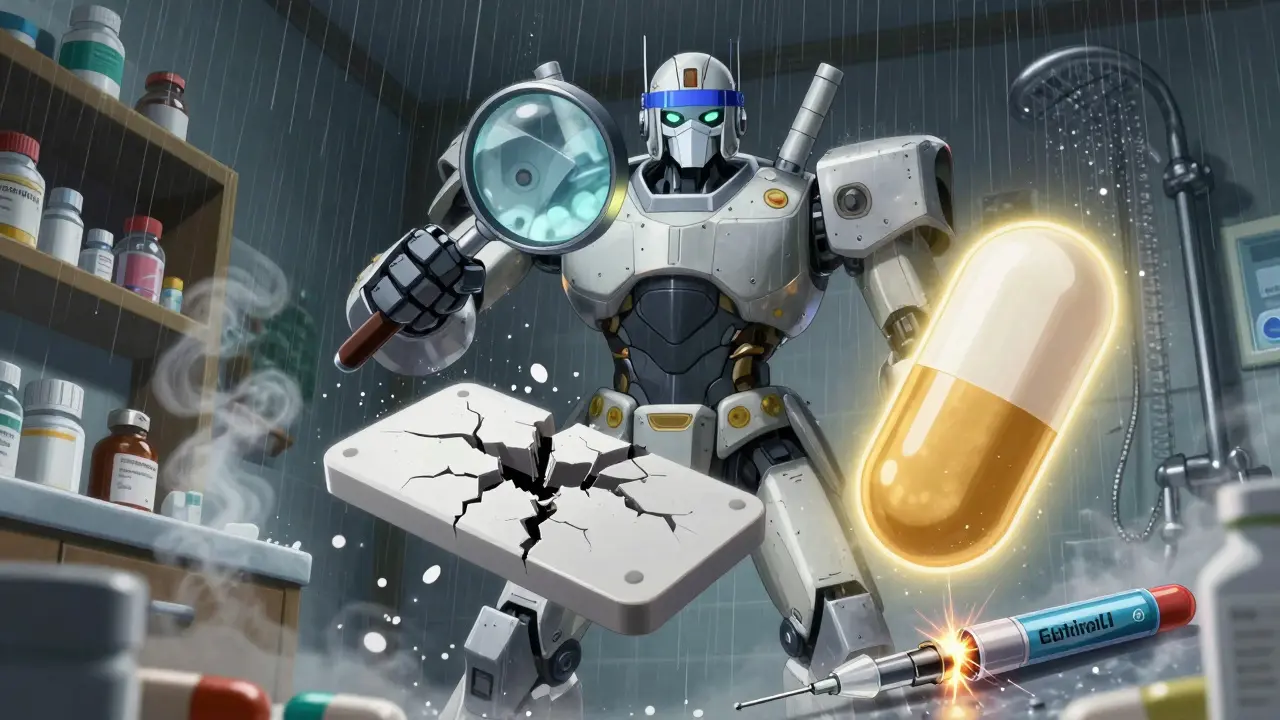
Your bathroom cabinet is the worst place for medicine. Humidity from showers can reach 85%-way above the 60% limit manufacturers test for. Heat from hot water pipes can push temperatures to 30°C or higher. At that level, drugs degrade 40% to 60% faster than at room temperature.
Keep pills in their original bottles, sealed tight, in a cool, dry place. A bedroom drawer, kitchen cabinet away from the stove, or even a sealed container in the fridge (if the label says it’s okay) are better choices. Avoid leaving them in the car, in direct sunlight, or near the sink.
And if you see any changes? Discoloration (white pills turning yellow), crumbling, weird smells, or crystals forming? Toss it. Those are signs the medicine has broken down. No expiration date can save you from that.
What Do Experts Really Say?
The FDA says: don’t use expired meds. They’re clear. Using them is risky. And for good reason-they can’t control how you store your medicine. If you leave your insulin in a hot car, they can’t guarantee safety.
But pharmacists and hospital experts see it differently. Dr. Joel Davis from Johns Hopkins says for stable conditions like high blood pressure, an expired ACE inhibitor might still work fine if stored properly. The Institute for Safe Medication Practices breaks it down into three risk levels:
- High risk: Nitroglycerin, insulin, liquid antibiotics-never use expired.
- Moderate risk: Antibiotics, blood thinners, seizure meds-potency loss can mean treatment failure.
- Low risk: Most statins, antidepressants, allergy pills-gradual loss, unlikely to cause harm.
So if you’re out of your blood pressure pill and the pharmacy is closed? An expired one might be better than nothing-just not for long. But if you’re out of your EpiPen? Don’t risk it.
Why Do We Waste So Much Medicine?
Here’s the irony: the U.S. throws away $765 billion worth of medicine every year because of expiration dates. That’s 13% to 15% of all drug spending. The military saves $1.2 billion a year by extending expiration dates on stockpiled drugs-because their testing shows they’re still good.
Pharmacies already do this too. When you pick up a prescription, the pharmacist puts a "beyond-use" date on the bottle-usually one year for pills, 14 days for liquid antibiotics. That’s their professional judgment, based on real-world stability data.
Now, new tech is helping. Smart packaging with temperature sensors can tell you if your medicine got too hot. Some companies are even using AI to predict how much potency is left based on your storage history. One University of Utah study got 89.7% accuracy predicting remaining strength in 28 common drugs.
What Should You Do?
Here’s your simple guide:
- Check the drug type. Is it nitroglycerin, insulin, or a liquid antibiotic? If yes, throw it out-even if it’s just one day past the date.
- Look for physical changes. Discoloration, odor, crumbling? Toss it.
- Think about the risk. Is this medicine for something minor, like occasional headaches? Maybe it’s fine. Is it for heart disease, seizures, or anaphylaxis? Don’t risk it.
- Store it right. Cool, dry, dark. Not the bathroom. Not the car.
- Dispose of safely. Use a drug take-back program. The DEA runs them twice a year. Or ask your pharmacist-they’ll take them back.
If you’re ever unsure, call your pharmacist. They don’t just fill prescriptions-they’re trained to answer these exact questions. No judgment. No rush. Just facts.
What’s Changing?
The system is slowly catching up. The FDA is testing Bluetooth-enabled sensors on insulin to update expiration dates based on actual storage. The 2024 National Strategy for Pharmaceutical Stewardship is pushing for smarter, science-based expiration labels-not arbitrary dates.
By 2030, experts think we could extend average drug shelf lives by nearly half-saving billions and reducing waste. But until then, use common sense. Your safety isn’t ruled by a printed date. It’s ruled by what’s in the bottle, how you stored it, and what you’re using it for.
Is it safe to take medicine after the expiration date?
For most solid pills like pain relievers, statins, or antidepressants, yes-especially if stored properly. But for critical drugs like insulin, epinephrine, nitroglycerin, or liquid antibiotics, no. These can lose potency quickly and dangerously. When in doubt, assume it’s not safe.
Why do expiration dates exist if drugs last longer?
Expiration dates are manufacturer guarantees-not scientific limits. They’re set conservatively to cover worst-case storage and ensure consistent effectiveness. The FDA requires testing under ideal conditions, but real life isn’t ideal. The date protects the company from liability, not necessarily your health.
Can I store medicine in the fridge to make it last longer?
Only if the label says so. Some medicines, like insulin or certain eye drops, need refrigeration. But others can become less effective or break down if chilled. Never store pills in the fridge unless instructed. Humidity from the fridge can damage tablets and capsules.
What should I do with expired medicine?
Never flush unless it’s on the FDA’s Flush List (like fentanyl patches). Instead, use a drug take-back program. Pharmacies, hospitals, and police stations often host collection events. If none are available, mix pills with coffee grounds or cat litter in a sealed bag and throw them in the trash-this prevents accidental ingestion.
Do pharmacies check expiration dates before giving out medicine?
Yes. Pharmacies are required to dispense medicine with at least 6 months left before expiration for prescriptions, and 1 year for over-the-counter drugs. They also add their own "beyond-use" date-usually one year for pills, 14 days for liquid antibiotics-based on how long they expect the drug to stay stable after dispensing.
Are there any legal consequences for using expired medicine?
No, there are no laws against using expired medicine for personal use. But if you give expired medicine to someone else, or if it causes harm, you could be held liable. Doctors and pharmacists are legally required to advise against using expired drugs, especially for serious conditions.

Man, I never thought about it this way-expiration dates are more like a warranty than a death sentence. I’ve got a bottle of ibuprofen from 2021 sitting in my drawer, and it’s still perfectly fine. I mean, if the military’s testing drugs for 15 years past expiry and they’re still working, why are we tossing stuff like it’s moldy bread?
Let’s be real-this whole post is a dangerous oversimplification. The FDA doesn’t just make up expiration dates because they want you to buy more. They’re protecting you from unpredictable degradation, especially with inconsistent storage. You’re cherry-picking military data while ignoring that most people store meds in humid bathrooms. That’s not science-it’s recklessness.
My pharmacist told me the same thing last month when I asked about my old blood pressure pills. She said if they’re stored right and it’s not a critical drug, it’s usually fine-but she still recommended replacing them. I think the real takeaway is: when in doubt, ask a professional. No shame in calling your pharmacy.
OH MY GOD. I just realized I’ve been keeping my EpiPen in my glove compartment for three years. 😱 I thought it was ‘just in case’-turns out I was one panic attack away from a funeral. Thank you for this. I just tossed it and ordered a new one. You saved my life today.
Ugh, I love how people act like expiration dates are some corporate conspiracy. Honey, if you’re taking expired antibiotics and your infection doesn’t clear, you’re not being ‘resourceful’-you’re being a walking antibiotic resistance poster child. And yes, I’ve seen the CDC reports. You’re not special. Stop.
This is a fascinating breakdown. I appreciate the nuance-most people treat expiration dates like a binary yes/no, but the reality is a spectrum. The key is context: drug type, storage, and risk tolerance. I’ve started keeping a little log in my phone: when I got the med, where I store it, and when it expires. Small habit, big peace of mind.
I knew it!!! 🚨 The FDA is lying to us!!! 🚨 They’re in cahoots with Big Pharma to make us buy pills over and over!!! And they don’t want you to know that the military has been secretly stockpiling 20-year-old insulin and it’s STILL WORKING!!! 🤫💊 They’re hiding the truth from us!!! You think your bathroom is bad? Wait till you find out what’s really in your meds!!! 😱
How can you Americans be so casual about this? In the UK, we have proper pharmaceutical stewardship-medicines are tracked, stored in climate-controlled pharmacies, and disposed of via regulated channels. You treat your medicine like it’s leftover pizza. No wonder your healthcare costs are insane.
Just want to add-don’t forget about liquid meds. I had a friend give her kid expired amoxicillin suspension because ‘it looked fine.’ Kid got worse. Turned out the suspension had separated and the antibiotic wasn’t evenly distributed. She ended up in the ER. Storage and form matter way more than people think.
🔥 I just threw out 6 months’ worth of expired meds. 🗑️💥 No more playing Russian roulette with my health. 💊😭 If you’re still holding onto that 2020 Zpack? You’re not a survivalist-you’re a walking CDC case study. 🚨 #MedicationSafety #DontBeThatPerson