
Imagine trying to photocopy a living cell. You might get the shape right, but you’d miss the pulse, the metabolism, and the subtle shifts that happen every second. That’s essentially the problem with biologic drugs. Unlike standard pills made from simple chemicals, these therapies are grown inside living systems-bacteria, yeast, or mammalian cells. Because they come from life itself, they are never exactly the same twice. This isn’t a flaw in quality control; it’s a fundamental characteristic of biology.
If you’ve ever wondered why your doctor can swap one blood pressure medication for another but hesitates when switching a cancer drug or an autoimmune treatment, this is why. Small molecule drugs (the traditional kind) are like Lego bricks-you can manufacture identical copies forever. Biologics are more like hand-thrown pottery. Each piece is unique, shaped by the specific conditions of its creation. Understanding this difference changes how we view safety, cost, and availability of modern medicines.
The Living Factory Behind Your Medicine
To make a small molecule drug, chemists mix ingredients in a vat, heat them up, and boom-you have aspirin. It’s predictable. For biologics, the "vat" is a bioreactor filled with living cells. These cells are genetically engineered factories designed to produce a specific therapeutic protein, such as insulin or monoclonal antibodies. The first commercially approved biologic was recombinant human insulin (Humulin), which hit the market back in 1982. Since then, the field has exploded. By 2023, the global biologics market was worth roughly $386.8 billion, projected to nearly double by 2030.
But here’s the catch: living things are messy. They respond to stress, temperature, and food supply. If the pH level in a bioreactor drifts slightly outside the ideal range of 7.0-7.4, or if oxygen levels dip for even a few hours, the cells might produce a protein with a different sugar structure attached to it. This process, called glycosylation, affects how the drug behaves in your body. You can’t just tweak a dial and fix it instantly because the cells are alive. They need time to adjust, often requiring 10-14 days just to grow enough biomass before harvesting begins.
Why No Two Batches Are Identical
The FDA explicitly states that slight modifications to proteins are expected during manufacturing. This variability happens because biological systems introduce natural noise into the production line. In contrast, generic drugs must prove bioequivalence-they must show that their active ingredient is chemically identical to the brand-name version. With biologics, you can’t achieve chemical identity. You can only aim for high similarity.
This distinction creates a massive hurdle for creating biosimilars. A biosimilar is not a copy; it’s a highly similar version. Think of it as a sibling rather than a twin. While a generic drug looks identical under a microscope, a biosimilar might have minor structural differences that don’t affect clinical outcomes but prevent it from being labeled "identical." Current analytical methods can characterize only about 60-70% of a typical monoclonal antibody’s structural attributes. That leaves a significant portion of the product uncharacterized, relying on statistical assurance rather than absolute proof of sameness.
| Feature | Small Molecule Drugs (Generics) | Biologic Drugs (Biosimilars) |
|---|---|---|
| Source | Chemical synthesis | Living organisms (cells) |
| Molecular Size | Small (< 1,000 Daltons) | Large (up to 150,000+ Daltons) |
| Manufacturing Time | Days to weeks | 3-6 months |
| Batch Variability | Negligible | Inherent and expected |
| Copy Type | Generic (Identical) | Biosimilar (Highly Similar) |
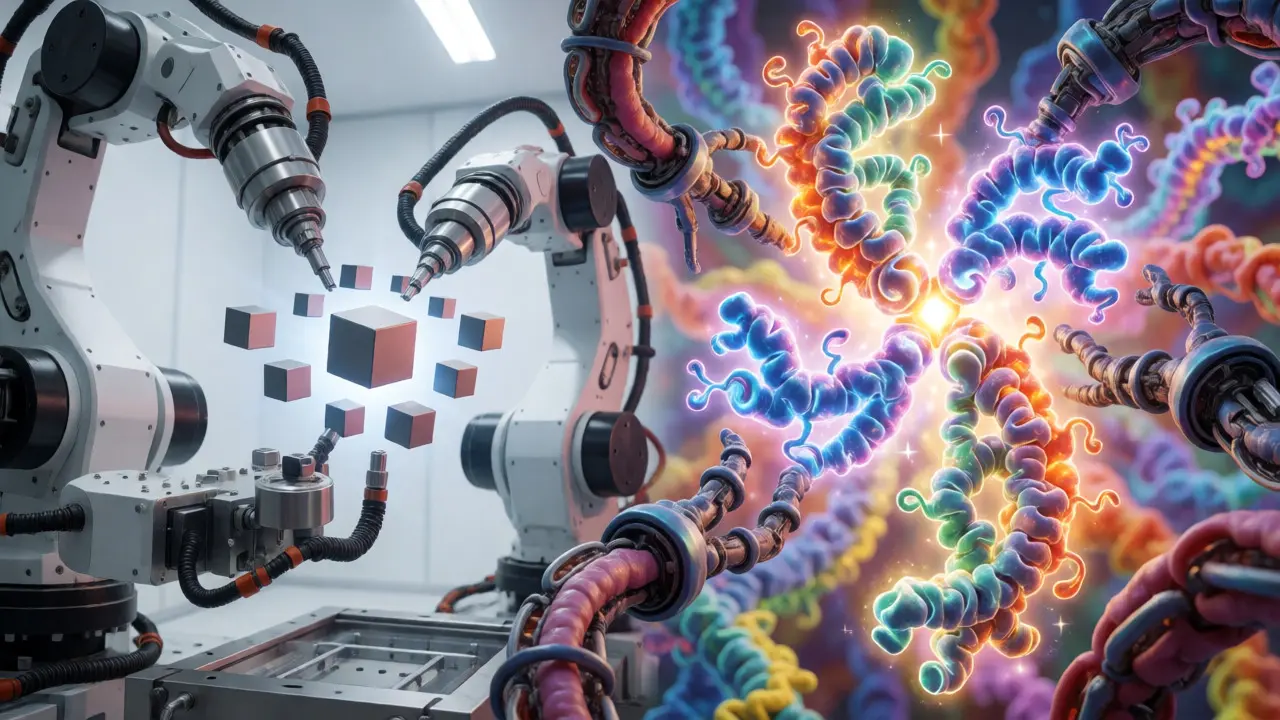
The High Cost of Precision
Because you can’t see everything happening inside the cell, manufacturers spend heavily on monitoring. Quality control testing accounts for 30-40% of total manufacturing costs for biologics, compared to just 5-10% for small molecules. Every batch requires rigorous testing to ensure that the variability stays within safe limits. If a batch fails-say, due to contamination or a drop in cell viability-it’s often a total loss. Industry data suggests failure rates hover around 10-15%, meaning one out of every ten batches might be discarded. Given that a single failed batch can cost over $500,000, the financial stakes are enormous.
Contamination is the biggest enemy. In a survey of 158 biopharmaceutical facilities, contamination accounted for about 35% of manufacturing issues. Unlike chemical plants, where you can sterilize equipment with harsh acids, bioreactors require gentle handling to keep cells alive. This forces companies to use expensive single-use technologies, which reduce cross-contamination risks by up to 60% but increase raw material costs by 15-20%. It’s a trade-off between purity and price, and there’s no way around it.
Scaling Up Is Not Just Making More
One common misconception is that making more biologic drug is just a matter of using a bigger tank. It’s not. Scaling up from a 2,000-liter bioreactor to a 15,000-liter system can take 17 months of re-optimization. Why? Because mixing, heat transfer, and gas exchange behave differently at larger scales. Cells in a big tank might experience stress zones that don’t exist in a small lab flask. One senior engineer noted that scaling up delayed revenue by $22 million while they tweaked parameters to match the original product profile.
This complexity means that changing the manufacturing site-even keeping the same process-can alter the product slightly. Regulators treat the manufacturing process itself as part of the product definition. If you move production from Bristol to Boston, you might need new clinical trials to prove the drug still works the same way. This rigidity protects patients but slows down innovation and keeps prices high.

What This Means for Patients
For patients, this complexity translates into fewer options initially. When a patent expires on a biologic, competitors can’t rush in with cheap generics. They must develop biosimilars, which takes years and hundreds of millions of dollars. The biosimilars market reached $10.5 billion in 2023, but it’s still far smaller than the generic market. However, competition does drive prices down over time. As more biosimilars enter the market for drugs like Humira (adalimumab) or Ozempic (semaglutide), access improves.
It also means interchangeability matters. Not all biosimilars are automatically interchangeable. Pharmacists can swap a biosimilar for the reference product without calling the doctor only if the regulatory agency (like the FDA or EMA) grants that specific designation. This requires extra data showing that the switch won’t change efficacy or safety. Always check with your healthcare provider before assuming a lower-cost option is a direct substitute.
The Future of Biologic Manufacturing
Technology is starting to crack the code. Continuous manufacturing, where products flow through a system non-stop rather than in discrete batches, is being adopted in about 15% of new facilities. Artificial intelligence is helping predict cell behavior, reducing trial-and-error in development. Modular facilities using disposable components are becoming standard, cutting capital costs by 25-30%.
Yet, challenges remain. Environmental concerns are rising, as biologics require 10-15 times more water per dose than small molecules. And despite advances, we still can’t fully characterize these complex structures. Until we can map every atom of a living-cell-produced protein, exact copies will remain impossible. But for most patients, "highly similar" is good enough-especially when it means access to life-saving treatments that were once out of reach.
Can a biosimilar replace my brand-name biologic?
Often, yes, but it depends on regulatory approval. Biosimilars must demonstrate they are highly similar to the reference product with no clinically meaningful differences. However, only those designated as "interchangeable" can be substituted at the pharmacy counter without prescriber intervention. Always consult your doctor or pharmacist before switching.
Why are biologic drugs so much more expensive than regular pills?
They require living cells to produce, which involves complex, slow, and risky manufacturing processes. Costs include maintaining sterile environments, extensive quality control (30-40% of production costs), and high failure rates. Additionally, developing biosimilars requires significant clinical data, unlike generics which rely on chemical equivalence.
Are biosimilars less effective than the original biologic?
No. Regulatory agencies require biosimilars to prove they work just as well and are just as safe as the reference product. Minor structural differences exist due to biological variation, but studies show these do not impact clinical outcomes for patients.
How long does it take to make a batch of biologic drugs?
The entire cycle typically spans 3 to 6 months. This includes cell line development, upstream processing (growing cells for 10-14 days), downstream purification, and formulation. This is roughly 10 times longer than producing small molecule drugs.
What happens if a biologic batch fails during manufacturing?
If a batch fails quality control tests-due to contamination, low yield, or improper protein folding-it is usually discarded entirely. Failure rates are estimated at 10-15%, representing a significant financial risk for manufacturers since each lost batch can cost hundreds of thousands of dollars.

Finally, someone explains why we can't just copy-paste these drugs like they are PDFs. The FDA needs to stop pretending biosimilars are identical twins and admit they are distant cousins at best. We need strict labeling that screams 'NOT INTERCHANGEABLE' in red letters so patients don't get screwed over by pharmacists swapping their meds for profit.
The analogy of hand-thrown pottery is apt but understates the complexity.
We are dealing with post-translational modifications that define efficacy. To suggest that statistical assurance replaces absolute proof is a dangerous oversimplification for the layperson. True understanding requires appreciating the stochastic nature of cellular metabolism.
I appreciate the empathy shown here towards the manufacturing struggles. It's truly heartbreaking to think about those cells working so hard only to fail due to a tiny pH shift. We must remain compassionate towards the scientists battling this invisible chaos every single day. Their dedication is inspiring amidst such uncertainty.
Wait... hold on... I'm not sure I agree??
Is it really impossible?? Or is it just expensive?? Because big pharma loves saying things are impossible when they want higher margins!!! They could probably fix it if they wanted to!!! But they won't!!! So don't believe the hype!!!
Ugh, another article trying to explain biology to people who just want cheap pills. It’s all drama anyway. Cells die, money burns, whatever. Too much reading for me today.
Omg yes!! 🤯 The bioreactor part gave me actual chills. Like imagine being a cell in there stressed out because some guy forgot to check the oxygen levels 😱 It’s basically a horror movie inside a tank! 💀✨ Also, the fact that we can’t even see 40% of the structure is wild. How do you trust what you can’t fully map? 🧐💅 #BiotechDrama
interesting take on the scaling issues
the jump from 2k to 15k liters is non linear mixing dynamics change completely
disposable tech helps but cost transfer is real
we accept variability as inherent risk profile now
This was super colorful and easy to follow! I love the Lego vs pottery comparison. It really helped me visualize why my doctor gets nervous about switching my autoimmune meds. Do you know if AI is actually fixing the glycosylation issues yet or is it still mostly theoretical? Just curious how close we are to cracking the code!
Your analysis lacks critical depth regarding the regulatory capture involved here. You present the impossibility of exact copies as a scientific inevitability, ignoring the economic incentives to maintain this status quo. The failure rates are conveniently used to justify price gouging rather than operational inefficiency. This narrative serves corporate interests, not patient safety.
Basic science 101 stuff here. If you didn't know biologics aren't generics, you weren't paying attention. :/ Still, good summary for the masses. :)
It is fascinating to consider that life itself introduces noise into our medicines. Perhaps this imperfection reminds us that we are treating living systems with living tools. There is a certain humility required in accepting that we cannot perfectly replicate nature's work. We should focus on outcomes rather than perfection.
this feels very reassuring honestly knowing the limits helps manage expectations its okay if its not perfect as long as its safe
hey guys nice read! i work in pharma ops and yeah the scale up pain is real lol 17 months is optimistic tbh sometimes its longer depending on the cell line. also water usage is huge issue now sustainability teams are killing us on that front. keep up the good work!
I love seeing more competition enter the market eventually. Even though it takes time, it gives hope that access will improve for everyone. Every step forward counts!
The omission of patent evergreening strategies in this discussion is suspicious. By focusing solely on biological variability, the author deflects from the legal mechanisms used to block true generic entry. We must be vigilant against narratives that obscure the financial motives behind drug pricing structures.