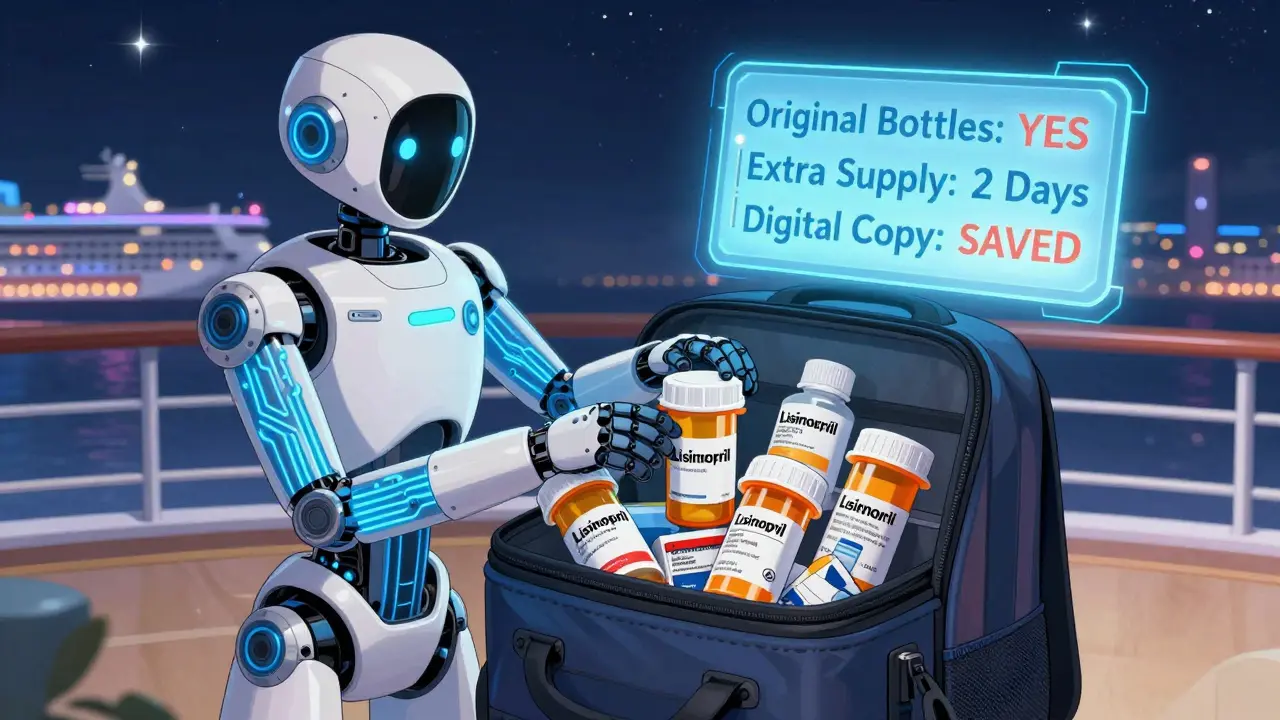
Don’t Risk Losing Your Meds on the Road or at Sea
Imagine this: you’re halfway through a 10-day cruise, the ship’s rocking gently, and you reach for your blood pressure pill-only to find the bottle is missing. Or you’re driving through Texas, and a state trooper asks to see your prescription for ADHD medication, but it’s in a plastic bag with no label. These aren’t rare stories. They happen more often than you think. Packing medications for long trips isn’t just about convenience-it’s about safety, legality, and peace of mind.
Always Keep Meds in Original Containers
Never transfer pills to unlabeled containers. Not even for a few days. Cruise lines like Royal Caribbean and Norwegian explicitly require medications to stay in their original pharmacy bottles with clear labels showing your name, the drug name, dosage, and prescribing doctor. The same rule applies to road trips. Why? Because TSA, U.S. Customs, and international ports all check for this. If your meds don’t match your passport name, you could be denied boarding, fined, or even have your medication confiscated.
Even if you think you’re being smart by putting everything in a pill organizer, keep the originals with you. Use the organizer as a daily tool, but never as your only container. A Reddit user named u/TravelMedNurse, who’s worked on cruise ships for 12 years, says 90% of medication issues she’s seen came from unlabeled pills. In 37% of those cases, passengers were turned away at foreign ports.
Bring Extra-Way More Than You Think
Plan for delays. Flights get canceled. Cruises change ports. Road trips hit traffic jams that turn into overnight stops. The OAG Aviation Report shows 23% of international flights experience delays long enough to mess up a medication schedule. Cruise Critic and Special Journeys both recommend bringing at least two extra days’ worth of medication for cruises and flights. For road trips, add one extra day.
But here’s the real trick: don’t just add extra pills. Add extra containers. If you take a daily pill, bring two full bottles. If you take insulin or other temperature-sensitive meds, bring a backup cooler and an extra pen. One RV owner in Arizona lost his insulin at a state border checkpoint because the bottle wasn’t labeled correctly. He ended up in the ER. A few extra bottles could’ve prevented that.
Organize Smart-No More Guessing at 3 a.m.
Use a system that works for you. There are five proven methods:
- Daily blister packs: Pre-filled by your pharmacy with pills sorted by time of day.
- Pill minders: Plastic boxes with compartments for AM/PM/night. Tape them shut and write the date and time clearly on the outside.
- Pill envelopes: Small labeled bags for each dose. Include your name, date, time, and pill count.
- Unit dose boxes: Used in hospitals, these are great for complex regimens.
- Color-coded Ziploc bags: One color for heart meds, another for pain relief, etc. Works great for group travel.
Special Journeys found that 78% of medication errors during group travel happened because labels were unclear or missing. If you’re using any of these systems, make sure the label is waterproof and readable in dim light. No tiny print. No cursive.
Carry a Physical and Digital Copy
Write down every medication you’re taking. Include:
- Brand name
- Generic name
- Dosage
- How often you take it
- Reason for taking it
- Prescribing doctor’s name and phone number
Print this list. Put it in your wallet. Put it in your carry-on. Then take a photo of it and save it in your phone’s notes app, iCloud, or Google Drive. The CDC says 12% of travelers struggle to explain their meds to foreign doctors because of language barriers. A printed list solves that instantly.
Pro tip: Use the CDC’s new Medication Travel Checklist. It’s free, has QR codes linking to country-specific rules, and is now used by 92% of U.S. travel clinics.
Cruise vs. Road Trip: Know the Differences
Cruise lines are stricter. They operate in international waters and stop in countries with wildly different drug laws. For example, codeine is a controlled substance in many Caribbean nations. If your painkiller has codeine, you need a doctor’s letter explaining why you need it. Norwegian Cruise Line requires you to declare controlled substances 30 days before sailing. Carnival requires documentation for any medication with Schedule II ingredients.
On the road, the problem is state laws. Medical marijuana is legal in 38 states-but still illegal in 13. Even if you have a prescription, crossing into one of those states could get your meds seized. The AAA reports 67% of road trippers have had medication issues crossing state lines. Don’t assume your prescription is enough. If you’re carrying anything even slightly controlled, call ahead to state health departments or check NORML’s state-by-state guide.
What About International Rules?
Some medications that are legal in the U.S. are banned in other countries. Common ones include:
- ADHD meds like Adderall and Ritalin (restricted in Japan, UAE, and many European countries)
- Strong painkillers with oxycodone or hydrocodone
- Some antidepressants and anti-anxiety drugs
The World Health Organization says 18% of commonly used medications face restrictions in at least one popular travel destination. The International Association for Medical Assistance to Travellers (IAMAT) says 42% of common meds need special permits for certain cruise ports.
Before you go, check the destination country’s rules. Use the U.S. State Department’s travel site or IAMAT’s database. Print a copy of your prescription and a letter from your doctor. Even if you don’t think you’ll need it, bring it. You’ll thank yourself when you’re standing at customs with a nervous look on your face.
Temperature-Sensitive Meds? Bring a Cooler
Insulin, some biologics, and eye drops need to stay cool. The FDA says 41% of these medications lose effectiveness if exposed to high heat for more than 24 hours. A regular cooler with ice packs works-but make sure it’s labeled. Don’t just toss it in your suitcase. Put it in your carry-on, right next to your meds.
Some pharmacies now offer UV-protective travel cases that keep meds cool for up to 72 hours. CVS and Walgreens give these out for free if you ask. Ask your pharmacist. It’s a simple fix for a big problem.
Pack Last, Check First
Always pack your medications last. Why? Because if your luggage gets lost, your meds are still with you. Put them in your carry-on. Never check them. The SITA Baggage Report shows only 0.02% of bags are permanently lost-but that’s still 1 in 5,000. You don’t want to be that one person.
Before you leave, do a quick checklist:
- Are all meds in original bottles with labels?
- Do you have two extra days’ supply?
- Is your written list printed and saved digitally?
- Do you have doctor’s notes for controlled substances?
- Are temperature-sensitive meds in a cooler?
Do this the night before you leave. Not the morning of. You’ll sleep better knowing you’re covered.
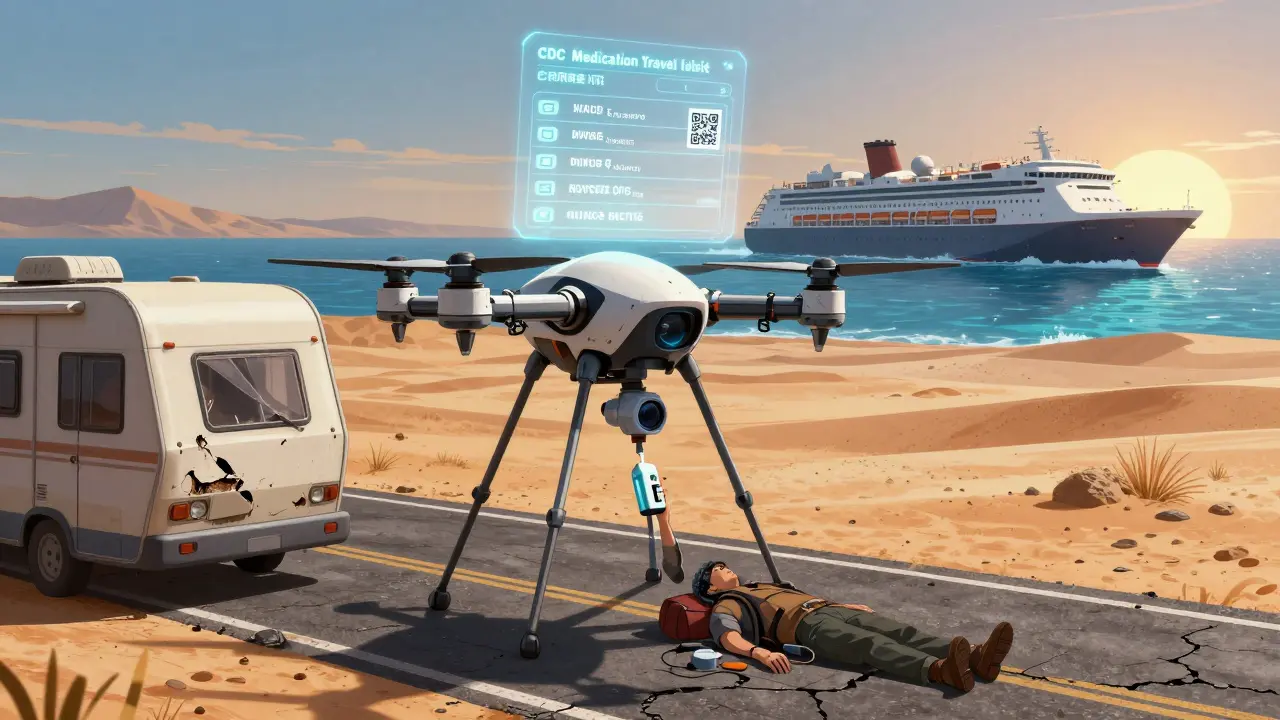
Insurance Isn’t Optional
Even if you pack perfectly, something can still go wrong. The Cruise Lines International Association says 28% of medical emergencies on cruise ships require evacuation-and those cost an average of $48,000. Travel insurance that covers medical emergencies and medication replacement is not a luxury. It’s a necessity.
Make sure your policy covers:
- Emergency medical transport
- Replacement of lost or damaged prescriptions
- Repatriation if you need to come home early
Dr. Jane Chen, a travel medicine specialist, says: "Carrying your own meds doesn’t replace the need for insurance." She’s right. You can do everything right and still get sick. Insurance is your backup plan.
What About Controlled Substances?
If you take anything with codeine, oxycodone, Adderall, or Xanax, you’re dealing with a higher level of risk. These are tightly controlled worldwide. In some countries, even having them without a special permit is a felony.
Here’s what to do:
- Call your doctor at least 30 days before travel. Ask for a letter on letterhead explaining why you need the medication.
- Check the destination country’s drug laws. Use the U.S. Embassy website or IAMAT.
- Carry no more than a 30-day supply.
- Never share your meds. Ever.
One traveler in 2023 was arrested in Dubai for carrying a single Xanax pill in a pill organizer. He didn’t know it was illegal. He spent three weeks in jail before being deported.
Future Trends: Digital Meds Are Coming
The industry is changing. Royal Caribbean now requires you to submit your medication list electronically 72 hours before sailing. IATA’s new Travel Pass app lets you verify prescriptions digitally on international flights. Carnival is testing fingerprint scanners on ships to prevent medication theft-yes, it happens, and it’s up 1.2% since 2022.
By 2027, experts predict 65% fewer medication-related travel disruptions thanks to global standardization. But until then, the rules are still messy. So stick to the basics: original bottles, extra supply, clear labels, digital backup, and insurance.
Final Thought: It’s Not About Being Perfect-It’s About Being Prepared
You don’t need to be a pharmacist or a travel ninja to pack your meds right. You just need to be thoughtful. Take 30 minutes before your trip. Double-check every bottle. Write down every detail. Bring the extras. Keep it with you. That’s all it takes.
Because when you’re on a ship in the middle of the ocean, or stuck in a rental car with a headache and no painkillers, you won’t care about how fancy your pill organizer is. You’ll just be glad you didn’t cut corners.
Can I put my pills in a pill organizer instead of the original bottle?
You can use a pill organizer for daily use, but you must always carry the original prescription bottles with you. Airlines, cruise lines, and customs officials require the original labels showing your name, drug name, and dosage. Using only a pill organizer can lead to denied boarding or confiscation of your medication.
How much extra medication should I bring?
For cruises and flights, bring at least two extra days’ supply. For road trips, bring one extra day. Travel delays happen in about 23% of international flights, and cruise itineraries can change unexpectedly. Having extra meds prevents emergencies if you’re stuck overnight or miss a port.
Are there medications that are banned on cruises or in certain countries?
Yes. ADHD medications like Adderall and Ritalin are restricted in Japan, the UAE, and several European countries. Painkillers with codeine or oxycodone are tightly controlled in the Caribbean and Southeast Asia. Even common antidepressants can be illegal in some places. Always check the destination country’s rules before you go.
Do I need a doctor’s note for my medications?
It’s strongly recommended for all prescriptions, and required for controlled substances like opioids, stimulants, or benzodiazepines. A doctor’s note on letterhead explaining why you need the medication can prevent delays or legal trouble at borders and ports. Some countries require it by law.
Can I bring my medications in my checked luggage?
Never. Checked bags can be lost, delayed, or stolen. The FAA and TSA require essential medications to be kept in carry-on luggage. Even if you’re only flying domestically, the risk isn’t worth it. Keep all your meds with you at all times.
What should I do if my medication gets lost or stolen?
If your meds are lost, contact your cruise line’s medical staff or the nearest U.S. embassy. Have your digital copy of your prescription ready. Travel insurance with medication replacement coverage can help you get new prescriptions filled locally. Never try to buy medication abroad without a local prescription-it’s often illegal and unsafe.
Is it okay to share my medication with someone else on the trip?
Never. Sharing prescription medication is illegal in every country and can be dangerous. Dosages are personalized. What works for you could harm someone else. Even if they ask nicely, say no. Your responsibility is to take care of yourself, not to be a pharmacy.
Do I need to declare my medications at customs?
You’re not always required to declare them, but you must be ready to show them if asked. If you’re carrying controlled substances, it’s best to declare them proactively. Customs officers appreciate honesty. Having your doctor’s note and original labels ready makes the process smoother.
Can I bring over-the-counter meds like ibuprofen or allergy pills?
Yes, and you should. OTC meds like ibuprofen, antihistamines, and antacids are safe to bring and often useful. But even these should be in their original packaging. Some countries restrict certain OTC ingredients, so check ahead if you’re traveling internationally. Better safe than sorry.
What’s the best way to store insulin during travel?
Keep insulin in a small cooler with ice packs, and carry it in your carry-on luggage. Avoid freezing it. Some pharmacies sell insulated travel cases that keep insulin cool for up to 72 hours. Never check insulin in luggage. Heat and pressure changes can ruin it. Always bring extra pens or vials in case of loss or damage.

bro i just throw all my pills in a ziplock and call it a day 😅 turns out that’s a bad idea. learned the hard way in thailand when they stopped me at customs. now i keep the bottles. no more shortcuts.
It is imperative that all travelers adhere strictly to the guidelines outlined herein. Failure to maintain original pharmaceutical packaging constitutes a potential violation of international narcotics regulations, and may result in severe legal consequences. Please ensure legibility, accuracy, and compliance at all times.
I used to pack everything in a pill organizer until my mom had a panic attack in Mexico because she couldn’t find her heart meds. Now I keep the bottles + a printed list in my wallet. Life saver. Seriously, just do it.
The insulin cooler tip is gold. I carry one of those UV cases from CVS and it’s been perfect for my 3-week road trips. Also, never check meds. I once lost my anxiety pills in a bag that got sent to Alaska. Took 5 days to get replacements. Not fun.
It’s funny how we treat medicine like luggage. We pack clothes like they’re sacred, but pills? Throw ‘em in a sock. Maybe it’s because we don’t think of them as vital. But they are. They’re not extras. They’re part of who we are when we’re away from home.
IF YOU’RE NOT CARRYING TWO EXTRA DAYS OF MEDS YOU’RE ONE FLIGHT DELAY AWAY FROM A HOSPITAL VISIT. I’M NOT KIDDING. I SAW A GUY ON A CRUISE SCRAMBLING FOR HIS DIABETES MEDS BECAUSE HIS BAG GOT LOST. HE HAD TO CALL HIS DOCTOR FROM A BAR IN THE BAHAMAS. DON’T BE THAT GUY.
lol imagine being this stressed about pills 😂 i just take what i need and if i run out i buy it abroad. worst case i get a little sick. its not the end of the world. also why are we still using paper lists in 2025? just use your phone. 🤷♂️💊
original bottles + extra supply + digital copy = peace of mind. simple. no drama. i do this for my dad’s blood pressure meds every time we travel. he forgets everything but he remembers the labels. weirdly helpful.
This guide is so painfully obvious it’s almost insulting. Of course you don’t put pills in a Ziploc. Of course you bring extras. Of course you check international laws. This reads like a kindergarten safety manual for adults who’ve never left their garage. The fact that this needs to be written at all speaks volumes about the collective laziness of modern travelers. Also, why is there a QR code? Are we children now?