
Licorice Safety Calculator
Glycyrrhizin Intake Calculator
Determine if your licorice consumption is safe based on daily intake and medications you take.
Check all medications you're currently taking that may interact with licorice
Your Safety Assessment
Important: If you experience swelling, muscle cramps, or irregular heartbeat after consuming licorice, stop immediately and consult your doctor.
These symptoms may indicate dangerously low potassium levels or high blood pressure.
Most people think of licorice as just a sweet, chewy candy - maybe something you grab at the checkout line or share with kids during movie night. But if you’re taking any kind of medication, that little stick of black licorice could be doing more than satisfying your sweet tooth. It might be messing with your blood pressure, your potassium levels, or even how your drugs work in your body. And you probably have no idea.
The problem isn’t the flavor. It’s the compound inside real licorice called glycyrrhizin. It’s what gives licorice root its distinctive taste - and its powerful, sometimes dangerous, effects on your body. Glycyrrhizin tricks your kidneys into holding onto salt and flushing out potassium. Over time, that can lead to high blood pressure, swelling, muscle cramps, and even heart rhythm problems. The European Food Safety Authority says healthy adults should not exceed 100 mg of glycyrrhizin per day. That’s about 50 grams of traditional black licorice candy. One bag. And most people don’t realize they’re eating that much.
How Licorice Tricks Your Body
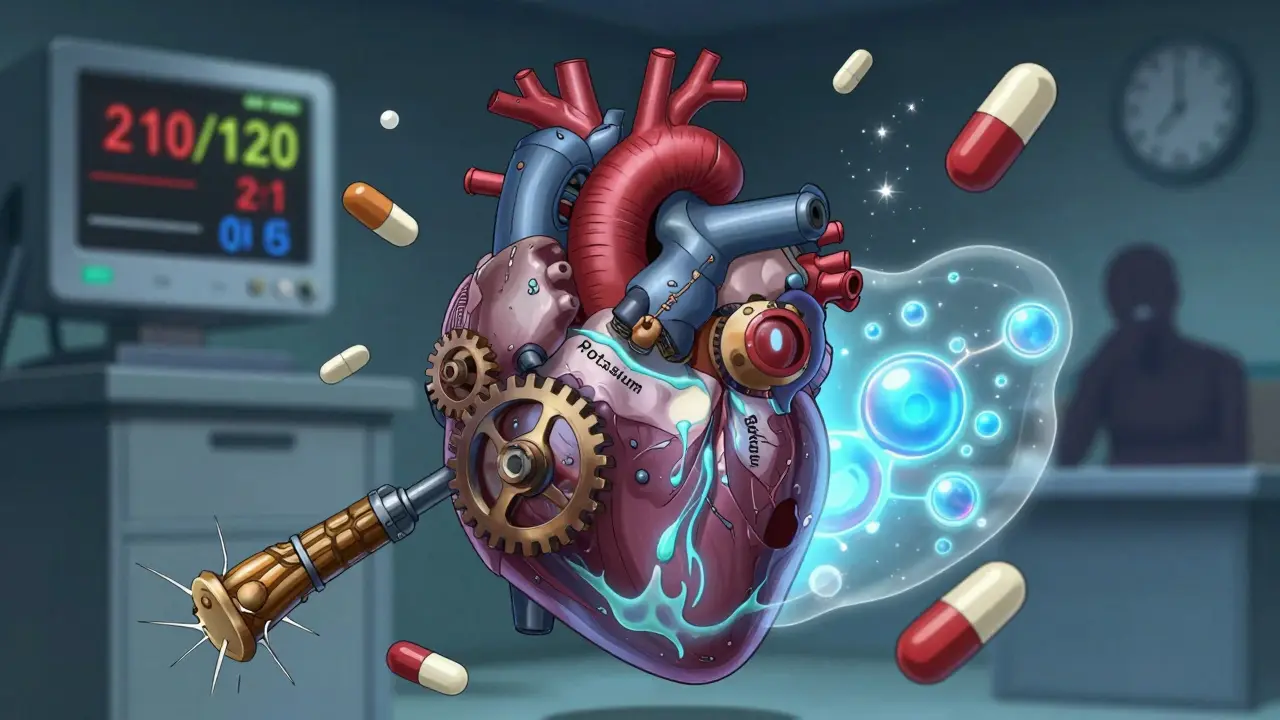
Your body has a natural system to balance salt and water. It uses enzymes like 11β-hydroxysteroid dehydrogenase type 2 to keep cortisol - a stress hormone - from acting like a mineralocorticoid. Cortisol normally doesn’t affect your kidneys the way aldosterone does. But glycyrrhizin shuts down that enzyme. Suddenly, cortisol starts mimicking aldosterone. Your kidneys think they’re getting a signal to hold onto sodium and dump potassium. Sodium builds up. Water follows. Your blood pressure rises. Potassium drops. And if you’re already on medication that affects this system, things get risky fast.
Think of it like this: your body is trying to keep a tight balance. Licorice throws a wrench in the gears. And it doesn’t matter if you’ve been eating licorice for years. One day, your body might just snap. A 47-year-old man in a 2012 study ate 200 grams of licorice daily for three weeks. His blood pressure spiked to 210/120. His potassium level crashed to 2.6 mmol/L - dangerously low. He needed hospitalization. And he wasn’t even on any medications.
Medications That Go Rogue with Licorice
Some drugs already push your body toward the same imbalance licorice creates. When you mix them, the effect isn’t just doubled - it’s multiplied.
- Diuretics (water pills) like furosemide or hydrochlorothiazide make you lose potassium. Licorice does the same. Together, they can send potassium levels into the toilet. One case from the University of Rochester described a patient whose potassium dropped below 3.0 mmol/L after combining thiazide diuretics with licorice. That’s enough to cause muscle paralysis or cardiac arrest.
- Antihypertensives like lisinopril or losartan are meant to lower blood pressure. Licorice does the opposite. A Reddit user reported his BP jumped from 120/80 to 165/95 after eating 30g of licorice daily for just three days - while taking lisinopril. His doctor had no idea the candy was the culprit.
- Corticosteroids like prednisone or fludrocortisone already mimic aldosterone. Add licorice? You’re stacking the deck. A man on fludrocortisone for years developed a panic attack and blood pressure of 205/110 after eating licorice. His doctor thought it was anxiety. It was licorice.
- Warfarin and other blood thinners are tricky. Some studies say licorice makes warfarin stronger, raising bleeding risk. Others show it weakens it, increasing clot risk. A 92-year-old woman on phenprocoumon saw her INR drop suddenly after eating licorice. She almost had a stroke. No one connected the dots.
- Digoxin - a heart drug - becomes toxic when potassium is low. Licorice lowers potassium. One case report described digoxin toxicity in a patient with a potassium level of 2.8 mmol/L after eating licorice daily. She needed emergency treatment.
Even if you’re not on any of these, you might be taking something else. Statins, antidepressants, antifungals - many are metabolized by liver enzymes that licorice can interfere with. The science here is messy. Some licorice compounds boost enzyme activity. Others block it. It depends on the product, the dose, and your genes. There’s no simple answer.
Not All Licorice Is Created Equal
Here’s where it gets confusing: not every candy labeled "licorice" contains real licorice root. Many - especially in the U.S. - are flavored with anise oil. Anise tastes similar but has zero glycyrrhizin. It’s safe. But how do you know?
Check the label. If it says "licorice extract," "Glycyrrhiza glabra," or "licorice root," you’re in danger zone. If it says "artificial flavor" or "anise flavor," you’re probably fine. But here’s the kicker: 92% of black licorice products in a 2023 Consumer Reports survey didn’t list glycyrrhizin content. None of them warned about drug interactions. You’re flying blind.
Supplements are worse. Licorice root capsules often contain 4% to 24% glycyrrhizin. A single 500mg capsule could have over 100mg of glycyrrhizin - the entire daily safe limit. And most people take them daily for "digestive support" or "adrenal health." No one tells them this could be dangerous.
There’s a version called DGL - deglycyrrhizinated licorice. It’s stripped of glycyrrhizin. It’s used for ulcers and heartburn. If you’re taking it, you’re likely safe. But again - check the label. Not all DGL is created equal.
Who’s at Highest Risk?
You don’t have to be elderly or sick to be affected. But some people are more vulnerable:
- People over 60 - kidneys don’t handle salt as well.
- Those with existing high blood pressure, heart disease, or kidney problems.
- People on diuretics, steroids, or heart medications.
- Women on birth control or hormone therapy - estrogen makes the body more sensitive to glycyrrhizin’s effects.
- Anyone eating more than 50g of licorice candy per week.
And here’s the scary part: symptoms don’t show up right away. It takes 2-4 weeks of daily consumption for problems to develop. You might feel fine. Then one day, you’re dizzy, your legs are swollen, your muscles cramp, and your blood pressure monitor screams red. By then, it’s already damage.
What You Should Do
Here’s what works in real life:
- Check your candy. If it’s labeled "licorice root," stop eating it daily. If you’re not sure, assume it’s risky.
- Read your medication labels. If you’re on blood pressure, heart, or kidney meds, talk to your pharmacist. Ask: "Could licorice interfere with this?"
- Track your intake. One 50g bag of licorice candy = 100mg glycyrrhizin. That’s the max safe daily dose. If you’re eating more than one bag a week, you’re likely over.
- Look for symptoms. Headaches, swelling in ankles, muscle weakness, fatigue, or irregular heartbeat after eating licorice? Stop it. Get your potassium and blood pressure checked.
- Ask for DGL. If you want licorice for stomach issues, ask for deglycyrrhizinated licorice. It’s labeled clearly. It’s safe.
And if you’ve been eating licorice daily for months - especially while on meds - don’t panic. But do get tested. A simple blood test for potassium and a blood pressure check can catch problems before they become emergencies.

Why No One Talks About This
The global licorice market was worth over $1.3 billion in 2022. Most of it is candy and supplements. Companies don’t want to scare people away. Regulatory agencies know the risk - the UK requires warning labels on high-glycyrrhizin products. Japan limits supplements to 100mg/day. The FDA has documented hundreds of adverse events since 2010. But in the U.S., there’s no mandatory labeling. No public warnings. No education in pharmacies.
A 2021 study found only 37% of community pharmacists could list all major licorice-drug interactions. That’s not just a gap. It’s a danger zone.
And consumers? A ConsumerLab survey found 68% had no idea licorice could interact with meds. They thought it was just sugar.
It’s not. It’s a hidden drug.
What’s Coming Next
The science is evolving. New research shows licorice’s effects aren’t just about glycyrrhizin. Different species - like Chinese licorice (Glycyrrhiza uralensis) - contain other compounds that can block or boost liver enzymes. Some people’s genes make them more sensitive. Clinical trials are now testing personalized thresholds based on DNA. By 2026, the American Herbal Pharmacopoeia wants all licorice products to list glycyrrhizin content on the label. That’s progress.
But for now? You’re on your own.
Can I eat licorice if I’m not on any medications?
If you’re healthy and under 60, occasional licorice (once a week or less) is probably fine. But if you eat more than 50g a week - especially daily - you’re at risk for high blood pressure and low potassium. It doesn’t take years. It can happen in three weeks. No medication doesn’t mean no risk.
Is red licorice safe?
Yes, if it’s truly red licorice. Most red licorice in the U.S. is flavored with anise or artificial flavoring and contains no glycyrrhizin. But check the label. Some imported or specialty brands use real licorice root even in red varieties. If it says "licorice extract," avoid it.
I’ve been eating licorice daily for months. Should I stop?
If you’re on blood pressure, heart, or kidney meds - yes, stop immediately. If you’re not on meds but have swelling, headaches, or muscle cramps, stop and get your potassium and blood pressure checked. The damage can be reversed if caught early. Waiting too long could lead to permanent kidney or heart strain.
Does DGL licorice have the same risks?
No. DGL stands for deglycyrrhizinated licorice. The glycyrrhizin has been removed. It’s used for stomach issues and is considered safe for most people, even on medications. But make sure the product actually says "DGL" and lists glycyrrhizin content below 1%. Some cheap brands still sneak in traces.
Why don’t pharmacies warn people about this?
Because most pharmacists don’t know. A 2021 study showed only 37% could list all major licorice interactions. It’s not on most training materials. It’s not in most drug databases. And since licorice is sold as candy or a supplement - not a drug - there’s no legal requirement to warn. That’s changing slowly, but for now, you have to ask.

This is all government propaganda. Licorice is natural. They want you to fear food so you buy their pills. They control the FDA. They control the labs. They control the doctors. You think they care about your potassium? They care about your money. Stop trusting the system. Read labels yourself. Always.
I had no idea. I eat licorice like it's candy because I love the flavor. But now I'm scared. I'm on lisinopril. I just checked my bag - it says 'licorice extract.' I'm tossing it out. I'm also calling my pharmacist tomorrow. This is the kind of thing you wish you knew sooner.
This is one of the most important public health blind spots I've seen in years. I'm a pharmacist, and I didn't know the full scope until I read this. We don't get trained on candy interactions. We don't get paid to ask about licorice. But we should. Every patient on BP meds, diuretics, or heart drugs needs a simple question: 'Do you eat black licorice?' It takes five seconds. Five seconds could save a life. Let's start asking.
As someone from Canada, I find it both alarming and unsurprising that regulatory oversight is so inconsistent across borders. In Canada, supplements must disclose active ingredients - even if they're 'natural.' Yet here, we treat candy like it's exempt from pharmacological scrutiny. This speaks to a deeper cultural blind spot: the assumption that if it's sold in a grocery aisle, it can't be a drug. It's a dangerous myth.
I used to eat a whole bag of black licorice every Friday night. Like a ritual. Then I got dizzy, my ankles swelled, and I nearly passed out at work. ER doc asked if I was on meds. I said no. He asked if I ate licorice. I said 'what's that?' He looked at me like I was from another planet. Turned out my K was 2.4. I haven't touched it since. Don't be dumb like me.
The real villain here isn't licorice - it's the corporate greed that markets poison as snack food. They don't warn you because they know you'll keep buying. They profit from your ignorance. And now they're quietly pushing 'DGL' as a 'safe' alternative while still selling the real stuff in bulk. It's not a coincidence. It's a business model. Wake up. They're not your friends.
i dont get why people are freakin out. i been eatin licorice since i was a kid. my grandpa did. his dad did. we all fine. you think some fancy science article is gonna tell you what your body knows? they just want you to buy their 'safe' candy. i eat the real stuff. the black stuff. with the sugar. and i dont need no label to tell me its fine. you all overthinkin this.
I eat licorice daily. No meds. 35 years old. No symptoms. But I just checked - my candy says 'licorice root.' I'm gonna stop for a week and see how I feel. If nothing changes, I'll go back. But I'll keep monitoring. Better safe than sorry. Thanks for the heads-up.
I appreciate the depth of this post. It’s rare to see such a well-researched, clinically grounded explanation of a common but overlooked interaction. I’ve counseled patients on drug interactions for over a decade, and licorice has never been on our standard screening list. This should be added to every pharmacy education module. I’ve already shared this with my team. Thank you for raising awareness with such clarity.