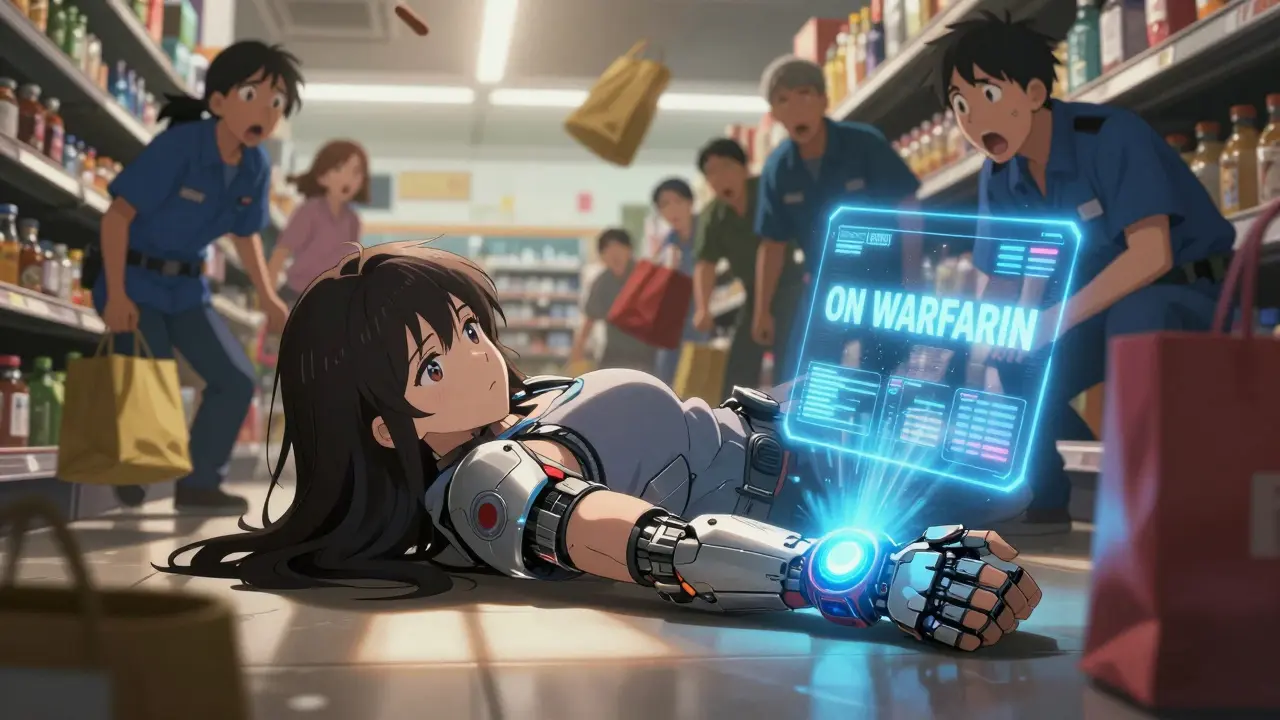
Imagine this: you collapse in a grocery store. No one knows you’re on warfarin. The paramedics arrive, see you’re pale and confused, and start giving you a drug to stop bleeding - the exact same drug that could make you bleed out. But then, someone notices your bracelet. It says: ON BLOOD THINNERS. Suddenly, everything changes. That small piece of metal saved your life.
Medical alert bracelets aren’t fashion accessories. They’re emergency lifelines. And when it comes to drug safety, they’re often the only thing standing between a patient and a deadly mistake.
Why Your Medications Could Kill You in an Emergency
One in three emergency room errors involves medication. That’s not a guess - it’s from a 2022 study in the Journal of Emergency Medicine. These aren’t minor mix-ups. They’re life-or-death mistakes: giving insulin to someone who’s not diabetic, administering penicillin to someone allergic, or pouring blood thinners into someone already on warfarin.
When you’re unconscious, confused, or too sick to speak, doctors can’t ask you what you’re taking. They don’t have time to call your pharmacy. They don’t have access to your electronic records. In those first critical minutes, they rely on one thing: what’s written on your wrist.
That’s why the American College of Emergency Physicians says every first responder is trained to check wrists and necks the moment they arrive. It’s standard procedure. And for good reason - in 89% of cases where a medical ID is present, responders use it correctly. That’s not luck. That’s design.
What You Need to Put on Your Bracelet (And What You Shouldn’t)
Not all information is created equal. If you write everything you take, your bracelet becomes useless. Too much text. Too hard to read. First responders need to scan, understand, and act - in seconds.
According to ACEP and MedicAlert Foundation guidelines, prioritize in this order:
- Drug allergies - especially penicillin, latex, sulfa drugs, and NSAIDs like aspirin or ibuprofen. Penicillin alone affects 10% of Americans. One wrong dose can trigger anaphylaxis.
- Current medications that change emergency treatment - blood thinners (warfarin, rivaroxaban, apixaban), insulin, seizure meds, and steroids. Warfarin users alone number 2.9 million in the U.S. Giving them a clot-busting drug during a stroke? That’s a death sentence.
- Chronic conditions requiring specific protocols - Type 1 vs. Type 2 diabetes, kidney failure, or heart disease. A diabetic in shock needs glucose - not insulin. If your bracelet doesn’t say which type you have, they might do the wrong thing.
Traditional metal bracelets only hold 3-5 items. That’s why 68% of orders from the ID Band Company focus on medications - not just “diabetic” or “allergic,” but which drug. If you’re on apixaban, write “APIXABAN.” If you’re allergic to codeine, write “ALLERGIC TO CODEINE.” No abbreviations. No jargon.
QR Code Bracelets: The New Standard for Drug Safety
Engraving has limits. What if you take seven medications? Or have three allergies? Or need to list drug interactions?
Enter QR code bracelets. Launched in 2018 by MedicAlert Foundation, these let you link to a full digital profile. Scan the code with a phone, and responders see your complete medication list, dosages, allergies, doctors, emergency contacts - even your pharmacy’s phone number.
And it gets better. Since January 2024, MedicAlert’s SmartProfile system syncs with pharmacy databases. If your doctor changes your warfarin dose, your bracelet updates automatically. No more forgetting. No more outdated info.
That’s huge. A 2023 Johns Hopkins audit found 19% of traditional bracelets had outdated or incomplete info. That’s dangerous. A QR bracelet doesn’t just store your data - it keeps it current.
Real Stories: When a Bracelet Was the Only Thing That Saved Them
On Reddit, user ‘AllergicAmy’ posted about her 2022 emergency. She had appendicitis. The ER team was about to give her penicillin. Then they saw her bracelet: ANAPHYLACTIC TO PENICILLIN. The nurse told her later: “We were minutes away from giving you the wrong drug. You’d have been dead in ten.”
Trustpilot reviews for MedicAlert show 4.7 out of 5 stars. Over 60% of users say they bought it because of drug safety. One man on warfarin said his bracelet stopped a hospital from giving him an IV of saline with potassium - a combo that could’ve stopped his heart. Another woman with Type 1 diabetes says her bracelet prevented a coma during a seizure. She’d passed out. They thought she was drunk. The bracelet said “INSULIN DEPENDENT.” They gave her glucose. She woke up.
But it’s not perfect. Some users complain. One wrote: “My bracelet only said ‘ON BLOOD THINNERS.’ They still had to run tests to find out which one. Took 45 minutes.” That’s the problem with vague info. Be specific. Name the drug.
Who Needs One Most - And Why
You don’t have to be elderly to need this. You don’t have to be sick. You just have to take something that could hurt you if given wrong.
According to the 2024 National Health Interview Survey:
- 41% of warfarin users wear one
- 33% of people with severe allergies do
- 28% of diabetics have one
But here’s the thing: if you take any blood thinner, insulin, seizure meds, or have a serious allergy - you’re in the top 10% of people who benefit most. And if you’re over 65? You’re even more at risk. The National Council on Aging found 73% of medical ID-related emergencies happen when people are away from home - shopping, traveling, walking the dog.
It’s not about being “old.” It’s about being smart.

Cost, Setup, and What to Avoid
Traditional metal bracelets start at $49.99. QR code versions start at $69.99 - but they require a $59.99 annual membership to keep your digital profile active. Medical Guardian’s 2025 system - which links your bracelet to a 24/7 monitoring service - costs $29.95/month.
Don’t get the cheapest one just because it’s cheap. A poorly engraved bracelet is worse than none. If the text is too small, if the info is vague, if it’s made of cheap metal that rusts - it won’t help.
Also, update it. The American Pharmacists Association says 35% of people never update their bracelets after a med change. That’s like having a GPS that still thinks you live in 2018. Set a calendar reminder. Every time your doctor changes your meds, change your bracelet.
And choose a provider with good support. MedicAlert Foundation scored 4.3/5 in customer service in a 2024 J.D. Power study. Smaller companies? Average 3.1/5. You don’t want to be stuck with a broken bracelet and no one to help.
The Future: When Your Bracelet Talks to Your Doctor
The next leap isn’t just QR codes. It’s integration. Epic Systems and Cerner - the two biggest electronic health record platforms - are building direct links between hospital records and medical ID profiles. When your doctor prescribes a new drug, your bracelet updates itself.
The FDA’s 2023 Medical ID Modernization Initiative is pushing for standardized formats: NDC codes for exact drug identification, clear icons for allergies, and universal symbols first responders can recognize in any state.
And it’s working. Johns Hopkins’ 2024 model predicts medical ID systems could cut medication-related emergency errors by 35% in the next five years.
That’s not science fiction. That’s what’s coming. And if you’re on meds that could kill you if given wrong - you need to be ready.
Final Thought: It’s Not About Being Paranoid. It’s About Being Prepared.
You don’t wear a seatbelt because you think you’ll crash. You wear it because you might. Same with a medical alert bracelet. You don’t need it every day. But if you need it once? It could be the difference between life and death.
So ask yourself: if you collapsed right now, would the people helping you know what’s in your body? Would they know what not to give you? If the answer is no - then you’re already at risk.
It’s not expensive. It’s not complicated. And it doesn’t take long. But it might save your life.
Do medical alert bracelets really work in emergencies?
Yes - and the data proves it. First responders are trained to check for medical IDs during emergencies. In 89% of cases where a bracelet is present, responders use the information correctly. Studies show medical IDs reduce medication errors by up to 28% in unconscious patients. Real-world cases, like preventing a penicillin reaction or avoiding a dangerous drug interaction with blood thinners, are documented in emergency departments across the U.S.
What’s the most important thing to include on a medical alert bracelet?
Drug allergies and current medications that affect emergency treatment. Specifically, list the exact drug names: "ALLERGIC TO PENICILLIN," not just "ALLERGIC." For medications, write "ON WARFARIN," not just "BLOOD THINNER." These details tell responders exactly what not to give you - and what treatment to avoid. Prioritize these over general conditions like "DIABETIC" unless you also specify Type 1 or Type 2.
Should I get a traditional engraved bracelet or a QR code one?
If you take more than three medications, have multiple allergies, or change drugs often - go with QR code. Traditional bracelets only hold 3-5 items, and vague info like "ON BLOOD THINNERS" can still lead to dangerous delays. QR bracelets link to a full digital profile with dosages, pharmacy info, and emergency contacts. With automatic updates (like MedicAlert’s SmartProfile), your info stays current without you lifting a finger.
Can I wear a medical alert bracelet if I’m young?
Absolutely. Age doesn’t matter - medication use does. A 28-year-old on warfarin after a blood clot, a 30-year-old with severe penicillin allergy, or a 25-year-old with Type 1 diabetes all need one. The National Council on Aging found 73% of emergencies happen when people are away from home - shopping, hiking, or traveling. Younger people are just as likely to be caught off guard.
What if I forget to update my bracelet after changing meds?
That’s a real risk - 35% of users don’t update their bracelets after a med change, according to the American Pharmacists Association. The solution? Use a QR bracelet with automatic syncing. Services like MedicAlert’s SmartProfile connect to pharmacy databases and update your profile when your doctor changes your prescription. If you’re using a traditional bracelet, set a calendar reminder every time you get a new script. A simple monthly check can prevent life-threatening errors.

So let me get this straight - we’re telling people to wear a metal bracelet like it’s a TikTok trend? 🤦♀️ I got my mom one for Christmas. She thought it was a ‘fashion statement’ and paired it with her floral sundress. Now she’s out there looking like a walking pharmacy ad. At least she’s alive. That’s win enough, I guess.
Also, QR codes? Please. My grandpa tried scanning his. Thought it was a coupon for free coffee. He’s still mad he didn’t get a latte.
Life is a river, my friends… and sometimes, the river forgets its own name. 🌊
That little bracelet? It’s not metal. It’s a mantra whispered by the soul before the storm. When the world goes silent and the body betrays you - the wrist remembers what the mind cannot. 💫
It’s not about drugs. It’s about dignity. About being seen - even when you’re unseen.
So wear it. Not for the ER. Not for the paramedics. But for the quiet part of you that still believes… someone will notice.
And if they don’t? Then you were never really lost. You were just waiting… for someone brave enough to read.
Yikes. I had no idea this was a thing. I’m 32, on Eliquis, and I’ve been wearing my Fitbit like it’s a status symbol. 🤡
Just got one of those QR ones. Took 3 minutes to set up. Linked it to my pharmacy. My doc even got a notification. Wild.
Also, my dog just licked it. He’s fine. So I guess it’s not radioactive? Good to know.
Wear one. Simple. Done.
Medicine is a temple. The body is its altar. And the bracelet? A sacred inscription - not of names, but of warnings carved into the flesh of modernity.
Do you know what it means to be forgotten in a hospital? To be a number, a chart, a void?
This is not about safety. It is about sovereignty. The right to be known - even when you cannot speak.
Those who dismiss this as ‘fashion’ do not understand death. They think it waits. It does not. It knocks - quietly - with a syringe.
Wow. Another feel-good PSA from the medical-industrial complex. QR codes? Subscription fees? $69.99 just to tell them you’re on blood thinners?
Let me guess - next they’ll sell us smart socks that ping the hospital when we trip.
Real solution? Train ER staff to ask questions. Or better yet - stop prescribing so many damn drugs in the first place.
Also, ‘MedicAlert Foundation’? Sounds like a cult. With a website.
I got mine after my cousin almost died from a mix-up with his seizure meds. He was 24. No one knew he was on Keppra. He woke up in ICU. Scary stuff.
Now I nag my whole family to get one. My brother’s on warfarin. My sister’s allergic to penicillin. My niece? Type 1. We’re basically a walking medical alert convention now 😆
It’s not about being dramatic. It’s about being smart. And honestly? It’s kind of empowering. Like you’re saying: ‘I’m still here. And I’ve got your back - even if I’m unconscious.’
Also - get the QR one. The auto-update feature? Chef’s kiss. 🙌
This is why the West is collapsing. You turn a life-saving tool into a marketing campaign. QR codes? Subscriptions? You’re turning survival into a SaaS product.
In India, we don’t need fancy tech. We have family. We have community. We remember who takes what. No bracelet needed.
And if you’re too lazy to tell someone what meds you’re on? Then maybe you shouldn’t be alive.
Also - why are Americans so obsessed with being ‘prepared’? You think a metal band makes you safe? It doesn’t. It just makes you look like a robot.