
When you pick up a prescription at your local pharmacy, you might not think twice if the pill looks different from last time. That’s generic substitution-and it’s happening right now in millions of pharmacies across the country. But if you were hospitalized last week and got the same medication on discharge, the process behind that switch was completely different. Retail and hospital pharmacies don’t just serve different settings-they follow entirely different rules when it comes to swapping one drug for another. Understanding these differences isn’t just for pharmacists. It matters for your safety, your bills, and how well your treatment works.
How Substitution Works in Retail Pharmacies
In a retail pharmacy, substitution is mostly about cost. When your doctor prescribes a brand-name drug like Lipitor, the pharmacist can legally swap it for the generic version, atorvastatin, unless your doctor checks "do not substitute" on the prescription or you say no. This isn’t optional-it’s built into state law. All 50 states allow pharmacists to make this switch, and insurance companies push hard for it. In fact, 92.4% of retail pharmacists say insurance formulary rules are the main reason substitutions happen. The numbers back this up. According to the 2023 IQVIA National Prescription Audit, about 90.2% of eligible prescriptions in retail settings are filled with generics. That’s over 5.8 billion prescriptions a year. And it saves the system roughly $317 billion annually. That’s real money. But here’s the catch: the decision is made by the pharmacist at the counter, often with little time or context. You might not even know it happened until you see the label. States require some level of patient notification. Thirty-two states demand a verbal warning. Eighteen require written consent the first time you get a generic. But many people don’t remember the conversation. A 2023 Consumer Reports survey found that 14.3% of patients didn’t realize they’d been switched-and some worried the new pill wasn’t as strong. That confusion can lead to missed doses or unnecessary calls to the doctor. Retail pharmacists also deal with insurance hurdles. Prior authorizations, formulary changes, and step therapy rules can delay your prescription for hours-or days. One pharmacist on Reddit described calling the insurer three times just to get approval for a generic version of a blood pressure med. That’s not clinical care. That’s paperwork.How Substitution Works in Hospitals
In a hospital, substitution isn’t a transaction. It’s a clinical decision. You won’t see a pharmacist handing you a different pill at the window. Instead, a team of doctors, pharmacists, and nurses meets regularly on a Pharmacy and Therapeutics (P&T) committee to decide which drugs belong on the hospital’s formulary. If a cheaper, equally effective drug is available-say, switching from brand-name vancomycin to a generic version-they’ll update the protocol across the entire system. This isn’t about saving money alone. It’s about improving care. A 2022 ASHP survey found that 84.6% of hospital pharmacists say patient-specific clinical factors drive substitution-not insurance. Maybe a patient has kidney issues, and one drug is safer. Maybe a new antibiotic has fewer side effects. The goal is to match the right drug to the right patient, using the best evidence. And it’s not just pills. Hospital substitution includes IV drugs, biologics, and complex compounded formulas. In fact, 68.4% of hospital therapeutic interchanges involve injectables or other non-oral forms-something retail pharmacies almost never handle. That’s because hospital pharmacists work inside the medical record. Every substitution is documented in the EHR, triggers alerts for prescribers, and gets flagged for follow-up. If a patient gets switched from one antibiotic to another, the attending physician gets notified within 24 hours-required by Joint Commission standards. The scale is smaller but more targeted. Hospitals handle about 1.2 billion medication orders a year, with substitutions occurring in 28.7% of eligible cases. That’s far fewer than retail-but the impact is deeper. Hospitals using structured substitution protocols have seen up to a 23% drop in C. difficile infections after switching to narrower-spectrum antibiotics. That’s not just cost savings. That’s lives saved.Who Decides? Pharmacists vs. Teams
This is the biggest difference. In retail, the pharmacist alone makes the substitution call. They’re trained, licensed, and legally authorized. But they’re also juggling 10 other patients, insurance calls, and a line out the door. The decision is fast, transactional, and often influenced by what the insurance plan allows. In hospitals, no single pharmacist decides. It’s a committee. A P&T committee reviews clinical data, cost, safety profiles, and outcomes. They vote. They update protocols. They train staff. Then, when a pharmacist sees a prescription for a drug that’s been replaced on the formulary, they don’t just swap it-they check if the doctor knows. If not, they call. They don’t assume. They verify. That’s why hospital pharmacists need more clinical training. A 2022 ASHP survey found 89.3% of hospital pharmacy directors prioritize therapeutic expertise over communication skills. In retail? It’s the opposite. Ninety-four point seven percent of retail managers say communication is the most critical skill for substitution success. Because in retail, you’re selling trust. In hospital, you’re managing risk.
What Drugs Can Be Substituted?
Not all medications are created equal when it comes to substitution. Retail pharmacies mostly swap oral tablets and capsules. Over 97% of retail substitutions are for pills you take by mouth. That’s because generics for these drugs are well-studied, stable, and easy to match. Hospitals deal with far more complexity. They substitute IV antibiotics, insulin formulations, chemotherapy agents, and even biologics-drugs made from living cells that are harder to copy. In fact, 22.1% of hospital therapeutic interchanges involve biologics or complex injectables. That’s rare in retail. Only 12.7% of specialty drugs in retail are even eligible for substitution, according to Express Scripts. And then there’s the issue of clinical trials. If you’re in a study testing a new drug, substitution is almost always forbidden. Eighty-seven percent of clinical trials prohibit any drug swap, even if it’s generic. Hospitals have strict protocols to prevent this. Retail pharmacies? They don’t know you’re in a trial unless you tell them.What Happens When You Leave the Hospital?
Here’s where things get dangerous. A patient gets discharged after a week in the hospital, switched from brand-name warfarin to a generic version as part of the hospital’s formulary. The discharge summary says “warfarin 5mg daily.” But the retail pharmacy, unaware of the hospital’s protocol, fills it with a different generic brand-because that’s what’s cheapest on the insurer’s list. The patient takes it. Their INR level spikes. They end up back in the ER. This isn’t hypothetical. The Institute for Safe Medication Practices found that 23.8% of medication errors during hospital-to-home transitions involve substitution mismatches. That’s one in four. And it’s because the two systems don’t talk to each other. That’s changing. Since 2023, 48.3% of hospitals now have formal medication reconciliation programs that include substitution history. And 37.6% of retail chains have started follow-up calls for discharged patients. But it’s still patchy. The 2023 CMS Interoperability Rule, effective July 2024, will force electronic health records to share substitution data between settings. That’s a big step forward.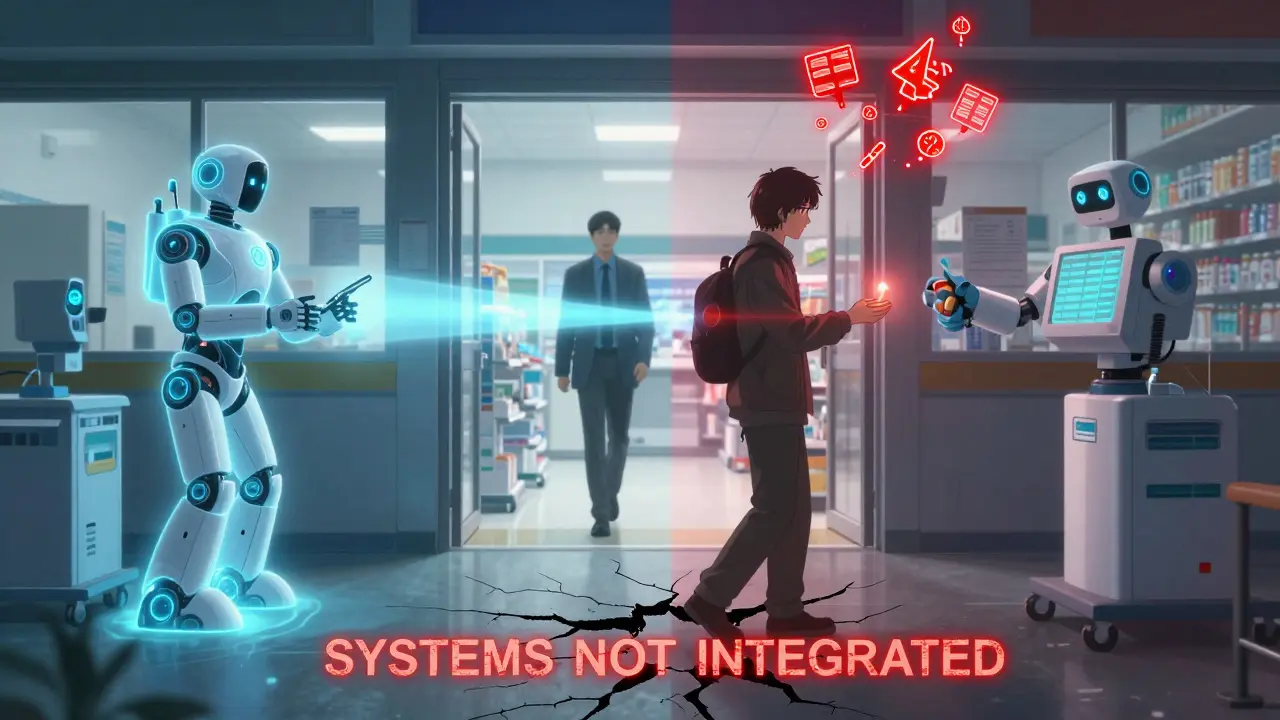
What’s Next for Substitution Practices?
The future is integration. Epic and Cerner are building EHR modules that will automatically flag substitution changes made in hospitals and send them to community pharmacies. By 2025, if you’re switched to a different generic in the hospital, your local pharmacy will see it in your profile. Biosimilars are also coming into play. Twenty-three states now have laws allowing pharmacists to substitute biosimilars for brand-name biologics-like switching from Humira to a biosimilar. But hospital and retail rules for biosimilars still differ. Hospitals require physician approval. Retail pharmacies can substitute without asking-unless you opt out. The bottom line? Retail substitution is about access and affordability. Hospital substitution is about safety and precision. One isn’t better than the other-they serve different purposes. But when they don’t align, patients pay the price.What You Can Do
If you’re switching from hospital to home care:- Ask your discharge pharmacist: "Was my medication changed in the hospital? What’s the new name?"
- Bring your discharge summary to the retail pharmacy. Don’t assume they’ll know.
- Ask: "Is this the same drug I was on in the hospital?" Even if the name is the same, the manufacturer might be different.
- If you’re on a biologic or specialty drug, confirm with your doctor before any switch.
Can a retail pharmacist refuse to substitute a generic drug?
Yes. Even though most states allow pharmacists to substitute generics, they can choose not to if they believe it’s unsafe or inappropriate. For example, if a patient has had a bad reaction to a specific generic brand in the past, or if the drug is one with narrow therapeutic windows like warfarin or levothyroxine, the pharmacist may hold the prescription and contact the prescriber. Some pharmacists also refuse if the patient explicitly asks not to be substituted.
Why do hospital pharmacies use therapeutic interchange instead of simple substitution?
Therapeutic interchange in hospitals isn’t just swapping one generic for another-it’s replacing one drug class with another based on clinical evidence. For example, switching from an older antibiotic to a newer one that’s more effective or has fewer side effects. This requires committee approval, clinical guidelines, and physician notification. It’s done to improve outcomes, not just cut costs. Retail substitution is mostly about cost and insurance rules, while hospital interchange is about optimizing care within a patient’s full treatment plan.
Are generic drugs really the same as brand-name drugs?
By FDA standards, yes. Generics must contain the same active ingredient, strength, dosage form, and route of administration as the brand. They must also meet the same quality and manufacturing standards. But there can be minor differences in inactive ingredients-like fillers or dyes-which can affect how a drug is absorbed in rare cases. That’s why some patients notice differences with drugs like levothyroxine or seizure medications. That’s not the generic’s fault-it’s about individual sensitivity.
Do insurance companies force substitution in hospitals too?
Not in the same way. Hospitals don’t bill insurance per prescription like retail pharmacies do. Instead, they negotiate bulk contracts with drug manufacturers. Cost matters, but it’s balanced against clinical outcomes. The 340B Drug Pricing Program gives hospitals discounted prices on certain drugs, which often drives substitution decisions-but always within clinical guidelines. Insurance doesn’t dictate what’s on the hospital formulary. The P&T committee does.
How can I tell if my medication was substituted?
Check the label. Generic drugs are required to list the active ingredient clearly. If the name on the bottle is different from what your doctor wrote, it’s likely a substitution. You can also look up the pill’s imprint code on websites like Drugs.com or ask your pharmacist directly. If you’re unsure, call your doctor’s office to confirm. Don’t rely on appearance alone-color and shape can change even within the same generic brand.

Man, I never realized how wild it is that your pharmacy can swap your meds without you even noticing. I got switched from one generic to another last month and thought my anxiety was getting worse-turns out the filler was different. Took me weeks to figure it out. Just saying-patients deserve better transparency.
Substitution isn’t the issue. Lack of communication between hospital and retail systems is.
Y’ALL. I just got discharged last week and they switched my blood thinner. I didn’t know. I took it. My arm went numb. I had to go back. Don’t let this happen to you. ASK QUESTIONS. Bring your discharge sheet. Your life matters.
Oh wow, so pharmacists are just glorified clerks in retail? Meanwhile hospital folks are saving lives with their fancy committees? Groundbreaking. I guess the 92% generic rate is just a sign of how lazy we’ve become as a society. Maybe if people stopped demanding cheap meds, we wouldn’t need this whole circus.
Let’s be real-this is a regulatory fragmentation crisis. The disconnect between EHR systems, formulary alignment, and payer-driven substitution protocols creates a perfect storm for iatrogenic harm. Especially in polypharmacy populations. We need interoperable substitution audit trails-stat.
Everyone’s acting like this is new. In 2018, I worked as a pharmacy tech in a hospital and we had to manually override substitution flags because the retail pharmacy kept switching my patient’s levothyroxine. The INR spiked. She almost bled out. This isn’t a ‘system issue’-it’s negligence. And no, the CMS rule won’t fix it unless they mandate real-time alerts. Which they won’t, because money.
OMG I JUST HAD THIS HAPPEN 😭 I was on brand-name Plavix in the hospital, got switched to generic, discharged, pharmacy gave me a DIFFERENT generic, I had a mini-stroke. I’m alive but my insurance won’t cover the rehab. Like… why is this still a thing?? 🥲💔 #PharmacyFail
So basically retail pharmacists are just playing Russian roulette with your life while hospital ones are doing brain surgery? And we’re supposed to be grateful? I’m done. I’m switching to telehealth and having my meds shipped from Canada. At least they don’t pretend to care.
It’s not just the substitution-it’s the silence. No one tells you. No one checks. You’re just handed a pill and told to trust it. I’ve been on the same meds for 12 years and I still get scared when the color changes. I cry every time. I know I shouldn’t. But I do. And no one ever asks if I’m okay.
America’s healthcare system is a joke. We let corporations decide what medicine you get. In Germany, they don’t do this. In Japan, they don’t do this. We’re the only country where a pharmacist can swap your heart med because it’s 17 cents cheaper. We’re not just broken-we’re ashamed.
Listen. I’m a nurse. I’ve seen this kill people. Not because generics are bad-but because we treat medication like a vending machine. You don’t just drop in a dollar and get a snack. You’re getting a chemical that changes your brain, your heart, your liver. If your hospital switched your drug, tell your retail pharmacy. Write it on your hand if you have to. Don’t assume. Don’t wait. Speak up. You’re not being difficult-you’re being alive.
As someone who works in pharmacy informatics, I can tell you: the real win is in the 37.6% of retail chains now doing follow-up calls. That’s progress. We’re not there yet, but we’re building bridges. And if you’re a patient-you’re part of that bridge. Your voice matters more than any algorithm. Keep asking. Keep advocating. You’re not alone.
Think about it this way: retail pharmacy is capitalism in action-optimize for cost, maximize throughput. Hospital pharmacy is medicine in action-optimize for safety, maximize outcomes. The conflict isn’t accidental. It’s structural. We’ve outsourced care to market logic. And now we’re surprised when people get hurt. Maybe the real question isn’t how to fix substitution-but how to fix a system that sees people as line items.
Why do we even need two systems? Why can’t one pharmacy handle everything? Why does discharge mean starting over? It’s absurd. And the fact that we accept this as normal is the real tragedy.
Actually, the whole ‘generic substitution’ thing is a scam. The FDA allows 20% variability in absorption for generics. That’s not ‘same drug’-that’s ‘close enough’. And the fact that people think this is safe is why we’re dying in droves. Wake up. The system is rigged. You’re not getting the same pill. You’re getting a gamble.