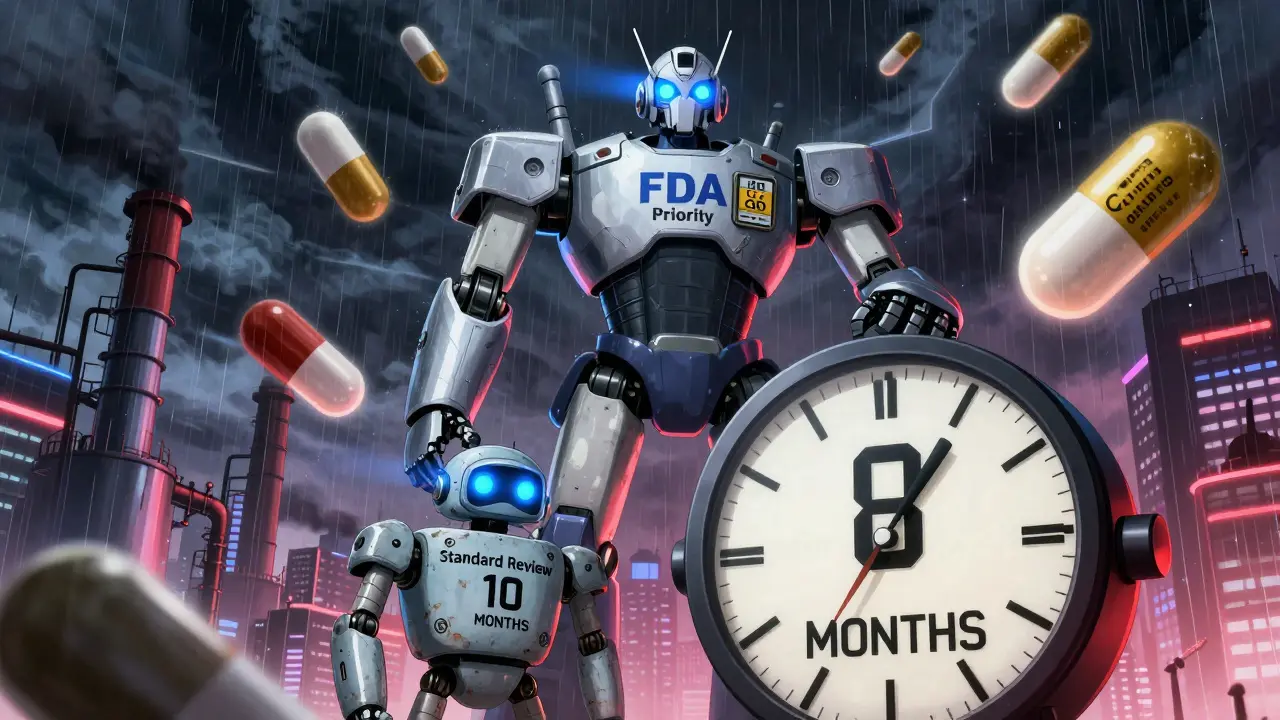
The U.S. Food and Drug Administration doesn’t treat every generic drug application the same. If you’re a manufacturer trying to bring a low-cost version of a brand-name drug to market, your application could be stuck in standard review-a 10-month wait-or fast-tracked under priority review, cutting that time to just 8 months. That two-month difference isn’t just paperwork. It can mean millions in revenue, access for patients in shortage, or even saving lives. So how does the FDA decide which apps get priority?
What’s the Difference Between Priority and Standard Review?
The FDA’s review system for generic drugs, called ANDAs (Abbreviated New Drug Applications), has two clear lanes: standard and priority. Both follow the same science-checking that the generic matches the brand in strength, safety, and effectiveness. But the clock starts differently.Standard review gives you 10 months from the day your application is officially filed. That’s the default path for most generics. Priority review? You get 8 months. Sounds simple, right? But you don’t just ask for it. You have to qualify.
The rules come from GDUFA III-the Generic Drug User Fee Amendments that kicked in on October 1, 2022, and run through 2027. This isn’t just bureaucracy. It’s a structured system designed to balance speed with safety. In 2022, 72.3% of standard review applications met their 10-month deadline. For priority, it was 83.1%. That gap? It’s not random. It’s because priority applications are usually cleaner, better prepared, and often tied to urgent needs.
Who Gets Priority Review?
Not every generic gets a speed pass. The FDA only gives priority review to specific cases:- First generics-the very first version approved after a brand-name drug’s patent expires. This is the big one. First-to-file companies get 180 days of market exclusivity. That’s why so many companies race to submit. In 2022, 92.7% of first generics qualified for priority review.
- Drugs in shortage-if the FDA’s Drug Shortage List says a medication is in critical supply, any generic application for it gets priority. In 2022, over 150 drugs were on that list, including antibiotics, insulin, and heart medications.
- Medically important advances-if your generic offers something better than what’s already out there-like fewer side effects, easier dosing, or better stability-it can qualify. This is rare but growing.
These aren’t guesses. The FDA tracks them using the Orange Book, a public database of patents and exclusivity periods. If your drug is the first to hit the market after exclusivity ends, you’re likely eligible. Miss the window? You’re back in standard review.
The New U.S. Manufacturing Pilot: A Game Changer
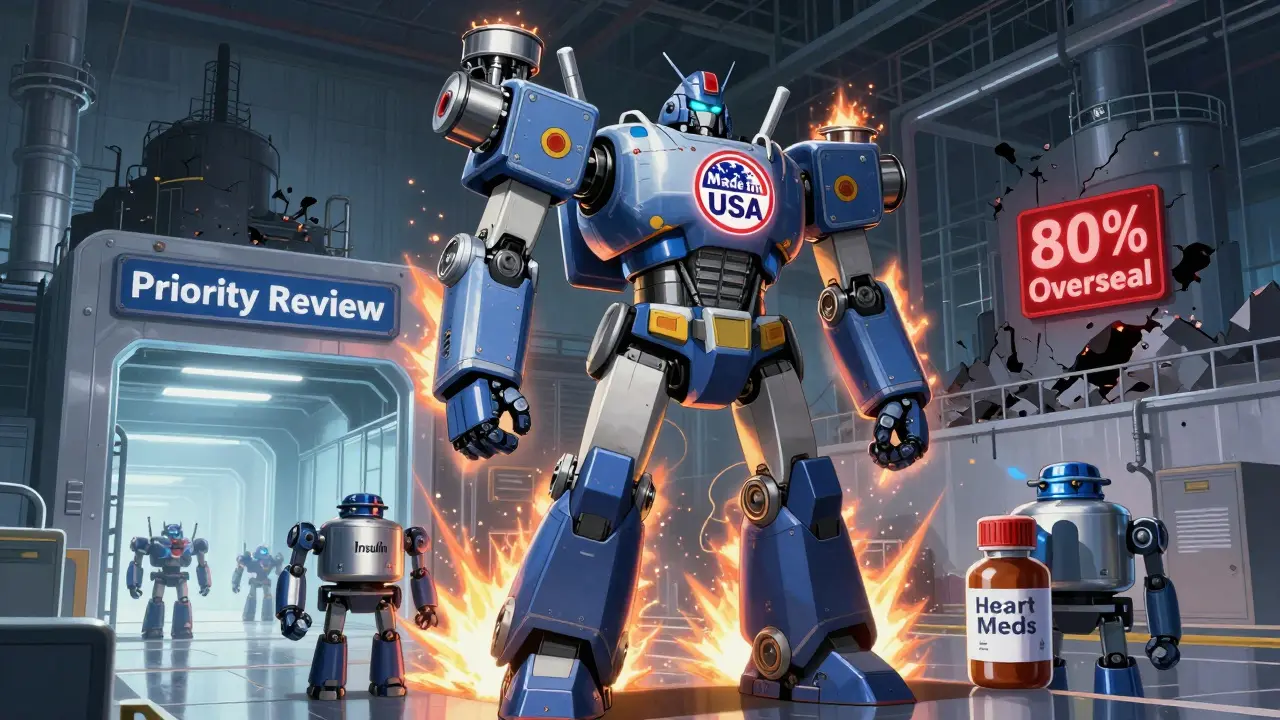
In October 2023, the FDA dropped a bombshell: the ANDA Prioritization Pilot Program. It’s not just about speed anymore-it’s about where the drug is made.If you want priority review, you now have a new option: prove your drug is made in the U.S. All the way. That means:
- Active pharmaceutical ingredients (APIs) sourced from U.S. suppliers
- Finished dosage forms (pills, injections, inhalers) manufactured in U.S. facilities
- Bioequivalence testing done in the U.S. (or with a valid waiver)
This isn’t a suggestion. It’s a requirement for the pilot. And it’s a direct response to the pandemic. In 2021, the FDA found that 80% of APIs came from overseas-mostly India and China. When global supply chains broke, shortages spiked. Now, the FDA is betting on U.S. production.
Here’s the catch: only 12.3% of generic manufacturers currently meet all three criteria, according to FDA facility data. That’s why big players like Teva and Sandoz are already shifting operations. Contract labs like PPD and Covance saw a 35% jump in U.S.-based bioequivalence studies in 2023. Companies are spending millions to build U.S. labs and factories just to cut 60 days off their review clock.
Why This Matters for Patients and Prices
Generic drugs make up 88.6% of all prescriptions in the U.S. but only 15.3% of total drug spending. That’s how the system keeps healthcare affordable. But if a first generic takes 2.7 years to hit the market after patent expiry-like it did in 2022-patients pay brand prices longer.Prioritizing faster approvals means more competition, faster. In 2022, the FDA approved 1,132 generic products-a 17.3% jump from 2021. Priority review applications grew twice as fast as standard ones. That’s not coincidence. It’s strategy.
For manufacturers, the financial stakes are huge. One regulatory expert estimated that a two-month head start on a blockbuster generic can mean $200-500 million in extra revenue. For a company like Hikma, that might mean $120 million on a single cardiovascular drug. For patients? That’s lower prices, sooner.
Why Most Applications Get Rejected-And How to Avoid It
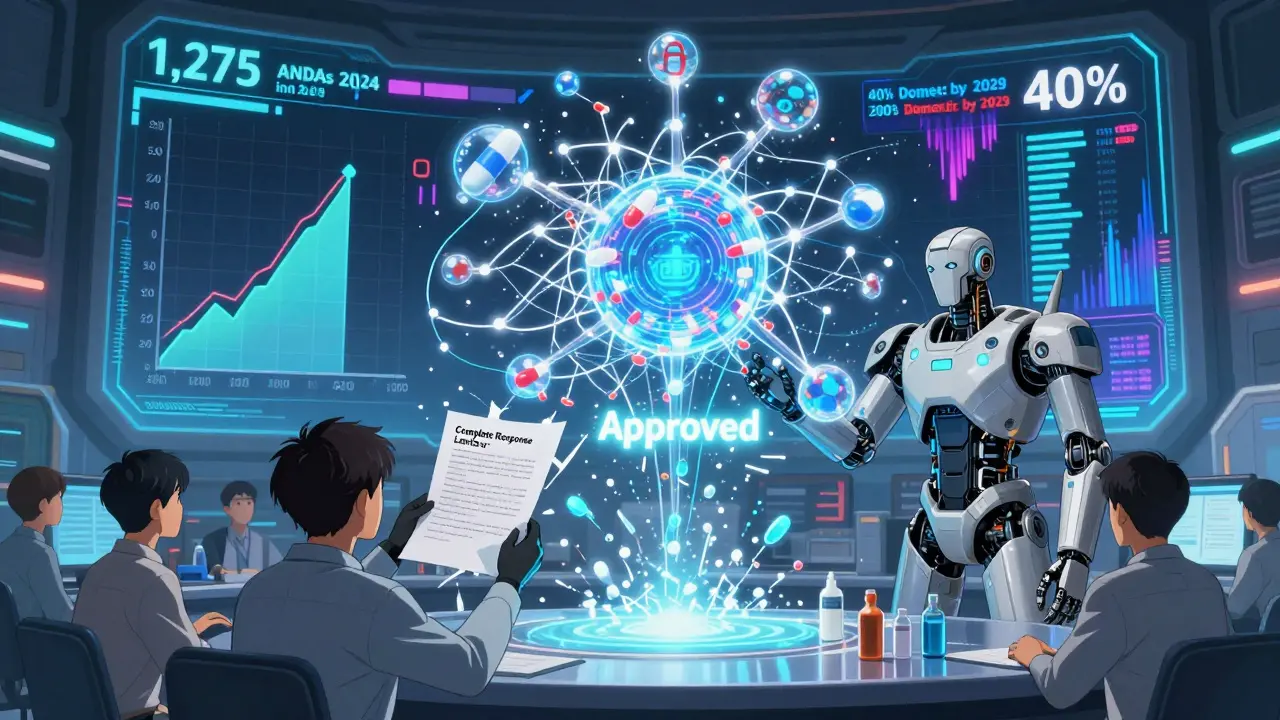
Even if you qualify for priority review, your application can still get rejected. In 2022, 31.7% of ANDAs got a Complete Response Letter (CRL)-meaning the FDA found serious flaws. The biggest problem? Chemistry, Manufacturing, and Controls (CMC). That’s 47.2% of all rejections.What does that mean? Your pill doesn’t dissolve the same way. Your packaging doesn’t protect the drug. Your manufacturing process isn’t consistent. These aren’t minor issues. They’re deal-breakers.
That’s why more companies are using pre-submission meetings with the FDA. In 2020, only 41% did. By 2023, it was 63%. These meetings let you ask the FDA: “Will this work?” before you spend $164,880 on a filing fee. Companies that used them saw their first-cycle approval rate jump from 24.1% to 38.7%.
For complex generics-like inhalers, topical creams, or extended-release tablets-the FDA launched a separate pilot in January 2023. These products are harder to copy. They account for 18.3% of pending applications but only 9.7% of approvals. The pilot gives early feedback, cutting years off development time.
What’s Next? AI, More Applications, and Bigger Goals
The FDA isn’t slowing down. In 2024, it expects to receive 1,275 ANDA applications-a 12.5% increase. Priority reviews are projected to make up 32.8% of all submissions, up from 28.4% in 2022.And here’s the next big thing: AI. The FDA is testing AI tools to speed up review of simple applications. In internal tests, AI cut review times by 18.7%. That’s not replacing scientists-it’s handling the repetitive parts: checking labeling consistency, flagging missing data, matching chemical structures. By late 2024, it could be rolling out.
The long-term goal? Get 40% of U.S. generic drugs made domestically by 2029. Right now, it’s 28%. That’s not just about supply chains-it’s about national health security. The Biden administration’s 2021 executive order called pharmaceutical manufacturing a critical vulnerability. 97% of antibiotics and 93% of antivirals rely on foreign production.
With the pilot, the FDA isn’t just reviewing drugs. It’s reshaping an entire industry. And the clock is ticking-for manufacturers, for patients, and for the future of affordable medicine.
What’s the difference between priority review and standard review for generic drugs?
Priority review for generic drugs (ANDAs) has a target timeline of 8 months from submission, while standard review is 10 months. Priority review is only given to applications that meet specific criteria, such as being the first generic for a brand-name drug, addressing a drug shortage, or offering a medically important improvement. Standard review applies to all other applications.
How do I qualify for FDA priority review?
To qualify for priority review, your ANDA must meet one of three criteria: (1) It’s the first generic version of a brand-name drug after patent or exclusivity expires, (2) The drug is on the FDA’s official shortage list, or (3) Your product is a medically important advance over existing generics. Additionally, under the 2023 pilot program, you can qualify by proving U.S.-based manufacturing of the API, finished product, and bioequivalence testing.
Why does the FDA prioritize U.S. manufacturing for generic drugs?
The FDA prioritizes U.S. manufacturing to reduce reliance on foreign supply chains, which were disrupted during the COVID-19 pandemic. In 2021, 80% of active pharmaceutical ingredients (APIs) were made overseas, contributing to drug shortages. The ANDA Prioritization Pilot rewards manufacturers who produce APIs, finished dosage forms, and conduct testing in the U.S., aiming to raise domestic production from 28% to 40% by 2029.
What happens if my ANDA application is refused?
If your ANDA is incomplete or doesn’t meet minimum filing standards, the FDA issues a Refuse-to-Receive (RTR) letter. You must fix the issues and resubmit with a new filing fee of $164,880 (as of 2024). RTRs are common-about 20% of initial submissions get rejected. Pre-submission meetings with the FDA can help avoid this.
How long does it take to get a generic drug approved on average?
The FDA’s official goal is 10 months for standard review and 8 months for priority review. But in practice, most applications need multiple review cycles. On average, an ANDA requires 1.7 cycles to get approved, adding about 4.2 months per cycle. So while the target is 8-10 months, the real-world timeline is often 12-16 months, especially for complex products.
Are there tools to help speed up the FDA approval process?
Yes. The FDA now offers pre-submission meetings where companies can get feedback before filing. Companies using these meetings have seen their first-cycle approval rates rise from 24% to 39%. There’s also the Complex Generic Drug Product Pilot for hard-to-copy drugs like inhalers and topical creams. Starting in late 2024, AI tools will help automate parts of the review, potentially cutting 18-20% off review time for straightforward applications.

lol who cares about 2 months? the real issue is 80% of APIs come from china and india and we're still acting like this is normal.
Let me break this down for the laypeople who think 'priority review' is some kind of VIP pass - it's not. It's a corporate incentive program disguised as public health policy. First-to-file generics get 180 days of monopoly profits? That's not innovation, that's regulatory arbitrage. And now they're rewarding U.S. manufacturing? Please. We're not building factories - we're just moving the same toxic supply chain from Mumbai to Milwaukee and calling it 'patriotic.' The FDA isn't fixing the system - it's just rebranding the exploitation.
It’s not about speed - it’s about control. The FDA has become a gatekeeper for Big Pharma’s profit margins. Priority review isn’t about patients - it’s about who can afford the $165k filing fee and the legal team to navigate the Orange Book maze. We’re treating medicine like a chess game where the pieces are patents and the board is the lives of people who can’t afford insulin. And now they want us to cheer because a pill is made in Ohio instead of Hyderabad? What a tragic, corporate fairy tale.
U.S. manufacturing? Please. The only thing 'American' about this is the PR spin. Teva and Sandoz aren't building factories - they're outsourcing to contract labs in Kentucky and calling it 'domestic.' And don't get me started on the bioequivalence testing - half of it's still done overseas under 'waivers.' This pilot is a loophole dressed as a policy. The FDA is just giving Big Generic a tax break and calling it national security. Pathetic.
Okay, let’s talk about the real hero here: the chemist in a basement lab in Ohio who spent 18 months perfecting the dissolution profile of a generic asthma inhaler because the brand-name version kept clogging in humid weather. That’s not a statistic - that’s someone’s life’s work. And yeah, the FDA took 14 months to approve it, but they finally did - and now a kid in rural Alabama can breathe without paying $400 a month. That’s what this is about. Not the $200 million windfalls. Not the ‘priority’ labels. It’s about the quiet people who show up every day to make sure a pill doesn’t just look right - it works right. And we’re not even talking about them.
soo... if i make a generic in the usa, i get priority? cool. but what if i can't afford to build a lab? does that mean my drug just... stays off the market? because that's what it sounds like. the system is rigged for the big guys. again.
So let me get this straight - the FDA is now rewarding U.S. manufacturing… but 80% of APIs still come from overseas? And we're supposed to believe this pilot is about 'national security' when the only thing being secured is the profit margin of companies that still outsource 70% of their production? This isn’t policy. It’s performative patriotism. They’re giving out gold stars for doing the bare minimum. Meanwhile, the guy who actually built the API plant in Pennsylvania got audited by the FDA for 11 months. That’s the real story.
Just had a friend in pharma tell me their company spent $2.3M to move one production line to Indiana - just to qualify for priority review. The drug? A $0.15 tablet for high blood pressure. The savings? Two months. The ROI? Negative. But they did it anyway. Why? Because if you’re not playing the game, you’re not in the game. And if you’re not in the game, your employees get laid off. This isn’t about patients. It’s about survival.
India has been making generics for 50 years - and now we're acting like we're inventing medicine? The FDA's 'pilot' is just a protectionist stunt. U.S. manufacturing is 10x more expensive. So who pays? Patients. Insurance companies. Medicare. This isn't 'health security' - it's economic nationalism disguised as public health. And it's going to hurt the very people it claims to help. We don't need more American-made pills - we need more affordable ones. Even if they're made in Hyderabad.
I get it - we want less reliance on foreign supply chains. But forcing companies to build U.S. labs just to get a 60-day head start? That’s like paying someone extra to show up on time. Meanwhile, the real bottleneck is the FDA’s own staffing. They have 1,200 reviewers for 1,200+ applications. That’s one per day. No wonder things get delayed. Fix the people, not the geography.
My cousin works at a small generic company in Iowa. They got a CRL because the tablet coating had a 0.3% variation in thickness. They spent $400k fixing it. Then got approved - 14 months later. No priority. No fanfare. Just a team of 12 people who didn’t give up. That’s the real story. The FDA doesn’t celebrate them. They just file it and move on.
Let’s not pretend this is about patients. It’s about who can afford the consultants, the legal teams, the FDA pre-submission meetings ($15k each), and the U.S. manufacturing upgrades. Small companies? They’re dead. The FDA’s system is designed to favor the giants - and it’s killing competition. If you want more generics, stop making the rules harder. Stop rewarding the rich. Start punishing the delays.
ai is gonna review apps now? lol. they already have like 5 people doing this and they keep missing stuff. how’s ai gonna fix that? also why is everyone acting like the usa is the only place that can make pills? i’ve seen indian labs - they’re cleaner than my uncle’s basement.
Priority review? More like 'priority for the companies with the best lobbyists.' First generic gets 180 days of monopoly? That’s not innovation - that’s a monopoly subsidy. And now they’re adding U.S. manufacturing as a bonus? So if you’re a small company that can’t afford a U.S. lab, you’re just out of luck? Brilliant. Let’s make healthcare even less accessible. And don’t even get me started on the 31.7% rejection rate - that’s not 'quality control,' that’s bureaucratic extortion.
88.6% of prescriptions are generic. 15.3% of spending. But the FDA lets a few big players game the system to delay competition for years. And we’re impressed by a 2-month head start? That’s like giving a guy a 10-second advantage in a marathon where everyone else is running barefoot. Meanwhile, people are dying because insulin is still $300 because no one else can get approved. This isn’t reform - it’s theater. And the FDA? They’re the ones holding the spotlight.