
When you walk into a doctor’s office, ER, or hospital, one of the most important things you can do isn’t something they ask you to do-it’s something you need to remember to bring: your full, accurate medical history. Not just the big stuff like diabetes or heart disease. Not just your prescriptions. But everything. Including that fish oil you take every morning, the ibuprofen you pop for headaches, the herbal tea your aunt swears by for sleep, and the over-the-counter antacid you’ve been using for months because your stomach feels off.
Why does this matter so much? Because medication reconciliation isn’t just a box-checking exercise for hospitals. It’s the single most effective way to stop dangerous drug mistakes before they happen. Every year, tens of thousands of people in the U.S. are harmed-or worse-because someone didn’t know they were taking a medication that clashed with another. These aren’t rare errors. They’re common, preventable, and often happen right at the moment you’re most vulnerable: when you’re admitted to the hospital, transferred between units, or sent home with new prescriptions.
Studies show that up to 50% of all medication errors occur during care transitions. That’s when your care moves from one provider to another-like from your family doctor to the ER, or from the hospital back to your home. And here’s the scary part: about 20% of those errors cause real harm. For people taking five or more medications, the risk of a dangerous mix-up jumps by 88%. If you’re on blood thinners, insulin, or heart meds, your odds of a serious reaction go up even more.
Technology helps. Hospitals now use systems that pull your medication history from pharmacies across the country. Surescripts, one of the biggest networks, delivers over 3 billion medication records annually. These systems can tell your doctor you’re taking a drug from a pharmacy in Texas while you’re being treated in Ohio. But here’s the catch: those systems only work if they have the right data. And they often miss the stuff you buy without a prescription.
Up to 67% of patients don’t tell their doctors about over-the-counter meds. That’s not because they’re hiding anything. It’s because they don’t think it counts. But aspirin can thin your blood. St. John’s wort can make your antidepressant useless. Calcium supplements can interfere with thyroid meds. And if your doctor doesn’t know you’re taking them, they might prescribe something that turns your body into a chemical battlefield.
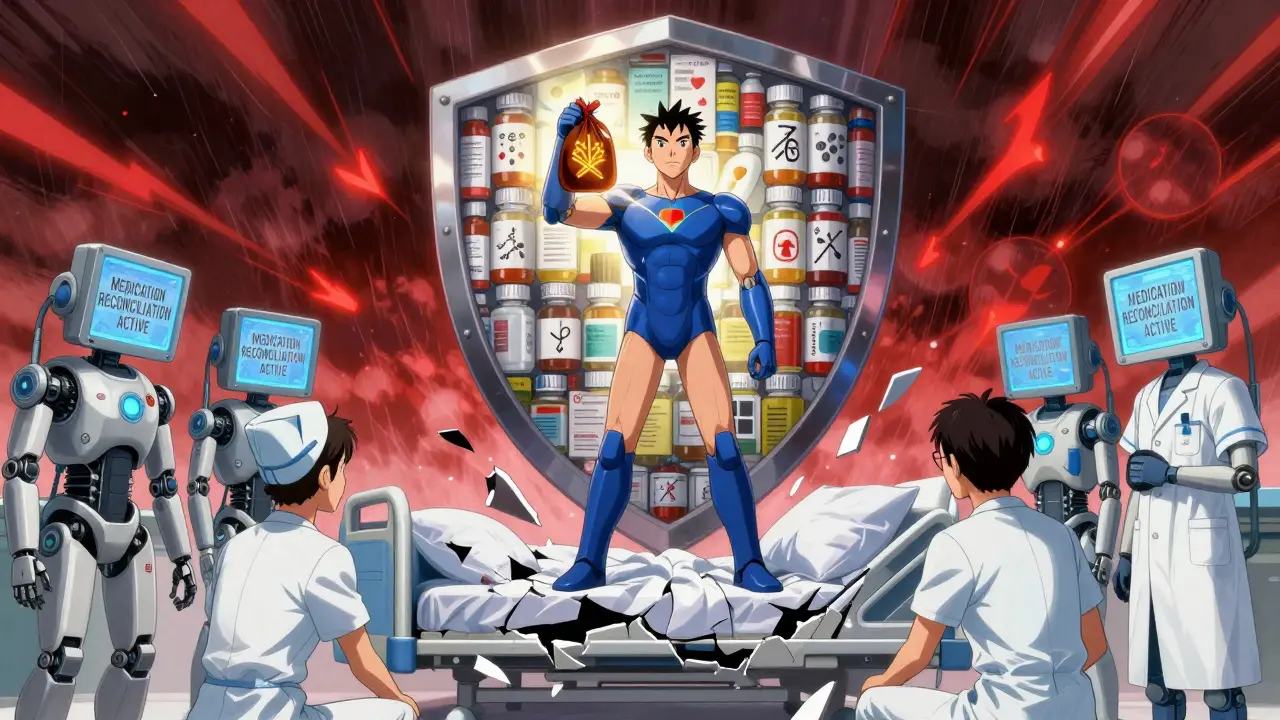
That’s why bringing your meds in a brown bag is still one of the best things you can do. Not a list. Not a memory. The actual bottles. Walk into your appointment with your pill organizer, your supplement jars, your cough syrup, your topical creams-all of it. This simple step cuts medication discrepancies by 40% compared to just telling your doctor what you take. Nurses and pharmacists have seen it again and again: patients think they’re taking three pills, but they’re actually taking seven. One woman brought in a bag with 14 different bottles. Her doctor had no idea she was on a blood pressure med, a sleep aid, and a muscle relaxant-all of which could have caused dangerous dizziness when combined with a new antibiotic.
It’s not just about what you take. It’s also about what you’re allergic to. But here’s another problem: allergy documentation is messy. One system says you’re allergic to penicillin. Another says you’re not. One doctor writes “rash.” Another writes “anaphylaxis.” There’s no standard. So if you’ve ever had a reaction-even a mild one-say it clearly. Write it down. And don’t just say “I’m allergic to penicillin.” Say what happened. “I broke out in hives after taking amoxicillin.” “My throat swelled up after a shot.” Details matter.
Doctors aren’t perfect either. Even with electronic records, they miss things. A 2022 study found that when hospitals relied only on pharmacy data without checking with the patient, they got the medication list wrong nearly 40% of the time. And clinicians get alert fatigue. When a system pops up with 20 warnings every hour, most of them false, they start ignoring them. One study found that nearly half of all drug interaction alerts are overridden-even when they’re real.
That’s where you come in. You’re not just a patient. You’re the most important part of the safety system. You know your body better than anyone else. If a new pill makes you feel weird, say something. If your pills look different than last time, ask why. If you’re confused about what to take and when, don’t nod and smile. Ask again. Use the teach-back method: repeat back what the doctor says in your own words. “So you want me to take this pill every morning with food, and not with my calcium supplement?” That simple step improves understanding by 75%.
And don’t wait until you’re sick to get organized. Start now. Keep a running list of everything you take-name, dose, why you take it, and how often. Update it after every doctor visit. Share it with your primary care provider, your pharmacist, and at least one family member. Put it in your phone. Print a copy. Keep it in your wallet. If you’re over 65, or managing multiple conditions, this isn’t optional. It’s survival.
There’s a reason the Joint Commission made medication reconciliation a national safety goal in 2006. It works. Hospitals that do it well see 30-50% fewer adverse drug events. At Johns Hopkins, anticoagulant-related errors dropped by 62% after they implemented structured reconciliation. In one ER, using Surescripts cut admission errors by 35% in six months. But none of that matters if you don’t speak up.
You don’t need to be an expert. You don’t need to know drug names or dosages. You just need to be honest, organized, and willing to ask questions. The system is designed to catch mistakes-but it can’t catch what you don’t tell them. Your medical history isn’t just paperwork. It’s your safety net. And it only works if you help hold it up.
What to Include in Your Medication List
When you’re putting together your list, don’t leave anything out. Even the stuff you think doesn’t matter. Here’s what to include:
- Prescription drugs (name, dose, frequency, reason)
- Over-the-counter meds (ibuprofen, antacids, allergy pills)
- Vitamins and supplements (vitamin D, magnesium, fish oil)
- Herbs and teas (echinacea, turmeric, chamomile)
- Topical treatments (creams, patches, eye drops)
- Recreational substances (alcohol, nicotine, marijuana)
- Any past reactions or allergies (what happened, when, and how severe)
Write it clearly. Use the full drug name, not abbreviations. “Metoprolol 25mg once daily for high blood pressure” is better than “blood pressure pill.”
How to Talk to Your Provider About Medications
Doctors are busy. But you have the right to be heard. Here’s how to make sure your message lands:
- Bring your brown bag to every appointment.
- Start with: “I want to make sure my list is complete. Here’s everything I’m taking.”
- Ask: “Is there anything here that could interact with my new prescription?”
- Use teach-back: “So if I understand right, I take this twice a day with food, and avoid grapefruit juice?”
- If something feels off after starting a new med, call back. Don’t wait.

Common Mistakes People Make
Even the most careful patients slip up. Here are the top mistakes-and how to avoid them:
- Mistake: Only listing prescriptions. Solution: Include every pill, patch, and drop.
- Mistake: Forgetting to update the list after a change. Solution: Update it the same day your meds change.
- Mistake: Assuming the pharmacy or hospital has the right info. Solution: Always verify with your provider.
- Mistake: Not knowing why you’re taking a drug. Solution: Ask your doctor to explain each one. If you can’t, question it.
What to Do If You’re Hospitalized
If you’re going into the hospital, take these steps before you go:
- Update your medication list. Include everything.
- Bring your brown bag. Don’t rely on memory.
- Ask for a pharmacist to review your meds during admission.
- When you’re discharged, get a new list in writing. Compare it to your own. Ask: “What changed, and why?”
- Follow up with your primary doctor within a week.
Don’t assume the hospital got it right. Even top hospitals miss things. One patient brought in 12 meds. The hospital listed only 7. The missing five included two blood thinners. That’s not a small error. That’s life-threatening.
How Technology Is Helping (and Where It Falls Short)
Electronic systems are getting better. Most hospitals now use EHRs that pull data from pharmacies. Some can even flag high-risk drugs like insulin or anticoagulants. But technology can’t replace you.
Here’s what systems still miss:
- Cash-pay prescriptions (15-20% of all meds)
- OTC drugs (67% of patients don’t report them)
- Herbs and supplements
- Medications from multiple pharmacy chains
- Changes made by specialists not connected to your main provider
AI tools are emerging-Google Health’s prototype cut reconciliation time by 63% in trials. But these are still in testing. Right now, the most reliable tool is still your own memory, your own list, and your own voice.

Let’s be real-most people treat their meds like a grocery list they forgot to write down. I’ve seen patients walk in with five prescriptions and a bag of gummy vitamins they think ‘don’t count.’ Spoiler: they do. And if you’re taking St. John’s wort with SSRIs, congrats, you’re basically running a clinical trial on yourself. No one’s impressed. Just stop.
You’re telling me the solution to systemic healthcare failure is… asking people to remember stuff? Brilliant. Let’s just blame the patient again. Meanwhile, the system doesn’t integrate pharmacy data across state lines, doesn’t standardize allergy terms, and still uses fax machines for referrals. But sure, bring your brown bag. That’ll fix it.
I love how this post doesn’t just dump info-it actually cares. I used to skip my supplements when I saw my doctor because I thought they were ‘just vitamins.’ Then I got dizzy and almost passed out. Turns out, magnesium + my blood pressure med = bad day. Now I bring my whole pill organizer. No shame. Just safety. You’re not weird for being organized-you’re smart.
As a pharmacist, I’ve seen this a hundred times. Patients think ‘I don’t take anything’ because they don’t have prescriptions. Then they pull out five bottles from their purse. One guy had 17 different supplements-some expired, some labeled ‘for energy’ with no ingredient list. We spent 45 minutes untangling it. Your body isn’t a vending machine. Don’t guess what goes in.
My mom died because they didn’t know she was on warfarin. They gave her a new antibiotic. She bled out in the ER. No one asked. No one checked. I’m not here to be ‘educational.’ I’m here because no one else will say this loud enough. Bring the bag. Say everything. Even if it feels embarrassing. Because silence kills.
So the entire burden of healthcare safety rests on the cognitive load of the patient? How convenient. Let’s not mention that 70% of Americans can’t afford to see a primary care doctor regularly, or that 40% of seniors are on 10+ meds and can’t read the labels. The real problem isn’t the brown bag-it’s a system designed to fail the vulnerable. But sure, keep blaming the patient for not being perfect.
OMG YES I DID THIS LAST WEEK!! I brought my whole bag and the nurse was like ‘WHY DO YOU HAVE SO MANY PILLS’ and I was like ‘BECAUSE I’M 72 AND MY DOCTOR IS A SLACKER’ and then they caught that I was double-dosing on lisinopril!! THANK YOU FOR THIS POST!!
I work in an ER and I can’t tell you how many times we’ve had to stop a procedure because the patient didn’t mention their herbal tea. One woman drank chamomile daily-thought it was ‘harmless.’ Turns out it’s a potent anticoagulant. She nearly bled out during a biopsy. You don’t need a PhD to know that ‘natural’ doesn’t mean ‘safe.’ But you do need to speak up.
This is the kind of post that makes me want to hug strangers on the internet. I used to be the person who thought ‘it’s just a multivitamin’-until my grandma ended up in the hospital because her blood thinner interacted with her ginkgo biloba. Now I have a Google Doc with everything: names, doses, why, when I started. I share it with my sister, my pharmacist, and my doctor. It’s not extra work. It’s peace of mind.
As someone from India where polypharmacy is rampant due to over-the-counter availability, I’ve seen patients take 15+ medications without knowing what any of them do. The cultural norm is to trust the pharmacist or the neighbor’s advice. This post is a lifeline. Please share it with elders. Teach them to write it down. A simple notebook saves lives.
Medication reconciliation is a core component of pharmacovigilance in transitional care settings. The absence of standardized patient-reported data introduces significant confounding variables into clinical decision-making algorithms, thereby elevating the risk of adverse drug events (ADEs) by orders of magnitude. Empirical evidence supports the efficacy of brown-bag reviews in reducing medication discrepancies by 40% in prospective cohort studies.
I know I’m not supposed to say this, but… why do we even have to do this? Why is it my job to be the human database for a broken system? I pay taxes. I have insurance. I’m not a nurse. I’m not a pharmacist. I’m just trying to survive my arthritis and my anxiety and now I have to memorize every pill I’ve ever taken? This is exhausting. And honestly? It’s not fair.
It is with profound respect for the dignity of the individual patient that I offer this reflection: the act of disclosing one’s pharmacological regimen constitutes not merely a procedural obligation, but a sacred covenant between the self and the healing arts. In the Canadian context, where primary care is constitutionally protected, the onus of accuracy remains a shared ethical imperative. May we all approach this duty with the gravity it deserves.
BRING THE BAG. BRING THE BAG. BRING THE BAG!!! 🚨🔥💥 I had a friend who took 8 supplements and 3 prescriptions and the hospital gave him a drug that made him hallucinate and scream at his cat for 3 hours. He didn’t even know the supplement had a name. It was just ‘that green powder from the guy at the gym.’ YOU DON’T KNOW WHAT’S IN THOSE PILLS. I’M NOT JOKING. BRING THE BAG. 📦💊 #MedicationSafety #BringTheBag #DontBeTheNextStat