
SSRI-Opioid Combination Risk Checker
Check Your Medication Combination
This tool helps you understand the risk of combining your SSRI antidepressant with a specific opioid pain medication. Based on FDA data and clinical evidence, it identifies whether the combination is dangerous and suggests safer alternatives.
Risk Assessment
Washout period:
Safer alternatives:
Critical Warning
Do not use this combination. Seek immediate medical attention if you're experiencing symptoms.
Stop all serotonergic drugs immediately and contact emergency services.
Safety Tips for Your Combination
When combining these medications, follow these guidelines:
- Do not adjust doses without consulting your doctor
- Monitor for symptoms like shivering, sweating, or muscle twitching
- Keep a symptom diary and share it with your healthcare provider
- Never take these medications together without medical supervision
Combining SSRIs and opioids might seem harmless if you’re just following your doctor’s prescriptions. But for thousands of people, this common mix can trigger something dangerous - serotonin syndrome. It doesn’t always show up as a dramatic emergency. Sometimes, it starts with a shiver you can’t stop, a racing heart, or sudden muscle twitches. Left unchecked, it can spiral into high fever, seizures, or even death. The good news? This isn’t random. It’s predictable. And it’s preventable.
What Exactly Is Serotonin Syndrome?
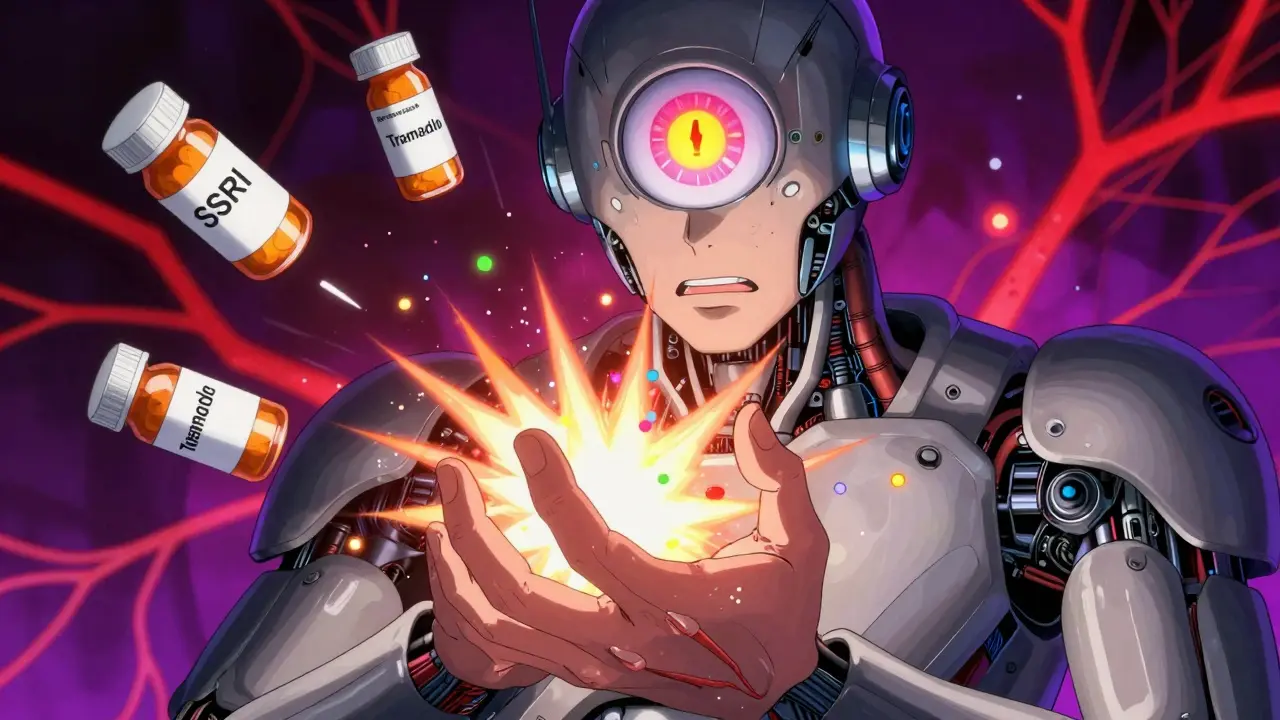
Serotonin syndrome happens when too much serotonin builds up in your nervous system. Serotonin is a natural chemical that helps regulate mood, sleep, and pain. SSRIs - like sertraline, fluoxetine, and escitalopram - work by blocking the reabsorption of serotonin, so more stays in your brain. Opioids like tramadol and methadone do something similar: they stop serotonin from being cleared away. When you take both, serotonin piles up faster than your body can handle.This isn’t just theory. Between 2018 and 2022, the FDA recorded 848 cases of serotonin syndrome linked to opioid-SSRI combinations. Tramadol alone was involved in nearly 4 out of 10 of those cases. Symptoms usually appear within hours of taking a new dose or increasing one. Mild cases look like anxiety, sweating, or diarrhea. Severe cases? Core body temperature over 41°C (106°F), rigid muscles, confusion, and seizures. About 10% of untreated severe cases end in death.
Not All Opioids Are Equal
Here’s the key thing most people don’t know: not all opioids carry the same risk. Some barely touch serotonin at all.High-risk opioids: Tramadol, methadone, and pethidine (meperidine). These directly block the serotonin transporter (SERT), the same system SSRIs target. Tramadol is especially dangerous - it inhibits serotonin reuptake about 30 times more strongly than morphine. A 2020 FDA analysis found tramadol-SSRI combinations carry 4.4 times the risk of serotonin syndrome compared to morphine-SSRI mixes.
Low-risk opioids: Morphine, oxycodone, hydromorphone, and buprenorphine. These don’t significantly interfere with serotonin clearance. Studies show they have little to no effect on SERT or serotonin receptors. If you’re on an SSRI and need pain relief, these are the safer choices.
Even fentanyl is tricky. Lab tests say it shouldn’t cause serotonin syndrome - but real-world reports tell a different story. Over 120 cases have been documented in global databases. Experts think it might act directly on serotonin receptors, bypassing the usual pathways. So don’t assume safety just because a drug doesn’t block SERT.
SSRIs Aren’t All the Same Either
Fluoxetine (Prozac) is the worst offender among SSRIs - not because it’s stronger, but because it lasts so long. Its active metabolite, norfluoxetine, sticks around for up to 16 days after your last dose. That means even if you stop taking it, your body is still flooded with serotonin. If you switch to an opioid too soon, the risk doesn’t disappear. You need a full five-week washout period before starting a new serotonergic drug.Sertraline (Zoloft) and citalopram (Celexa) clear out faster - around 24 to 36 hours. That makes them slightly safer when paired with opioids, but the risk still exists. SNRIs like venlafaxine (Effexor) are even riskier than SSRIs because they also block norepinephrine reuptake, adding another layer of stimulation.
MAOIs - older antidepressants like phenelzine - are the most dangerous. Combining them with any opioid can be fatal. Even a single dose of tramadol after an MAOI can trigger a lethal reaction. That’s why doctors avoid this combo entirely.
Who’s Most at Risk?
It’s not just about the drugs. Your body matters too.Older adults: People over 65 take, on average, 31% more medications than younger adults. That means more chances for dangerous combinations. The American Geriatrics Society specifically warns against tramadol in seniors already on SSRIs.
People with liver or kidney problems: If your liver or kidneys can’t clear drugs efficiently, serotonin builds up faster. A normal dose of tramadol can become toxic in someone with cirrhosis or chronic kidney disease.
Genetic factors: About 7% of people are poor metabolizers of the CYP2D6 enzyme. This enzyme breaks down tramadol into its active form. If you’re a poor metabolizer, tramadol doesn’t work well for pain - but it still floods your system with serotonin. That doubles your risk of serotonin syndrome.
Post-surgery patients: A hospital pharmacist in Bristol told me they see 2-3 cases a month in their 500-bed facility. Almost all involve tramadol given for acute pain after surgery, combined with an SSRI the patient was already taking for depression or anxiety. It’s a blind spot in routine care.
How to Prevent It
Prevention isn’t complicated - it just requires attention.- Ask your doctor: If you’re on an SSRI and your pain isn’t controlled, don’t assume tramadol is the next step. Say: “Is there a safer opioid I can try?”
- Choose morphine or oxycodone: If you need an opioid, ask for one with minimal serotonin activity. Hydromorphone is another safe alternative.
- Wait before switching: If you’re stopping an SSRI and starting an opioid, wait at least 14 days - 5 weeks if you were on fluoxetine.
- Check your meds: Review all your prescriptions with your pharmacist. Many don’t realize that even over-the-counter drugs like dextromethorphan (in cough syrup) can add to the risk.
- Know the warning signs: Shivering you can’t control, muscle twitching, rapid heartbeat, sweating, confusion, or agitation. If you feel this way after starting a new drug, stop taking it and call your doctor immediately.
Hospitals are starting to catch on. Kaiser Permanente cut dangerous tramadol-SSRI prescriptions by 87% after adding automatic alerts in their electronic system. Your doctor’s office should be doing the same. If they’re not, speak up.

What to Do If You Suspect Serotonin Syndrome
Time is critical. The sooner you stop the drugs, the better your chances.- Stop all serotonergic drugs immediately. That includes your SSRI, the opioid, and any other meds that boost serotonin - even herbal supplements like St. John’s Wort.
- Call emergency services or go to the ER. Don’t wait. Symptoms can worsen in minutes.
- Don’t try to treat it yourself. Benzodiazepines like lorazepam help with agitation and muscle rigidity. Cyproheptadine is the antidote - it blocks serotonin receptors - but it’s not available over the counter. Only a hospital can give it safely.
- Supportive care saves lives. Cooling blankets for high fever, IV fluids, and monitoring heart rhythm are often all that’s needed if caught early.
One woman in her 60s in Bristol developed serotonin syndrome 12 hours after starting tramadol for back pain. She was already on sertraline. Her temperature hit 40.2°C, her blood pressure spiked, and she had uncontrollable clonus - sudden jerks in her ankles. She was misdiagnosed twice before someone recognized it. She spent five days in intensive care. She’s fine now. But she almost didn’t make it.
The Bigger Picture
Serotonin syndrome isn’t rare. It’s underdiagnosed. Many doctors still think it’s a myth or something only seen in drug overdoses. But it’s happening in everyday patients - people taking prescribed meds, trying to manage pain and depression. The FDA, the European Medicines Agency, and UK poison control centers have all issued stronger warnings in the last few years. Tramadol labels now carry black-box warnings in the EU and the US.Research is moving fast. The NIH is funding $2.4 million to find early biomarkers for serotonin syndrome. Epic Systems, the biggest electronic health record provider, is building tools to flag risky drug combinations based on your genes and kidney function. But until those tools are everywhere, you have to be your own advocate.
If you’re on an SSRI and your doctor suggests an opioid for pain, ask: “Is this one safe to take with my antidepressant?” If they say yes without checking the type, push back. There are safer options. You don’t have to risk your life for pain relief.
Can you get serotonin syndrome from one dose of tramadol?
Yes. Even a single therapeutic dose of tramadol can trigger serotonin syndrome if you’re already taking an SSRI. The risk is highest in people with kidney or liver problems, or those who are poor metabolizers of the CYP2D6 enzyme. Symptoms can appear within hours.
Is codeine safe with SSRIs?
Codeine was thought to be low-risk, but case reports show it can cause serotonin syndrome when combined with SSRIs like paroxetine. It doesn’t inhibit serotonin reuptake directly, but it may act through other mechanisms. Don’t assume it’s safe - especially if you’ve had symptoms before.
How long should I wait after stopping an SSRI before taking an opioid?
For most SSRIs like sertraline or citalopram, wait at least 14 days. For fluoxetine, wait 5 weeks because its metabolites linger in your system for up to 16 days. Never start an opioid sooner than this - even if you feel fine.
What’s the safest opioid to take with an SSRI?
Morphine, oxycodone, and hydromorphone are the safest choices. They don’t significantly affect serotonin levels. Avoid tramadol, methadone, and pethidine entirely if you’re on an SSRI.
Can I use ibuprofen or acetaminophen instead of opioids?
Yes - and you should. For most types of pain, NSAIDs like ibuprofen or acetaminophen are safer and just as effective. Opioids should only be used when absolutely necessary, especially if you’re on an SSRI. Talk to your doctor about non-opioid pain management options.
Does serotonin syndrome go away on its own?
Mild cases may improve within 24-72 hours after stopping the drugs. But moderate to severe cases require hospital treatment. Without proper care, symptoms can worsen rapidly - leading to seizures, organ failure, or death. Never wait to see if it gets better.
If you’re taking an SSRI and need pain relief, don’t accept the first opioid your doctor suggests. Ask for the safer options. Know the signs. Speak up. Your life could depend on it.

Just got prescribed tramadol for my back pain last week-already on sertraline. I read this post and immediately called my doctor. They switched me to oxycodone. I’m alive because I didn’t ignore the red flags. Please, if you’re on an SSRI, don’t assume it’s fine. Ask. Ask again. Then ask a pharmacist.
Stay safe out there.
I never knew codeine could do this too. My mom took it after surgery and got really shaky. They thought it was anxiety. Turns out it was serotonin syndrome. She’s fine now but scared to take anything. This post saved her life.
Oh please. This is just fearmongering. People have been taking tramadol with SSRIs for decades and nobody dies. The FDA is just trying to sell more expensive meds. Morphine? That’s for junkies. Tramadol’s fine if you’re not a hypochondriac.
Also, why are we letting Big Pharma dictate pain management? Wake up.
As a pharmacist for 18 years, I’ve seen this exact scenario play out too many times. Tramadol + SSRI = ticking time bomb. We’ve had patients come in with clonus, hyperreflexia, temp over 105°F. One guy almost died. We now have a checklist in our system. If you’re on an SSRI and your doc pushes tramadol, push back. Ask for morphine, oxycodone, or hydromorphone. They work. They’re safer. And yes, ibuprofen is often enough. You don’t need an opioid unless you’re in severe, acute pain. Your body isn’t a lab rat.
Trust me. I’ve seen the aftermath. Don’t gamble with your brain chemistry.
bruh i was on zoloft and took tramadol for a sprained ankle… woke up at 3am sweating like i’d run a marathon and my legs were twitching like a robot having a seizure 😳
thought i was dying. called my mom. she made me go to er. they were like ‘lol yep serotonin syndrome’
now i only take tylenol. and i tell everyone. this shit is real.
This is a well-researched and deeply necessary article. In India, many patients self-medicate with over-the-counter tramadol and antidepressants bought from pharmacies without prescriptions. There is little awareness. I have shared this with my local health NGO. We need more public education on drug interactions, especially in low-resource settings. Thank you for writing this.
Can you provide primary literature sources for the 848 FDA-reported cases between 2018 and 2022? Specifically, the methodology used for case identification and causality assessment. Additionally, the claim that fentanyl acts on serotonin receptors directly-what receptor subtype? 5-HT2A? 5-HT3? And what is the binding affinity data from in vitro studies? I ask because the mechanism described lacks biochemical specificity.
my grandma got serotonin syndrome after her dentist gave her tramadol and she was on fluoxetine. they thought she was having a stroke. she spent a week in the hospital. now i make sure every single doctor i see knows i’m on an SSRI. i even have a card in my wallet. don’t wait until it’s too late. speak up. you’re not being annoying-you’re saving your life.
ps: i told my doctor to stop prescribing it to anyone over 60. he listened.
Drugs are bad. Bodies are fragile. You’re not special. Stop mixing things.
so let me get this straight… the solution to pain is to suffer more because some dude on the internet said tramadol is bad? what’s next, no ibuprofen because it might make you pee funny?
Just got off tramadol after 6 months. Switched to oxycodone and my pain’s under control. No tremors. No anxiety spikes. No nightmares. This isn’t about fear. It’s about smart choices. You can still live well without risking your brain. Stay sharp. Stay safe.
Let’s deconstruct the neuropharmacological hegemony here. The serotonin model is a reductive, monoaminergic fantasy-part of the DSM-5’s chemical imbalance mythos, funded by pharma to maintain market dominance. Tramadol’s SERT inhibition is incidental; its mu-opioid agonism is the real player. Why are we pathologizing pharmacokinetic synergy as a ‘syndrome’? Because the medical-industrial complex needs diagnostic categories to monetize risk. The real issue isn’t serotonin-it’s the lack of holistic pain frameworks that don’t reduce human suffering to a receptor binding assay. We’re treating symptoms, not systems. And yes, I’ve seen the data. And yes, I still think this is a construct. But if you’re gonna play the game, at least use morphine. It’s less colonial.
My cousin was on escitalopram and got prescribed tramadol after a car accident. She started shaking, couldn’t stop talking, and thought the walls were breathing. They thought she was having a panic attack. Took 48 hours to diagnose. She’s fine now, but she’s terrified of all meds. I told my doctor about this post-he actually added a warning pop-up in his EHR. Small wins, man. This stuff matters. Share it. Save someone.
bro i took tramadol once while on prozac and my heart felt like it was gonna explode 💥
then i started sweating and my fingers curled like i was holding invisible ice
called 911 thinking i was dying
they were like ‘yeah you’re lucky you didn’t have a seizure’
now i only take ibuprofen and cry in the shower
serotonin syndrome is real and i’m never trusting a doctor again 🥲
People are so lazy they’ll take a pill that could kill them just because it’s easier than asking a question. You think your doctor knows everything? They’re overworked, underpaid, and still using 2008 guidelines. You think your pharmacist cares? They’re ringing up your $200 co-pay. Nobody’s looking out for you except YOU. If you’re on an SSRI and someone hands you tramadol, say NO. Then say it again. Then go to another doctor. You don’t owe anyone your life. You owe it to yourself to be the damn adult.