
ACE Inhibitor Safety & Creatinine Monitor
Patient Risk Profile
Select conditions present in the patient.
Post-Therapy Monitoring
Enter values taken approx. 10 days after initiating ACE inhibitor.
Imagine you are prescribed a standard, life-saving blood pressure pill. It is one of the most trusted medications in modern medicine. But for a small group of patients, taking this drug can trigger sudden, severe kidney failure within days. This is not a rare side effect; it is a predictable physiological reaction known as a contraindication. Specifically, the combination of ACE inhibitors and undiagnosed bilateral renal artery stenosis creates a dangerous trap that clinicians must avoid at all costs.
If you have high blood pressure, you likely know about ACE inhibitors. They are the first line of defense against hypertension and heart failure. However, their mechanism of action-which makes them so effective for most people-becomes their fatal flaw when blood flow to the kidneys is already compromised. Understanding why this happens is crucial for patient safety and informed medical decision-making.
The Mechanism: How ACE Inhibitors Work Normally
To understand the risk, we first need to look at how these drugs function in a healthy body. ACE inhibitors are pharmaceutical agents that block the conversion of angiotensin I to angiotensin II. Angiotensin II is a potent vasoconstrictor, meaning it tightens blood vessels. By blocking its production, ACE inhibitors cause blood vessels to relax, lowering blood pressure.
In the kidneys, this process has a specific local effect. The kidneys filter waste from the blood through tiny clusters of capillaries called glomeruli. Blood enters the glomerulus through an afferent arteriole and leaves through an efferent arteriole. Under normal conditions, angiotensin II helps maintain pressure within the glomerulus by constricting the efferent arteriole (the exit pipe). When you take an ACE inhibitor, the efferent arteriole dilates (widens). In a healthy kidney, this reduces intraglomerular pressure slightly, which is actually protective because it prevents protein leakage into the urine. This is why ACE inhibitors are recommended for diabetic nephropathy.
| Parameter | Healthy Kidney | Stenotic Kidney (Bilateral) |
|---|---|---|
| Afferent Arteriole Status | Dilated or Normal | Constricted (due to low perfusion pressure) |
| Efferent Arteriole Response to ACEI | Dilation (protective) | Dilation (dangerous drop in filtration pressure) |
| Intraglomerular Pressure Change | Decrease (~10-15%) | Sharp Decrease (~25-30%) |
| GFR Outcome | Stable or Slight Decrease | Precipitous Drop (Acute Kidney Injury) |
The Danger Zone: Bilateral Renal Artery Stenosis
The problem arises when a patient has Bilateral Renal Artery Stenosis, defined as significant narrowing of the renal arteries supplying both kidneys.
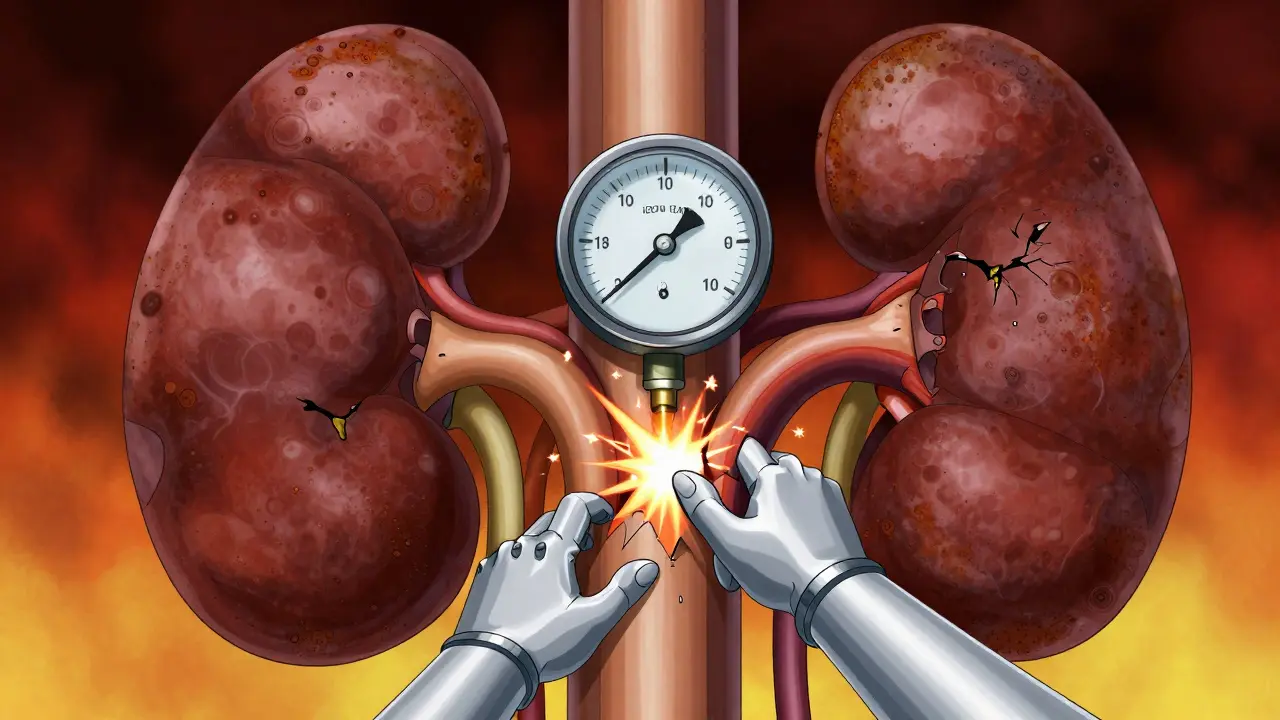
In this condition, blood flow entering the kidneys is restricted. The kidneys sense this low pressure and respond by releasing renin, which triggers the production of angiotensin II. Here is the critical part: the stenotic kidneys rely heavily on angiotensin II to constrict the efferent arterioles. This constriction maintains high pressure inside the glomerulus, allowing filtration to continue despite the low incoming blood flow. It is a desperate survival mechanism.
When you introduce an ACE inhibitor to this system, you remove that vital support. The efferent arteriole dilates. Without the resistance at the exit, the intraglomerular pressure collapses. Studies using micropuncture techniques have shown that angiotensin II increases efferent arteriolar resistance by approximately 37.5% in stenotic kidneys compared to only 8.3% in normal kidneys. Blocking this pathway causes intraglomerular pressure to plummet by 25-30%. The result is an abrupt decline in the Glomerular Filtration Rate (GFR), manifesting clinically as acute kidney injury.
This phenomenon was first formally documented in 1984 by Textor et al. in the New England Journal of Medicine. They reported acute renal failure in 12 out of 15 patients with bilateral renal artery stenosis who received captopril. This finding remains unchanged today. The contraindication applies strictly to bilateral stenosis or unilateral stenosis in a solitary functioning kidney. If a patient has one healthy kidney and one stenotic kidney, the healthy kidney can compensate, and ACE inhibitors may be used cautiously. But if both kidneys are dependent on angiotensin II, the drug becomes toxic to renal function.
Clinical Presentation and Diagnosis
How do doctors spot this before it causes permanent damage? The key is monitoring serum creatinine levels. According to NICE guidelines and the American Heart Association, renal function should be checked before starting an ACE inhibitor and again approximately 10 days after initiation.
A rise in serum creatinine of greater than 30% within the first two weeks is a major red flag. While a small increase (up to 30%) can be acceptable and often stabilizes, a jump beyond this threshold suggests hemodynamically significant renal artery stenosis. The 2022 American Heart Association Scientific Statement emphasizes that such a rise should prompt immediate evaluation for bilateral renal artery stenosis.
Diagnosis typically involves renal artery duplex ultrasound. This non-invasive test has a sensitivity of 86% and specificity of 92% for detecting significant stenosis. High-risk patients include those with:
- Accelerated or resistant hypertension
- Unexplained renal impairment
- Abdominal bruits (whooshing sounds heard through a stethoscope over the abdomen)
- History of cardiovascular disease with sudden onset of kidney issues
The European Society of Cardiology notes that about 6.8% of hypertensive patients with renal impairment have significant renal artery stenosis. Screening these individuals before prescribing ACE inhibitors is a standard of care.
Common Misconceptions: Are ARBs Safe?
A frequent question from patients and even some clinicians is whether Angiotensin Receptor Blockers (ARBs) are a safe alternative. The answer is no. ARBs work downstream of ACE inhibitors but ultimately achieve the same result: they block the action of angiotensin II on its receptors. Consequently, they also cause efferent arteriolar dilation and reduce GFR in stenotic kidneys.
The 2019 KDIGO Clinical Practice Guideline explicitly lists bilateral renal artery stenosis as a contraindication for both ACE inhibitors and ARBs. A 2002 American Heart Association scientific statement noted that "Ang II receptor blockers are not an appropriate substitute" when acute renal failure occurs due to ACE inhibitors in renal artery stenosis. Switching from an ACE inhibitor to an ARB will not save the kidneys in this scenario.

Reversibility and Prognosis
The good news is that the renal deterioration caused by ACE inhibitors in renal artery stenosis is usually reversible. As noted in clinical resources updated in 2023, stopping the drug typically restores GFR to baseline levels. However, there is a window of vulnerability. If renal hypoperfusion persists beyond 72 hours, permanent damage may occur. A 2019 case series by Patel et al. highlighted that prolonged ischemia can lead to irreversible tubular necrosis.
This underscores the importance of rapid detection. If a patient’s creatinine spikes after starting an ACE inhibitor, the drug should be withheld immediately, and the patient evaluated for renal artery stenosis. Delaying discontinuation can turn a temporary functional issue into permanent structural damage.
Current Guidelines and Best Practices
Despite clear warnings, errors still happen. A 2020 study published in the Journal of General Internal Medicine found that 22.4% of patients with known bilateral renal artery stenosis were still prescribed ACE inhibitors in primary care settings across 15 US healthcare systems. This gap highlights the need for better electronic health record alerts and clinician education.
For patients with creatinine exceeding 150 micromol/L, NICE recommends introducing ACE inhibitors only under specialist supervision. For those with suspected or confirmed bilateral renal artery stenosis, alternative antihypertensive classes such as calcium channel blockers or beta-blockers are preferred. These drugs lower blood pressure without disrupting the delicate angiotensin-dependent filtration balance in the kidneys.
Understanding this contraindication is not just academic; it is a matter of patient safety. By recognizing the signs of renal artery stenosis and respecting the physiological limits of ACE inhibitors, clinicians can prevent acute kidney injury and ensure long-term health outcomes for their patients.
Can ACE inhibitors be used in unilateral renal artery stenosis?
Yes, ACE inhibitors can often be used cautiously in unilateral renal artery stenosis if the contralateral kidney is healthy. The healthy kidney can compensate for any drop in filtration in the affected kidney. However, close monitoring of serum creatinine is essential. The contraindication strictly applies to bilateral stenosis or unilateral stenosis in a solitary functioning kidney.
What is the safe limit for creatinine increase after starting an ACE inhibitor?
A rise in serum creatinine of up to 30% within the first two weeks of therapy is generally considered acceptable and often stabilizes. However, an increase greater than 30% is a warning sign of potential renal artery stenosis or other renal compromise and warrants further investigation and possibly discontinuation of the drug.
Are ARBs safer than ACE inhibitors for patients with renal artery stenosis?
No, ARBs share the same contraindication as ACE inhibitors. Both drug classes interfere with the angiotensin II-mediated constriction of the efferent arteriole, leading to a drop in glomerular filtration rate in patients with bilateral renal artery stenosis. They are not safe alternatives in this specific context.
Is kidney damage from ACE inhibitors in renal artery stenosis permanent?
In most cases, the kidney damage is reversible if the ACE inhibitor is stopped promptly. However, if the drug continues to be taken and renal hypoperfusion persists beyond 72 hours, there is a risk of permanent tubular necrosis and irreversible kidney injury.
Who should be screened for renal artery stenosis before starting ACE inhibitors?
High-risk patients include those with accelerated or resistant hypertension, unexplained renal impairment, abdominal bruits, or a history of cardiovascular disease. Screening with renal artery duplex ultrasound is recommended for these groups to detect significant stenosis before initiating therapy.
