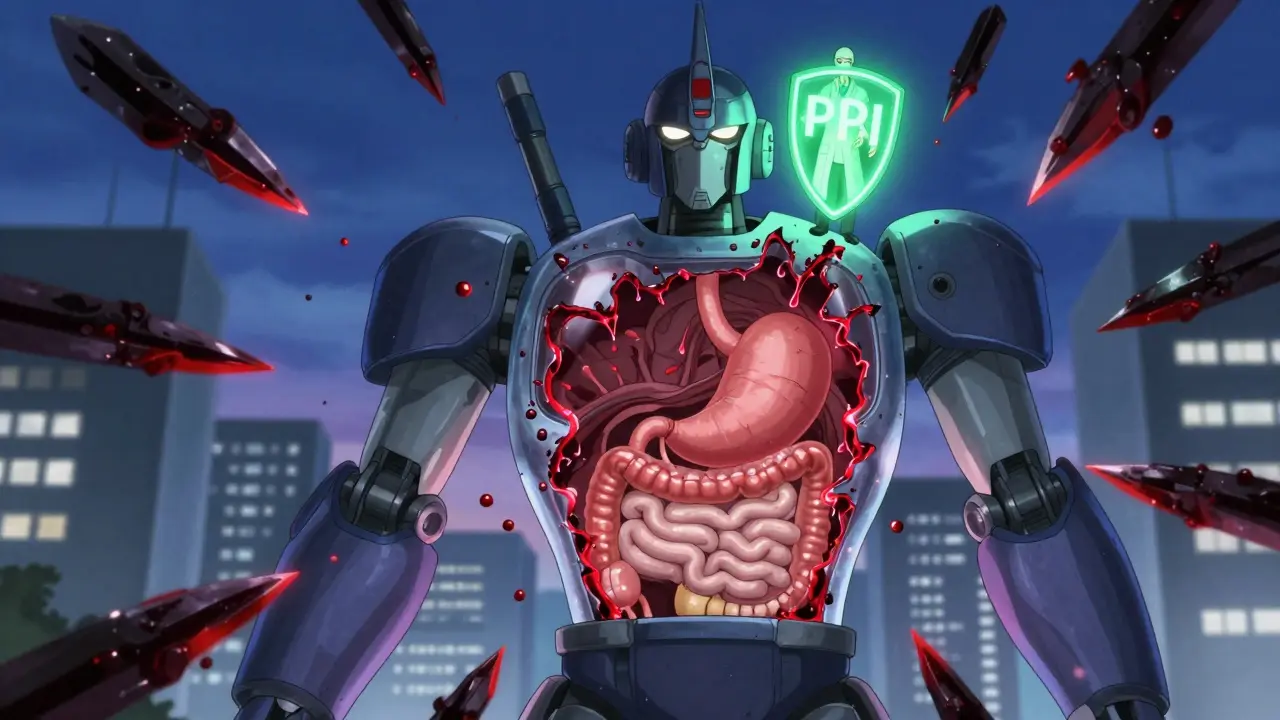
NSAID Gastrointestinal Bleeding Risk Calculator
This calculator uses the American College of Gastroenterology risk assessment criteria to determine your risk of NSAID-induced gastrointestinal bleeding. Based on your inputs, it will provide a risk score and recommend appropriate gastroprotection.
0
Low Risk
Every year, millions of people reach for ibuprofen, naproxen, or diclofenac to ease joint pain, headaches, or muscle soreness. These drugs - non-steroidal anti-inflammatory drugs, or NSAIDs - work fast and feel like a simple fix. But behind that relief lies a quiet danger: gastrointestinal bleeding. It doesn’t always come with warning signs. Sometimes, it starts with fatigue, dizziness, or unexplained anemia. By the time it’s caught, it’s already life-threatening.
How NSAIDs Damage the Gut
NSAIDs block enzymes called COX-1 and COX-2. COX-2 is involved in inflammation and pain, which is why these drugs help. But COX-1 protects the stomach lining by producing mucus and bicarbonate that shield it from acid. When COX-1 is suppressed, that protective layer breaks down. The stomach and upper intestine get exposed to their own acid - and start to erode.
This isn’t just about ulcers. Studies show that NSAIDs cause damage along the entire digestive tract - from the stomach all the way to the small bowel. In fact, a 1999 study from the Cleveland Clinic Journal of Medicine found that 86% of people with lower GI bleeding had taken NSAIDs, even though they didn’t have a classic peptic ulcer. The damage can be invisible: tiny erosions, slow oozing, or internal bleeding that only shows up as iron deficiency anemia.
Doctors classify this damage into four grades. Grade 1? Superficial scrapes. Grade 4? Deep ulcers with visible blood vessels. And once you hit Grade 3 or 4, hospitalization isn’t rare.
The Numbers Don’t Lie
A 2020 meta-analysis in JAMA Internal Medicine looked at data from over 30 years of studies. The result? NSAID users are 3.2 to 4.2 times more likely to suffer upper GI bleeding or perforation than non-users. That’s not a small risk. That’s a major one.
And it’s not just prescription pills. A 2021 review found that 26% of people take over-the-counter NSAIDs at doses higher than recommended. Many never tell their doctor. That’s a problem because the risk climbs fast with higher doses. Taking more than 1,200 mg of ibuprofen a day doubles your risk compared to lower doses.
Worse, older adults are hit hardest. People over 65 make up the largest group of NSAID users. And for every decade past 60, your odds of developing a bleeding ulcer go up by 60%. Combine that with a history of ulcers, blood thinners, or steroids - and your risk skyrockets.
Not All NSAIDs Are the Same
Some NSAIDs are riskier than others. Non-selective ones - like naproxen, diclofenac, and high-dose ibuprofen - hit both COX-1 and COX-2. That means more gut damage. Selective COX-2 inhibitors - like celecoxib - were designed to avoid this. A 2000 Lancet study showed celecoxib caused 50% fewer serious ulcers than ibuprofen.
But there’s a trade-off. The 2004 APPROVe trial found rofecoxib (a COX-2 drug) doubled the risk of heart attacks. That’s why it was pulled off the market. Celecoxib is still around, but it comes with its own warnings. The FDA requires a black box warning on all NSAIDs for both GI and cardiovascular risks.
So what’s the safest option? For most people with no heart problems, low-dose naproxen with a proton pump inhibitor (PPI) is still the go-to. But if you’ve had a bleed before? Then COX-2 inhibitor + PPI is the gold standard.

Protecting Your Gut: What Actually Works
If you’re on NSAIDs long-term, you need protection. Not just hope. Not just “I’ll watch for symptoms.” You need science-backed prevention.
Proton pump inhibitors (PPIs) like omeprazole, pantoprazole, or esomeprazole are the most effective. A 2017 Cochrane review of 13,342 patients showed PPIs cut ulcer complications by 75%. That’s not a guess. That’s from randomized trials. And if you start the PPI before the NSAID? Protection jumps to 74%.
Misoprostol is another option - it reduces ulcers by 50-75%. But it causes diarrhea in up to 20% of users and severe abdominal cramps. Most people can’t tolerate it long-term.
Then there’s the new combo drug: naproxen/esomeprazole (Vimovo). Approved in 2023, it combines the painkiller with a PPI in one pill. In the PRECISION-2 trial, it cut ulcer complications from 25.6% down to just 7.3%. For high-risk patients, this is a game-changer.
Who’s at Highest Risk?
Not everyone needs a PPI. But if you have two or more of these, you’re in the danger zone:
- Age 70 or older
- History of peptic ulcer or GI bleeding
- Taking blood thinners like warfarin or aspirin
- Using corticosteroids (even low-dose prednisone)
- Taking more than one NSAID at a time
- Having heart failure, kidney disease, or liver cirrhosis
The American College of Gastroenterology uses a simple scoring system: 2 points for age over 70, 2 for past ulcer, 2 for blood thinners, 1 for steroids. Score of 2 or more? You need gastroprotection. No exceptions.
One patient story from Reddit sums it up: a 78-year-old woman with arthritis took ibuprofen daily for years. She felt fine. Then she collapsed from internal bleeding. Three blood transfusions later, doctors found multiple small bowel ulcers - all from NSAIDs. She never told her doctor about the dark stools or fatigue. She thought it was just “old age.”

What Patients Don’t Talk About
On patient forums, a pattern emerges. In a 2022 survey of 247 people on HealthUnlocked, 63% had GI symptoms while on NSAIDs - but only 37% mentioned it to their doctor. Why? They think it’s normal. Or they’re afraid their painkiller will be taken away. Or they don’t know the connection.
Another survey by the Arthritis Foundation found 42% of users stopped NSAIDs because of stomach pain, nausea, or bloating. But many didn’t switch to safer options. They just quit. And that’s dangerous too - uncontrolled inflammation can cause more harm than the drug.
Meanwhile, on Drugs.com, 78% of people taking celecoxib reported no GI issues. That’s encouraging. But it’s not the whole story. The people who had bad reactions? They’re less likely to leave reviews.
What to Do If You’re on NSAIDs
Here’s your action plan:
- Ask yourself: Do I have any of the risk factors? Age? Past ulcer? Blood thinners? Steroids?
- Check your dose. Are you taking more than the recommended amount? OTC pills are easy to overuse.
- Don’t combine NSAIDs. No ibuprofen + naproxen. No aspirin + naproxen unless your doctor says so.
- Ask for a PPI. If you’re on NSAIDs long-term and have one or more risk factors, ask for omeprazole or esomeprazole. It’s cheap, effective, and safe for most people.
- Watch for symptoms. Black, tarry stools? Unexplained fatigue? Dizziness? Pale skin? These aren’t normal. Go to your doctor.
- Consider alternatives. Physical therapy, topical creams, or acetaminophen (for pain only) might be safer options.
And if you’ve had a GI bleed before? The American College of Gastroenterology says COX-2 inhibitor + PPI is your best bet. The number needed to treat to prevent one complication in 12 weeks? Just 16. That’s powerful.
The Bigger Picture
In the U.S., NSAID-related GI bleeding causes 107,000 hospitalizations and 16,500 deaths every year. Costs? Over $2.2 billion. Globally, the NSAID market is worth $11.3 billion. That’s a lot of money spent on drugs that are killing people.
But they’re not going away. NSAIDs work. For arthritis, back pain, sports injuries - they’re hard to beat. The goal isn’t to ban them. It’s to use them smarter.
Future drugs are coming. NAPROX-2 trial data shows a new class called CINODs - COX-inhibiting nitric oxide donors - cut ulcer rates by half compared to naproxen. They’re in phase III trials. They might be the next big thing.
For now, the solution is simple: know your risk. Talk to your doctor. Don’t assume your stomach is fine. And if you’re taking NSAIDs regularly - protect your gut. It’s not optional. It’s essential.
Can I take NSAIDs if I’ve had a stomach ulcer before?
If you’ve had a peptic ulcer or GI bleeding, you should avoid non-selective NSAIDs like ibuprofen or naproxen unless absolutely necessary. The safest option is a COX-2 inhibitor (like celecoxib) combined with a proton pump inhibitor (PPI). This combination reduces the risk of another bleed by over 70%. Never restart NSAIDs after a bleed without discussing it with your gastroenterologist.
Are over-the-counter NSAIDs safer than prescription ones?
No. OTC NSAIDs carry the same risks as prescription versions. Many people take them daily without realizing the danger. The FDA requires the same black box warning on OTC and prescription NSAIDs. Taking higher doses than recommended - which is common with OTC products - increases your bleeding risk significantly. Always read the label and don’t exceed the maximum daily dose.
Do PPIs have long-term side effects?
Long-term PPI use (over a year) may slightly increase the risk of bone fractures, low magnesium levels, or certain infections like C. diff. But for people at high risk of NSAID-induced bleeding, the benefits far outweigh the risks. If you’re on PPIs long-term, your doctor should monitor you. Never stop PPIs suddenly - tapering may be needed. For most, short-term or intermittent use is safe and effective.
What are signs of NSAID-induced bleeding?
Signs include black, tarry stools (melena), vomiting blood (which may look like coffee grounds), unexplained fatigue, pale skin, dizziness, or shortness of breath. Sometimes, there are no symptoms at all - just low iron levels from slow, chronic bleeding. If you’re on NSAIDs and feel unusually tired, get your hemoglobin checked. Occult bleeding is silent but dangerous.
Is acetaminophen (Tylenol) a safer alternative to NSAIDs?
For pain relief without inflammation, yes. Acetaminophen doesn’t affect COX enzymes and doesn’t cause GI bleeding. But it doesn’t reduce inflammation like NSAIDs do. So it’s good for headaches or mild joint pain, but not for arthritis flare-ups. Also, don’t exceed 3,000 mg per day - it can damage the liver, especially if you drink alcohol or have liver disease.
Can I take aspirin with NSAIDs?
If you’re taking low-dose aspirin for heart protection, combining it with NSAIDs like ibuprofen or naproxen can cancel out aspirin’s protective effect and increase bleeding risk. If you need both, talk to your doctor. Some recommend taking aspirin at least 30 minutes before the NSAID, or switching to naproxen, which interferes less with aspirin. Never combine them without medical advice.

I've been on naproxen for years for my back and never thought twice about it. Found out last year I had a silent ulcer from a routine blood test. Now I take omeprazole daily and feel better than ever. Simple fix, huge difference.
Doctors don't always bring it up, but if you're on NSAIDs long-term, just ask for a PPI. It's like insurance for your stomach.
Lmao I take ibuprofen like candy. 😅 My stomach’s fine. If it ain’t broke, don’t fix it.
This is one of the most critical public health messages we’ve overlooked for decades.
The normalization of NSAID use without consideration for gastrointestinal consequences is nothing short of a silent epidemic. We treat pain like a trivial inconvenience, not a symptom that demands systemic understanding.
The data is irrefutable. The risk is quantifiable. The solution - PPIs - is accessible, affordable, and proven.
Yet, we continue to let people suffer silently until they collapse. This isn’t medical negligence - it’s cultural negligence.
I’ve been thinking about this a lot lately, especially after my dad had that internal bleed last year. He was 72, took ibuprofen daily for his knees, never complained, thought the fatigue was just aging.
It made me realize how much we ignore the body’s quiet signals - the dark stools, the dizziness, the low iron - because they don’t come with screaming pain. We’ve been trained to think of pain as the only warning, but GI bleeding doesn’t work like that.
It’s not about being paranoid. It’s about listening to the body when it whispers before it screams. And honestly, if we had better public education on this, a lot of people wouldn’t need transfusions.
As someone from India where OTC NSAIDs are sold like candy at every corner store, this is terrifying. I’ve seen grandmas on daily diclofenac for arthritis with zero medical oversight. No PPIs. No warnings. Just painkillers and prayers.
The real tragedy? Many don’t even know what a proton pump inhibitor is. The solution isn’t just medical - it’s educational. Pharmacies should be required to hand out a one-page warning sheet with every NSAID pack. Simple. Clear. Non-negotiable.
I used to think PPIs were just for people with heartburn. Then I got my first GI scare at 45 and found out I was at high risk from years of ibuprofen for migraines.
Switching to naproxen + omeprazole changed my life. No more bloating, no more fatigue. My doctor said I was lucky I didn’t need surgery.
PS: If you’re on NSAIDs and feel tired all the time? Get your iron checked. It’s not ‘just stress’.
I’m sick of this anti-NSAID fearmongering. People are scared of everything now. Take a pill, get scared. Take two, get paranoid.
My grandpa lived to 92 and took aspirin daily. He never had a bleed. You think your stomach is fragile? It’s not. Your mind is.
Also, PPIs cause dementia. Google it. 😈
How delightful. Another public health pamphlet masquerading as a Reddit post.
Let me guess - you’re also going to tell us that sunlight causes skin cancer and water is a carcinogen if consumed in excess.
The fact that people are still surprised by the side effects of drugs they take daily is less concerning than the fact that they think this level of oversimplification counts as ‘education’.
Next up: ‘Why breathing oxygen may be a silent killer’.
You know who really benefits from this? Big Pharma. They make billions off NSAIDs and then sell you the PPI to fix what they broke.
It’s a racket. They don’t want you to know about natural alternatives - turmeric, CBD, physical therapy - because those don’t come with patent protection.
And don’t even get me started on how the FDA is just a puppet of the drug companies. You think they’d let celecoxib stay on the market if it wasn’t profitable?
Wake up. This isn’t medicine. It’s capitalism.
I take naproxen twice a week for my knees. Never had issues. But I started omeprazole just in case. Five bucks a month. Zero downsides.
Why not?
Vimovo (naproxen + esomeprazole) is a game changer. Took me 3 years to convince my doctor to prescribe it. Now I take one pill. No more juggling pills. No more forgetting.
High-risk patients: ask for it. It’s covered by most insurance.
I read the whole thing and still think this is overblown.
People die from falling down stairs. Should we ban stairs?
NSAIDs are the most studied drugs on earth. The risk is low if you’re not a 75 year old on warfarin.
Also, PPIs cause kidney damage. So you’re trading one problem for another.
Just don’t take them if you’re fine. Problem solved.
If you’re taking NSAIDs without a PPI, you’re asking for trouble.
It’s not complicated.
Stop being lazy.
Protect your gut.
Let me tell you something - I used to be the guy who scoffed at PPIs. Thought they were for hypochondriacs. Then I went on a 6-month NSAID binge for a sports injury.
Woke up one morning with black stools. Thought it was from the burritos.
Turned out I had 3 bleeding ulcers.
Spent 3 days in the hospital. Got a blood transfusion.
Now I take Vimovo. Every day. No questions.
And if you’re reading this and still not protecting your gut? You’re not just reckless. You’re disrespecting your own body.
Get your act together. It’s not that hard.