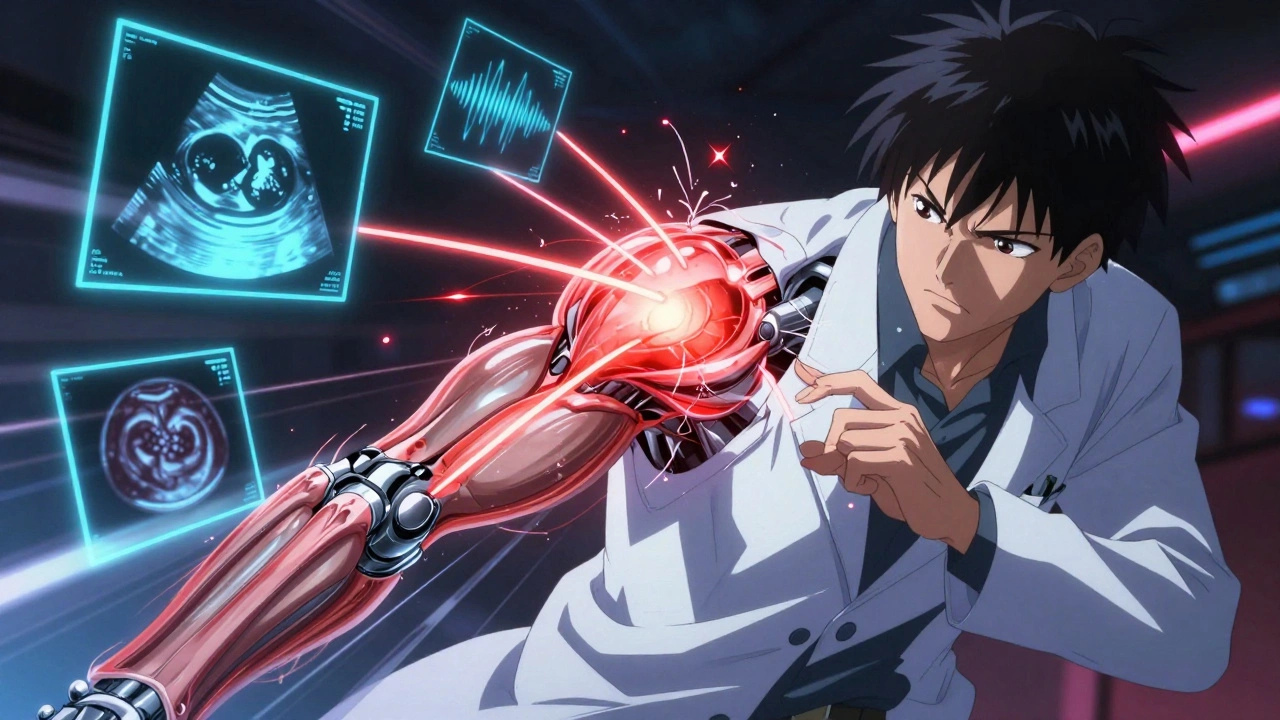
What Exactly Is a Rotator Cuff Tear?
A rotator cuff tear happens when one or more of the four tendons that hold your shoulder joint together get damaged. These tendons connect the muscles of your shoulder blade to the top of your arm bone. The most commonly torn tendon is the supraspinatus, but tears can also involve the infraspinatus, teres minor, and subscapularis. You don’t need a major accident to tear it-many people develop these tears slowly over time from wear and tear, especially after 40. In fact, studies show that over half of people over 60 have a rotator cuff tear without even knowing it because they feel no pain.
How Do You Know If You Have One?
Common signs include pain when lifting your arm, weakness when reaching behind your back, and trouble sleeping on the affected side. Doctors start with a physical exam. They’ll check your range of motion and test specific movements like the Empty Can test (raising your arm straight out with thumbs down) or the Hawkins-Kennedy test (bending your arm and pushing it forward). If these movements cause sharp pain, it’s a red flag. But physical exams alone can’t confirm the tear. That’s where imaging comes in.
Imaging: X-Ray, Ultrasound, or MRI?
X-rays are usually the first step-not because they show tendons, but because they rule out bone problems like arthritis or bone spurs that can mimic a tear. For actual tendon damage, you need soft tissue imaging. That’s where ultrasound and MRI come in.
Ultrasound is fast, cheap, and doesn’t require you to lie still in a noisy tube. It costs about $200-$400, compared to $500-$1,200 for an MRI. It also lets the technician watch your shoulder move in real time, which helps spot problems that only show up during motion. Studies show it’s 87-91% accurate for full-thickness tears. But it’s only as good as the person holding the probe. Only about 45% of general radiologists have the specialized training needed to read it well. It also struggles with people who have a high BMI-fat tissue can block the view.
MRI gives you a detailed, high-resolution picture of the tendons. It’s 92-95% accurate for full-thickness tears and better at spotting partial tears. It’s the go-to when surgeons need a clear map of the damage before operating. But it’s more expensive, takes longer, and can’t be used if you have metal implants like pacemakers or joint replacements. Most MRIs for rotator cuff tears are done without contrast. Contrast dye is only used if you’ve had surgery before and the doctor suspects a retear.
Guidelines from the American Roentgen Ray Society say ultrasound should be the first imaging test for most people. But if the tear looks complex, or if surgery is being considered, MRI is the better choice.
When Is Surgery Needed?
Not every tear needs surgery. In fact, about 85% of people with partial-thickness tears get better with rehab alone. But full-thickness tears in active people under 65 often require repair. If you’re still in your 40s or 50s and you play tennis, lift weights, or work with your arms overhead, waiting too long can make the tear worse. The tendon can shrink, the muscle can turn to fat, and repair becomes harder-or impossible.
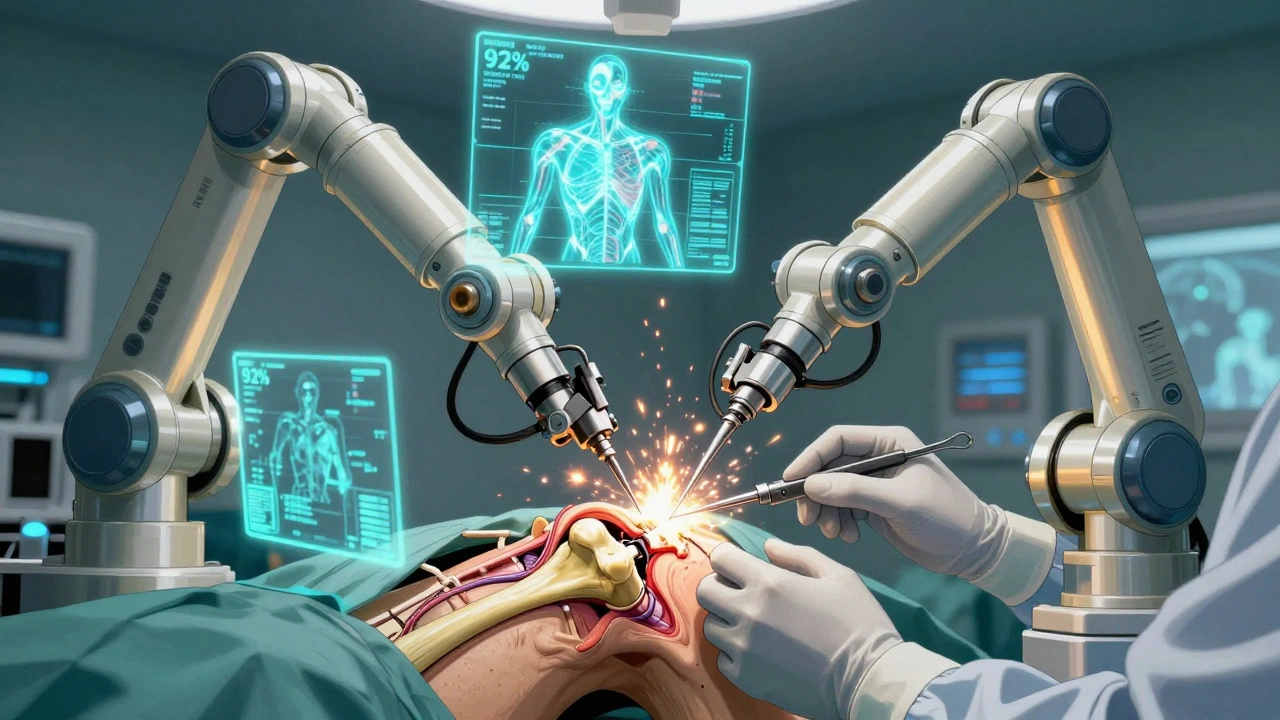
Today, 90% of rotator cuff repairs are done arthroscopically. That means the surgeon makes three or four small cuts, inserts a tiny camera, and uses miniature tools to stitch the tendon back to the bone. It’s less invasive than the old open surgery, which required a large incision. Arthroscopic repair cuts complication rates by 30% and gets you back to daily activities 25% faster.
For massive tears-those over 3 cm-things get trickier. Even with surgery, retear rates hit 27%. New techniques like using a patch to reinforce the repair or injecting platelet-rich plasma (PRP) are being tried, but evidence is still mixed. The Cochrane Review found only moderate support for PRP, and it’s not routinely recommended.
Rehab: The Real Key to Recovery
Rehab isn’t just what you do after surgery-it’s what you do before, too. For people choosing non-surgical treatment, a 6-8 week course of physical therapy is now the standard first step, even if imaging shows a tear. Many people improve without ever needing an operation.
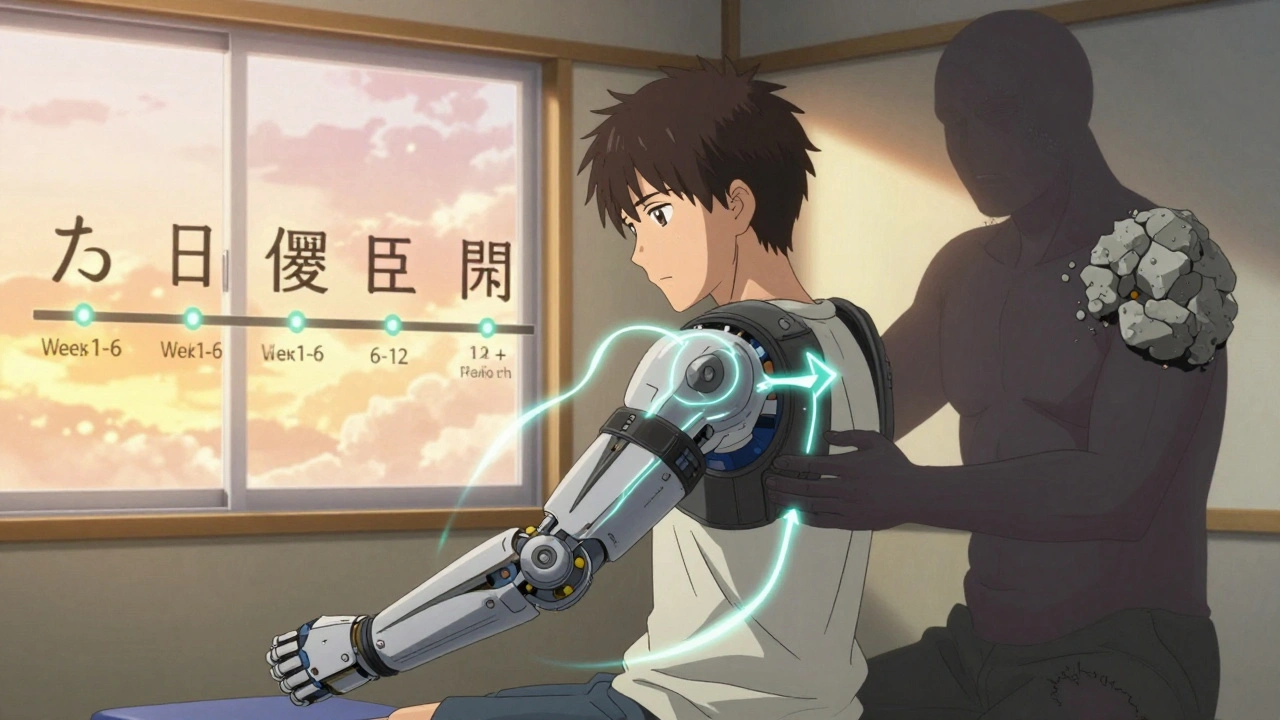
After surgery, rehab follows a strict timeline:
- Weeks 1-6: Passive motion only. Your arm stays in a sling. A therapist moves your shoulder gently-no lifting with your own muscles.
- Weeks 6-12: Active-assisted motion. You start using your own muscles, with help from a band or your other arm.
- After 12 weeks: Strengthening begins. Light resistance exercises, then gradually heavier ones.
Modern rehab starts moving your shoulder much sooner than it used to. In the 1990s, patients were locked in a sling for 4-6 weeks. Now, most surgeons allow passive motion the day after surgery. This reduces stiffness and improves long-term outcomes.
One study found that patients who stuck to their rehab plan had an 82% satisfaction rate five years after surgery. But skipping steps or rushing into lifting weights too soon is the #1 reason for retears.
What Happens If You Don’t Treat It?
Some tears stay stable and never get worse. But others do. Without treatment, the tendon can retract further, the muscle can atrophy, and fatty deposits can build up. Once that happens, even surgery may not restore full strength. You might end up with chronic pain, limited motion, and a shoulder that just doesn’t work the way it used to.
For older adults with low activity levels, avoiding surgery and managing pain with therapy and anti-inflammatories is often the smart choice. But for anyone who still wants to lift, reach, or play, waiting too long can cost you your function.
What’s New in the Field?
Technology is changing how we see and treat these tears. Researchers are now using machine learning to analyze MRI scans. A 2023 study showed an AI model could distinguish between partial and full-thickness tears with 89% accuracy-almost matching expert radiologists. That could speed up diagnosis and reduce human error.
Also, ultrasound is becoming more widely used in clinics because it’s portable, affordable, and gives instant feedback. More physical therapists are being trained to use it, which means you might get your diagnosis during your first appointment instead of waiting weeks for an MRI.
The big shift in the last decade? We no longer assume every tear needs surgery. We treat the person, not just the image. If you’re not in pain and you can still move your arm, you might not need anything beyond monitoring and gentle exercise.
Bottom Line
Rotator cuff tears are common, but they’re not all the same. The right path depends on your age, activity level, tear size, and symptoms. Imaging helps-but it doesn’t decide everything. Rehab is powerful, even without surgery. And if you do need an operation, arthroscopic repair is now the gold standard, with faster recovery and fewer risks than ever before. The key? Don’t delay. Get evaluated early, follow your rehab plan, and don’t let fear of surgery keep you from getting back to the life you love.
Can a rotator cuff tear heal without surgery?
Yes, many can-especially partial-thickness tears and tears in less active individuals. About 85% of people with partial tears improve with physical therapy alone. Even some full-thickness tears in older adults don’t cause enough pain or weakness to require surgery. The goal is function, not just a perfect scan. If you can lift your arm, sleep through the night, and do daily tasks without pain, surgery may not be necessary.
Is MRI always better than ultrasound for rotator cuff tears?
Not always. Ultrasound is just as accurate as MRI for full-thickness tears and better for spotting dynamic problems during movement. It’s cheaper, faster, and has no metal restrictions. But MRI gives a clearer picture of the tendon’s full structure, especially for complex tears or when planning surgery. Most guidelines recommend starting with ultrasound unless you’re a young, active person with a suspected large tear-then MRI is preferred.
How long does recovery take after rotator cuff surgery?
Most people return to light daily activities within 4-6 months. Full recovery, including returning to sports or heavy lifting, can take 6-12 months. The first 6 weeks are focused on protecting the repair with passive motion. Strengthening doesn’t start until after 12 weeks. Rushing this process is the biggest cause of retears. Patience and consistency with rehab are more important than speed.
Can you prevent a rotator cuff tear?
You can’t always prevent it, especially with age-related wear, but you can reduce your risk. Strengthening the rotator cuff muscles with light resistance exercises (like external rotations with a band) helps. Avoiding repetitive overhead motions without rest, improving posture, and keeping shoulder mobility through stretching also help. People who do regular shoulder conditioning have fewer injuries and better outcomes if a tear does occur.
What’s the success rate of rotator cuff surgery?
Patient satisfaction is high-about 82% report being happy with results five years after surgery. But success depends on tear size. Small tears (<1 cm) have a 12% retear rate. Large tears (>3 cm) have a 27% retear rate. Age, smoking, diabetes, and skipping rehab also lower success. The surgery itself works well-it’s the healing and rehab afterward that make the difference.

I had a partial tear last year and just did PT for 8 weeks. No surgery. Now I can lift my dog again 😊💪
So we pay $1200 for an MRI to confirm what a $200 ultrasound can show just because the system loves expensive gadgets and hates common sense
The data presented herein is statistically robust and clinically significant. However, one must consider the ontological implications of treating anatomical pathology as a binary condition when human function exists on a spectrum. The medical-industrial complex has commodified the shoulder.
Bro, I'm 32 and work construction. I ignored my shoulder for 6 months. Now I can't even reach my back pocket. Don't be stupid. Get it checked. PT isn't weak, waiting is.
The real magic isn't in the scan or the scalpel-it's in showing up for rehab even when your shoulder feels like it's holding a grudge. I did the whole 12-week plan while listening to lo-fi beats and eating cold pizza. Somehow, it worked. 🍕🧘♂️
It is imperative to recognize that the conflation of symptomatology with structural pathology constitutes a fundamental epistemological error in contemporary orthopedic practice. The image is not the tissue; the tissue is not the function.
I read this whole thing and now I'm crying because my dad had a rotator cuff tear and he never got help and now he can't hug me properly and I miss it so much and also I think my shoulder hurts too maybe I should get an MRI but what if it's just anxiety and what if I'm being dramatic and what if I'm just a burden?
Ah yes, the modern orthopedic paradigm-where we reduce the sacred architecture of the human body to a series of MRI pixels and rehab schedules dictated by insurance companies. The Greeks would weep. They knew a shoulder was a temple, not a broken appliance.
You guys are overcomplicating this. If you can't reach behind your back, you got a tear. If you can, you don't. No MRI needed. PT first. If it doesn't work, surgery. Done. Stop overthinking.
Actually, you're all wrong. The real issue is that most people don't train their scapular stabilizers. Rotator cuff tears are just the symptom. You need to fix the kinetic chain, not the tendon. I've been studying biomechanics since I was 14. The studies you cited? Flawed. Underpowered. Mostly funded by implant companies. You're being manipulated.