Gout Risk & Uric Acid Estimator
While these medications are incredibly effective at protecting your heart and arteries, they can inadvertently turn your kidneys into a "saver" for uric acid rather than a "filter," leading to painful crystals in your joints. Understanding this link helps you and your doctor make a safer choice for your long-term health.
How Thiazides Trigger Uric Acid Buildup
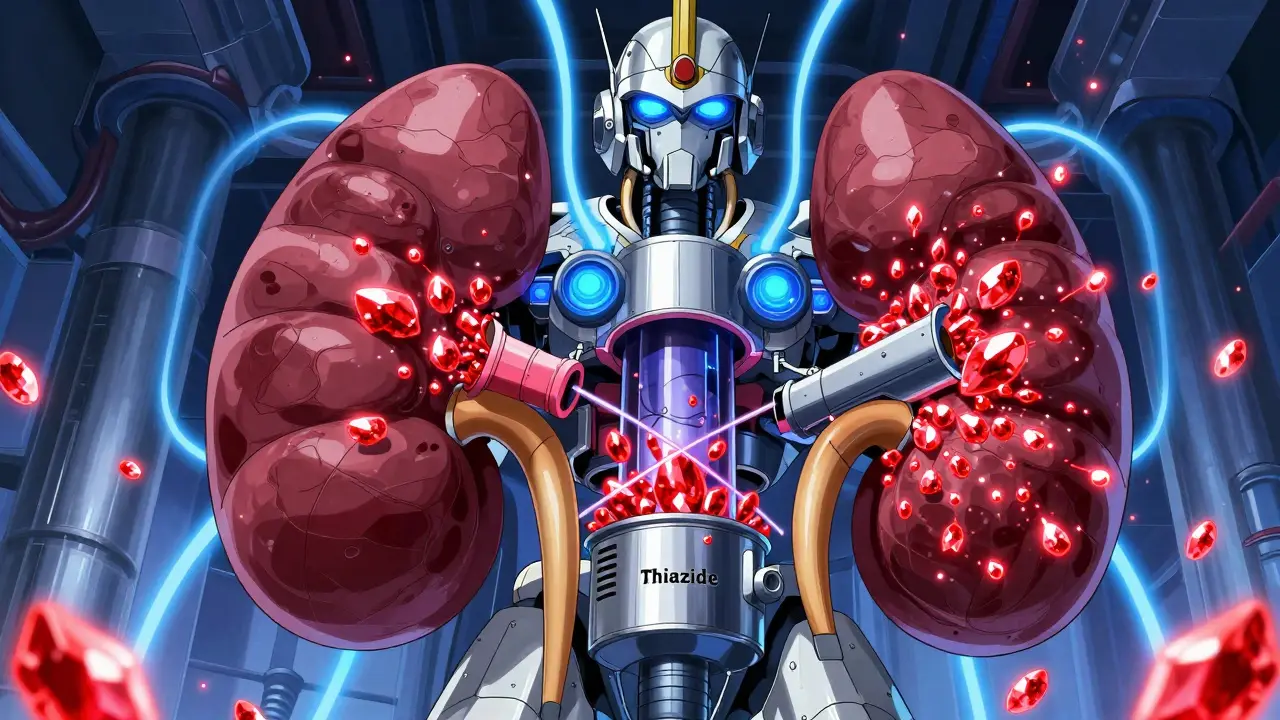
To understand why this happens, we have to look at the kidneys. Thiazide diuretics is a class of antihypertensive medications that lower blood pressure by blocking sodium reabsorption in the distal convoluted tubule of the kidney. This process helps you flush out excess salt and water, which reduces the volume of blood pumping through your veins.
The problem is that the kidneys use specific "doors" called transporters to move waste. Hydrochlorothiazide (HCTZ), one of the most common thiazides, competes with uric acid for a spot on a transporter called OAT1. Think of it like a crowded bus; when HCTZ jumps on the bus first, uric acid gets left behind. Instead of being flushed out in your urine, the uric acid stays in your blood.
This process is further complicated by OAT4 transporters, which can actually pull uric acid back into the bloodstream. Clinical data shows that this shift can increase your serum uric acid levels by 6% to 21% from where they started. In some cases, this jump happens quickly-often within just 3 to 7 days after you start the medication or increase your dose.
The Path from High Uric Acid to a Gout Attack
Having high uric acid in your blood (a condition called hyperuricemia) doesn't always mean you'll get gout. In fact, while about 12-15% of people on thiazides develop high uric acid, only 1-2% actually experience a full-blown gout attack. Whether you feel the pain usually depends on your genetics, your diet, and how well your kidneys function.
Gout happens when uric acid levels cross a specific threshold-typically 6.8 mg/dL. At this point, the acid can no longer stay dissolved in your plasma and starts forming sharp, needle-like crystals. These crystals settle in the joints, most commonly the first metatarsophalangeal joint (the base of your big toe), causing intense inflammation and pain.
The risk isn't just a one-time event. Research shows that the longer you stay on these diuretics, the higher the risk becomes. People using these drugs for more than 180 days show a significantly higher likelihood of needing anti-gout medication compared to those who just started.

Comparing Common Diuretics and Gout Risk
Not all "water pills" are created equal. While both thiazides and loop diuretics (like furosemide) can raise uric acid, some studies suggest loop diuretics have an even stronger link to gout.
| Diuretic Class | Effect on Uric Acid | Relative Gout Risk | Key Example |
|---|---|---|---|
| Thiazide | Increases (OAT1 competition) | Moderate to High | Hydrochlorothiazide |
| Loop Diuretic | Increases (Significant) | Highest | Furosemide |
| Potassium-Sparing | Neutral/Minimal | Low | Spironolactone |
The "Prescribing Cascade" Danger
One of the biggest concerns for doctors is the "prescribing cascade." This happens when a side effect of one drug is mistaken for a new medical condition, leading to a second prescription. In this case, a patient takes a thiazide for hypertension, develops hyperuricemia, and is then prescribed allopurinol or colchicine to treat the resulting gout.
Roughly 18.7% of thiazide users end up needing these anti-gout meds within two years. While this manages the symptoms, it adds more chemicals to the body and increases the potential for drug-drug interactions. This is why it's so important to check your uric acid levels *before* starting a diuretic if you have a history of joint pain.

Better Alternatives and Management Strategies
If you have a history of gout, you don't have to just "deal with the pain." There are several ways to manage your blood pressure without risking a flare-up.
- Switching Medications: Losartan is a popular choice because it actually helps the kidneys excrete uric acid, making it a double win for patients with both hypertension and gout. Calcium channel blockers are another neutral option.
- Potassium-Sparing Options: As mentioned, drugs like spironolactone don't typically cause the same uric acid spikes.
- Lifestyle Tweaks: If you must stay on a thiazide, focus on lowering purines. This means cutting back on alcohol (especially beer) and red meats, which can keep your baseline uric acid lower.
- Proactive Monitoring: If your serum uric acid is above 8.0 mg/dL, most current guidelines advise against using thiazides as a solo therapy without also using a urate-lowering drug.
Next Steps for Patients and Caregivers
If you are currently taking a thiazide and notice new joint stiffness or pain, don't ignore it. Start by documenting when the pain occurs and whether it correlates with any dose changes in your medication.
Ask your doctor for a simple blood test to check your uric acid levels. If you're in the "danger zone" (above 7.0 mg/dL for men or 6.0 mg/dL for women), it's time to have a conversation about whether a different class of antihypertensive might be safer for your specific chemistry.
Does stopping the diuretic instantly fix the uric acid levels?
Not instantly. While the drug leaves your system quickly, clinical observations show that uric acid levels typically take about 2 to 3 months to fully return to your baseline levels after you stop taking a diuretic.
Is Chlorthalidone worse for gout than Hydrochlorothiazide?
Actually, recent data suggests the risk is quite similar. Earlier beliefs held that chlorthalidone was riskier, but a 2019 comparison study found that patients on similar doses of either drug had a similar risk of developing new-onset gout.
Can I take Allopurinol while staying on my water pill?
Yes, and in many cases, it is recommended. If a thiazide is the best option for your heart health but you have high uric acid, doctors often prescribe allopurinol (starting at 100mg daily) to keep your uric acid levels below 6.0 mg/dL and prevent crystals from forming.
Why does the big toe usually hurt first?
Uric acid crystals are less soluble at lower temperatures. Since your big toe is further from your core and generally cooler than the rest of your body, the crystals are more likely to precipitate and settle there first.
Are there any diuretics that don't cause this problem?
Yes, potassium-sparing diuretics like spironolactone generally do not share the hyperuricemic effect seen with thiazides and loop diuretics, making them a safer choice for those with gout.
