
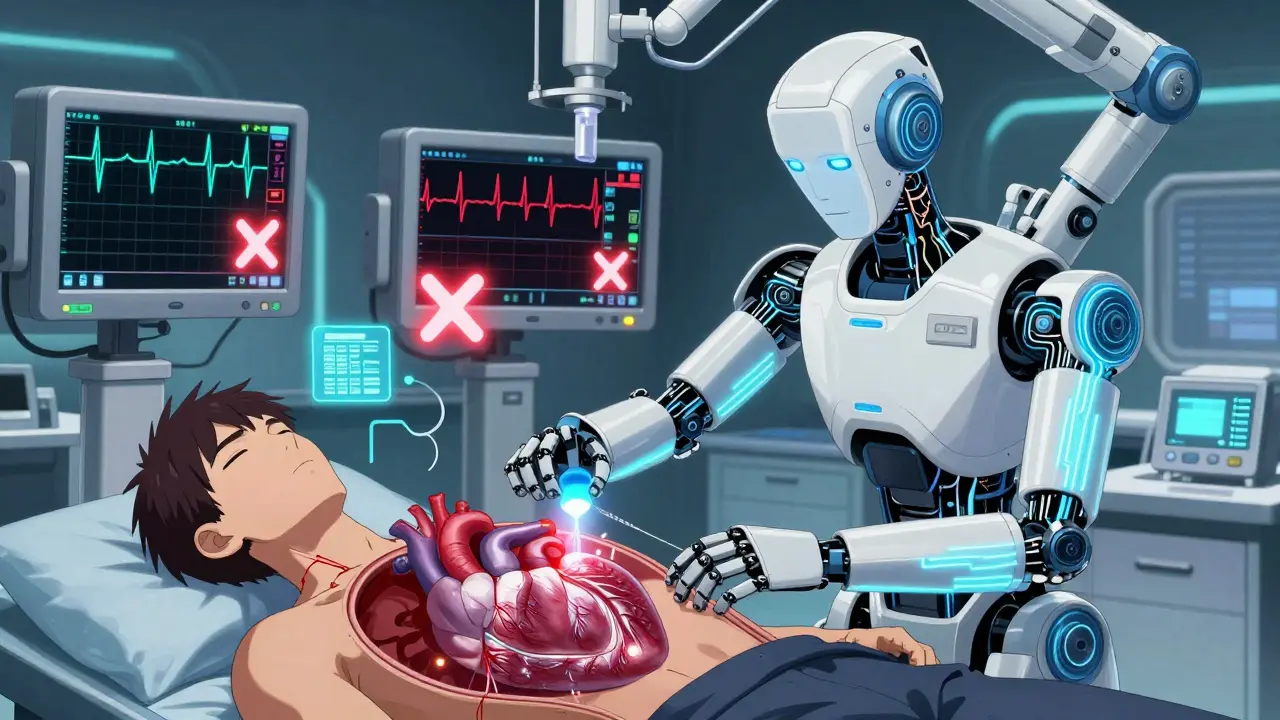
Torsades de Pointes isn’t something most people have heard of - until it’s too late. It’s a dangerous, irregular heart rhythm that can strike without warning, often triggered by common medications. Unlike a typical heart palpitation, this isn’t just discomfort. It’s a medical emergency that can spiral into sudden cardiac arrest. And the scary part? It’s almost always preventable.
What Exactly Is Torsades de Pointes?
Torsades de Pointes (TdP) is a specific type of irregular heartbeat that shows up on an ECG as a twisting pattern of the QRS complexes - hence the name, which means "twisting of the points" in French. It doesn’t happen on its own. It’s always linked to a prolonged QT interval on the ECG. The QT interval measures how long it takes the heart’s ventricles to recharge between beats. When that time stretches too long, the heart’s electrical system becomes unstable, and TdP can kick in.This isn’t just a theoretical risk. About 4 out of every million women and 2.5 out of every million men experience drug-induced TdP each year. And when it happens, 10% to 20% of cases turn fatal if not treated immediately. The good news? Most cases happen in people who are already at higher risk - and those risks can be spotted before it’s too late.
Which Medications Cause QT Prolongation?
Over 200 medications are known to lengthen the QT interval. Some are obvious culprits - like certain antiarrhythmics - but many are everyday prescriptions you might not suspect.- Antibiotics: Erythromycin, clarithromycin, and moxifloxacin
- Antidepressants: Citalopram and escitalopram (especially at doses above 20 mg/day in older adults)
- Antipsychotics: Haloperidol, thioridazine, ziprasidone
- Antiemetics: Ondansetron (particularly IV doses over 16 mg)
- Antifungals: Ketoconazole, voriconazole
- Opioid replacement: Methadone (risk rises sharply above 100 mg/day)
The CredibleMeds database classifies these drugs into three levels: Known Risk, Possible Risk, and Conditional Risk. Drugs like methadone and citalopram are in the highest-risk group. Even azithromycin, once thought to be low-risk, was linked to a small increase in heart-related deaths in older adults in a 2012 study - though the FDA still considers it safe when used appropriately.
Who’s Most at Risk?
It’s not just about the drug. It’s about the person taking it. Nearly 9 out of 10 TdP cases happen in people with one or more modifiable risk factors.- Women: 70% of cases occur in women, even though men and women experience similar QT prolongation from drugs.
- Age over 65: Two-thirds of cases are in older adults.
- Low potassium or magnesium: 43% of cases have low potassium (below 3.5 mmol/L); 31% have low magnesium (below 1.6 mg/dL). These electrolytes help stabilize heart rhythms.
- Slow heart rate: Over half of TdP cases happen when the heart rate is under 60 bpm.
- Multiple QT-prolonging drugs: Taking two or more of these medications together increases risk by nearly 30%.
- Heart disease or kidney/liver problems: 41% of patients have pre-existing heart conditions. Impaired kidneys or liver can cause drugs to build up in the body, raising the risk.
- Genetics: People with inherited long QT syndrome - even if undiagnosed - are far more vulnerable.
Here’s the reality: A healthy 30-year-old taking one low-risk drug might never have an issue. But a 72-year-old woman on citalopram, with low potassium, taking clarithromycin for a sinus infection, and with mild kidney disease? That’s a perfect storm.
How to Spot It Before It’s Too Late
The key to prevention is early detection. TdP often comes without symptoms - no chest pain, no dizziness. But the ECG tells the story.Here’s what to look for:
- QTc > 500 ms (corrected QT interval) - this doubles or triples your risk.
- QTc increase of 60 ms or more from baseline - even if it’s under 500 ms.
- Prominent U waves on the ECG - a sign the heart is struggling to repolarize.
- Short-long cycle pattern - a brief pause followed by a long beat, often right before TdP starts.
Many doctors skip baseline ECGs before prescribing QT-prolonging drugs. That’s a mistake. The American Heart Association, American College of Cardiology, and Heart Rhythm Society all recommend an ECG before starting high-risk medications - and again if the dose is increased.
For methadone, guidelines say: ECG at start, then again when the dose hits 100 mg/day. For citalopram, don’t go above 20 mg/day if you’re over 60. For ondansetron, avoid IV doses over 16 mg. These aren’t suggestions - they’re safety thresholds backed by data.
How to Prevent It
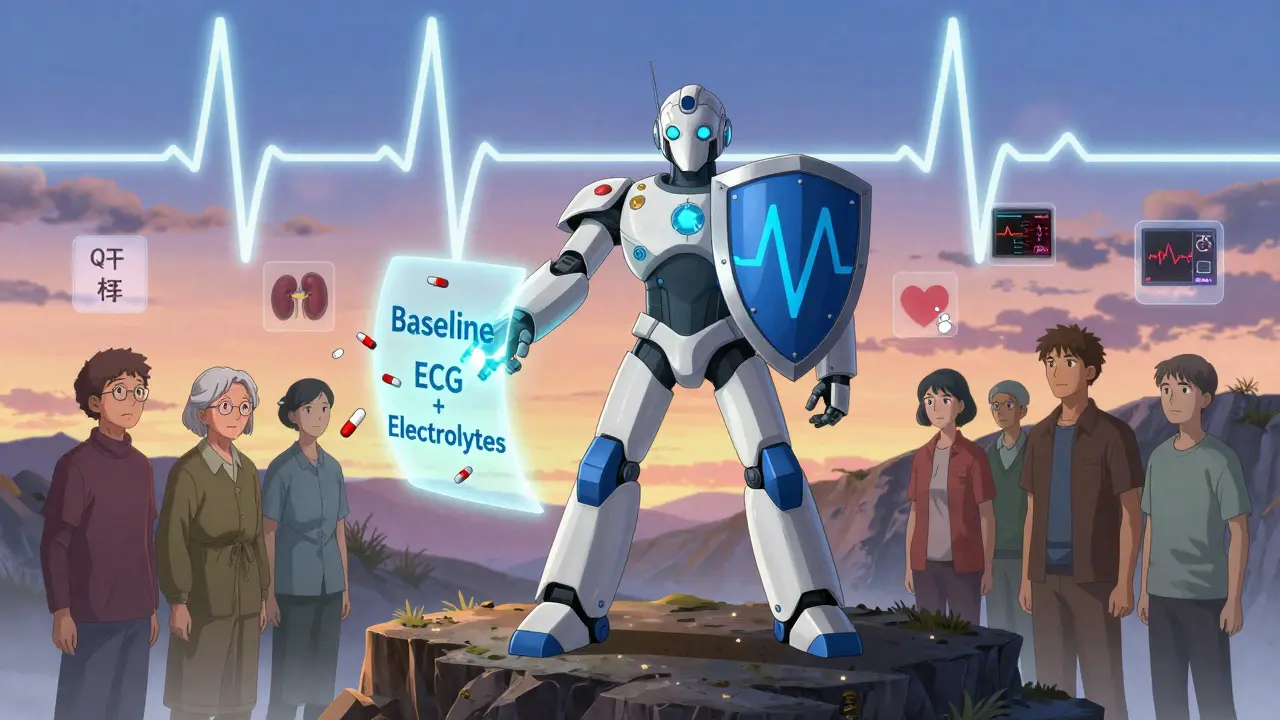
Prevention is a five-step process used by cardiac safety experts:- Screen for inherited long QT: Use the Schwartz score - a simple tool based on family history, ECG findings, and symptoms like fainting.
- Check electrolytes: Get potassium and magnesium levels before starting any high-risk drug. Correct low levels first. Aim for potassium above 4.0 mmol/L and magnesium above 2.0 mg/dL.
- Review all medications: Use CredibleMeds.org to check if any drug you’re taking - even over-the-counter - can prolong QT. Don’t forget herbal supplements like licorice root, which can lower potassium.
- Get a baseline ECG: Measure the QTc before starting the drug. Recheck after dose changes or if symptoms appear.
- Set up monitoring: For high-risk patients, schedule follow-up ECGs at 1 week and 1 month. If QTc jumps by 60 ms or hits 500 ms, stop the drug.
VA Healthcare System data from 2018 to 2022 showed that following this protocol reduced TdP cases by 78%. That’s not luck - that’s systematic care.
What to Do If TdP Happens
If someone goes into TdP, time is everything. The heart is quivering chaotically. It can turn to ventricular fibrillation and stop beating.Immediate steps:
- Magnesium sulfate: Give 1-2 grams IV immediately. It works in 82% of cases, even if magnesium levels are normal.
- Stop the offending drug: Immediately discontinue the medication causing the problem.
- Temporary pacing: Speed up the heart rate to over 90 bpm. This shortens the QT interval and stops the arrhythmia. It’s successful in 76% of cases.
- Isoproterenol: If pacing isn’t available, this drug can be used to increase heart rate.
- Correct electrolytes: Replenish potassium and magnesium as soon as possible.
Defibrillation is needed if TdP turns into ventricular fibrillation. But if caught early, magnesium and pacing can stop it without shocks.
The Bigger Picture: Regulations and New Tools
Since the 1990s, over a dozen drugs have been pulled from the market because of TdP risk - like terfenadine (Seldane) and cisapride (Propulsid). Today, every new drug must be tested for QT prolongation before approval. That’s added $1.2 million and 6-8 months to development costs.New tools are emerging. Mayo Clinic developed a machine learning model that predicts individual TdP risk with 89% accuracy by analyzing 17 factors - age, sex, kidney function, drug combinations, and more. The CredibleMeds database added 12 new drugs to its "Known Risk" list in 2023, including lesinurad and fedratinib. Domperidone was downgraded from "Known" to "Possible Risk" after new data showed lower risk than thought.
The 2022 PREVENT TdP Act proposed in the U.S. Congress would standardize ECG monitoring for high-risk drugs across hospitals and clinics. If passed, it could prevent 185 to 270 deaths each year - at a cost of $227 million annually. That’s a bargain if you consider the human cost of one preventable death.
Final Takeaway: It’s Not About Avoiding Drugs - It’s About Managing Risk
Some doctors avoid prescribing QT-prolonging drugs altogether. That’s not the answer. Many of these drugs - like methadone for opioid addiction or citalopram for depression - are life-changing or even life-saving.The goal isn’t to eliminate them. It’s to use them safely. A 68-year-old woman with depression shouldn’t be denied citalopram. But she should have her potassium checked, her ECG monitored, and her other medications reviewed. A 55-year-old man on methadone shouldn’t be denied pain control - but he needs an ECG at 100 mg/day.
Drug-induced TdP is rare. But when it happens, it’s devastating. And it’s almost always preventable. The tools are there. The guidelines are clear. What’s missing is consistent practice.
If you’re taking any of these medications - or prescribing them - don’t assume "it won’t happen to me." Check the numbers. Look at the ECG. Fix the potassium. Talk to your pharmacist. One simple step can mean the difference between a routine prescription and a cardiac arrest.

man i had no idea my zpack could do this. my grandma almost died last year after they gave her erythromycin for a cold. she’s 78, on citalopram, and her potassium was always low. doc never checked her ekg. scary stuff.
thanks for laying this out.
oh wow. so the real villain here isn’t the drug-it’s the doctor who thinks ‘it’s probably fine’ and skips the ekg like it’s optional. congrats, healthcare system. you turned a simple check into a lottery ticket.
let’s be brutally honest: this isn’t about medical guidelines. it’s about capitalism’s failure to prioritize human life over patent timelines and profit margins. every time a drug gets approved without rigorous long-term cardiac monitoring, we’re trading lives for quarterly earnings.
the fact that we need a *database* to tell us what kills people? that’s not progress. that’s systemic negligence dressed up as science.
and don’t get me started on how the FDA still lets azithromycin on shelves after that 2012 study. they’re not protecting us-they’re protecting Big Pharma’s bottom line.
in south africa, we’ve seen this play out with methadone clinics-patients on high doses, no ekg, no electrolyte checks. the result? preventable deaths that get buried in paperwork.
but here’s the thing: it’s not just about the meds. it’s about access. if you’re poor, rural, or uninsured, you don’t get a baseline ekg. you get a script and a prayer.
the solution isn’t just more guidelines-it’s equity. someone’s life shouldn’t depend on whether they live near a hospital with an ecg machine.
you think this is about meds? nah. it’s the vaccines. they altered the ion channels in everyone’s heart during the rollout. that’s why QT prolongation is suddenly ‘common’-they’ve been testing it on us for years. the cdc won’t admit it, but if you look at the raw data from 2021… it’s all connected.
also, did you know licorice root is a government plant? they put it in candy to lower potassium so we’d get more arrhythmias. it’s a population control thing. check the source.
the five-step prevention protocol is gold. i’ve trained nurses in rural clinics using this exact framework. simple, actionable, free. the biggest barrier? time. doctors are rushed. but if you make it part of the checklist-like ‘check vitals’-it sticks.
and yes, magnesium sulfate works even if levels are normal. i’ve seen it reverse torsades in under 90 seconds. it’s a miracle drug that costs $12 a vial.
we don’t need more tech. we need more discipline.
critical clarification: QTc >500 ms is a hard stop, but the delta >60 ms from baseline is equally significant-and often overlooked. many clinicians fixate on absolute values and miss dynamic changes. serial ekgs are non-negotiable for high-risk regimens.
also, ondansetron IV >16 mg is a class i risk. the 2012 meta-analysis in jama cardiology showed a 3.8x increase in arrhythmia events. yet, ERs still push 24 mg doses for nausea. this is iatrogenic harm.
to the person who said ‘it won’t happen to me’-you’re right. it probably won’t. but it might happen to your mom, your dad, your aunt who’s on methadone for pain and citalopram for anxiety. we need to stop treating this like it’s someone else’s problem.
if you’re on any of these meds, ask your pharmacist: ‘is this on crediblemeds?’ it takes 10 seconds. do it.
americans be like: ‘oh no, my zpack might kill me!’ while china’s got 1.4 billion people on daily antipsychotics and zero reports. guess what? we’re weak. we overprescribe, overtest, and overfreak out. just take the damn pill. if your heart stops, you were gonna die anyway.
also, potassium? eat a banana. done. stop making this a medical circus.
OMG I JUST REALIZED I’M ON ONDANSETRON AND CITALOPRAM 😱 I’M SO SCARED RIGHT NOW!! 😭
also, can we talk about how the FDA is literally just a puppet for big pharma? 🤡 #TdPawareness #SaveOurHearts 💔🫀
the va’s 78% reduction stat is the most important number here. when systems are designed to catch risk-not just react to it-lives are saved. this isn’t magic. it’s workflow integration: ehr alerts, pharmacist reviews, automated potassium flags.
we know how to fix this. we just need to stop treating cardiac safety as an afterthought.
if you’re on methadone, get an ekg at 100mg. if you’re over 60 and on citalopram, don’t go past 20mg. if you’re on antibiotics and antidepressants together? ask your doc if it’s safe.
that’s it. no fancy tech. just basic checks. stop overcomplicating it.
people like you make me sick. you’re just trying to scare folks into avoiding meds so you can feel morally superior. if you’re so worried about torsades, why don’t you move to a cave and live off berries? no drugs. no doctors. no risk.
your fearmongering is just another form of arrogance.
as a med student from india, i’ve seen this in our rural hospitals-patients on erythromycin for pneumonia, no ekg, no labs. we don’t even have machines sometimes. but when i showed my resident the crediblemeds list, he started checking potassium before every script.
small change. big impact.
thanks for writing this. it’s helping people like me speak up.
the notion that ‘it’s preventable’ implies personal responsibility. but what about the elderly patient who can’t afford potassium supplements? the single mother on Medicaid who can’t schedule an ekg? the undocumented worker prescribed methadone without follow-up?
systemic failure is not a personal choice. stop blaming the patient.