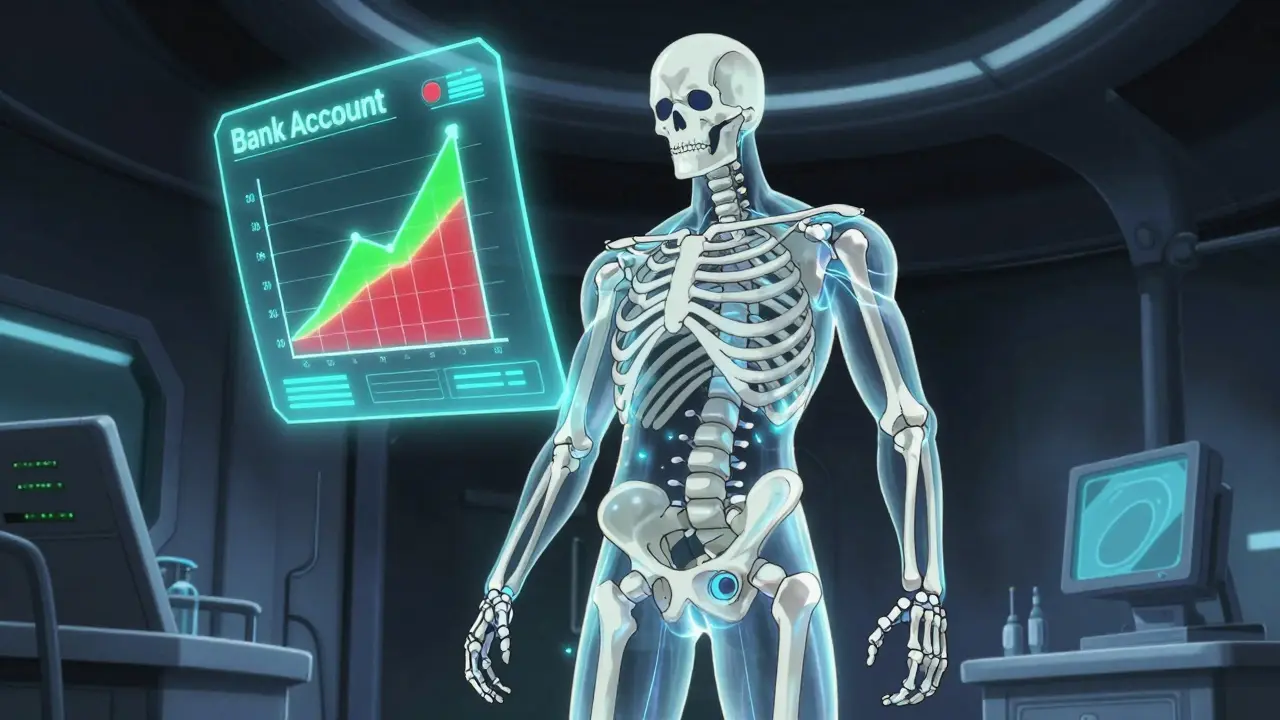
Imagine your skeleton as a bank account. For the first few decades of your life, you’re depositing calcium and building strong assets. But around age 30, the deposits stop, and the withdrawals begin. Most people don’t notice the balance dropping until they’ve already overdrafted-often with a broken hip or wrist from a simple fall. This silent thief is osteoporosis, a systemic skeletal disease characterized by low bone mass and deterioration of bone tissue microarchitecture. It’s not just an "old person’s problem"; it’s a structural failure that starts years before the first fracture occurs.
The statistics are stark. According to the International Osteoporosis Foundation (IOF) 2023 report, approximately 200 million women worldwide live with this condition. In the UK and US, we see that 1 in 3 women and 1 in 5 men over 50 will experience an osteoporotic fracture. The stakes are high: hip fractures carry a 20-24% mortality rate within 12 months, as reported by NHS clinical guidelines. But here is the good news: unlike many chronic conditions, osteoporosis is largely preventable if you understand how bone biology works and act on it early.
Understanding Your Bone Bank Account
To prevent bone loss, you need to understand what happens inside your skeleton. Bones are living tissue, constantly breaking down old cells and building new ones. This process is called bone remodeling. When you are young, your body builds bone faster than it breaks it down. You reach your peak bone mass between ages 25 and 30. Think of this peak as your maximum savings potential.
After 30, the scales tip. Everyone loses bone gradually-at about 0.3% to 0.5% per year. But for women, menopause acts like an accelerator pedal. During the first 5 to 7 years after menopause, bone loss can skyrocket to 2-3% annually due to the drop in estrogen, a hormone that protects bones. Professor Cyrus Cooper, Director of the MRC Lifecourse Epidemiology Unit, notes that peak bone mass achieved by age 30 accounts for 60-80% of lifetime osteoporosis risk. If you didn’t build a strong foundation in your youth, you have less buffer against this inevitable decline.
Who Is at Highest Risk?
Not everyone loses bone at the same rate. Your risk profile is shaped by factors you can change and those you cannot. Understanding these helps you gauge where you stand.
Non-modifiable risks (The cards you were dealt):
- Age: Individuals over 65 have 4.2 times higher fracture risk than those under 50, according to the National Health and Nutrition Examination Survey (NHANES).
- Gender: Women are four times more likely to develop osteoporosis than men. This is due to lower peak bone mass and the rapid loss during menopause.
- Ethnicity: White and Asian women face a 1.7 times higher risk compared to Black women, based on the Multi-Ethnic Study of Atherosclerosis.
- Genetics: If your parents had a hip fracture, your risk increases by 60-80%. The Framingham Osteoporosis Study confirms that family history is a powerful predictor.
- Early Menopause: Going through menopause before age 45 doubles your risk compared to natural menopause at age 50-55.
Modifiable risks (The choices you make):
- Low Calcium Intake: Consuming less than 1,000mg of calcium daily contributes to a 30-40% higher fracture risk.
- Vitamin D Deficiency: With levels below 20ng/mL, your fracture risk jumps by 33%. NHANES 2023 data shows this affects 42% of adults.
- Smoking: Smoking one pack a day elevates risk by 55% because toxins impair calcium absorption and disrupt estrogen metabolism.
- Alcohol: Drinking more than two units a day increases hip fracture risk by 41%.
- Sedentary Lifestyle: Lack of movement leads to 25-30% higher fracture risk. Bones need stress signals to stay strong.
The Silent Threat: Secondary Osteoporosis
While most cases are primary (age-related), about 5% of cases are secondary, caused by medical conditions or medications. These often present with more severe bone loss and require specific management.
Corticosteroids, commonly prescribed for asthma or autoimmune diseases, are major culprits. Long-term users lose 5-15% of their bone density in the first year alone, compared to the usual 0.5-1% annual loss. Other conditions like rheumatoid arthritis increase fracture risk by 30-50% due to chronic inflammation. Even diabetes plays a role: Type 1 diabetes increases risk sixfold, while Type 2 diabetes raises it by 1.4 times, despite patients often having normal bone density scans. This paradox means standard tests can miss danger signs in diabetic patients.
| Factor | Primary Osteoporosis | Secondary Osteoporosis |
|---|---|---|
| Prevalence | 95% of cases | 5% of cases |
| Main Cause | Aging, Menopause | Medications, Chronic Disease |
| Bone Loss Rate | 0.5-1% per year | Up to 15% in first year (steroids) |
| Detection Challenge | Slow, gradual decline | Rapid loss, often masked by other symptoms |
How Doctors Measure Your Risk
You can’t manage what you don’t measure. The gold standard for diagnosing bone health is the DXA scan (Dual-energy X-ray Absorptiometry). It measures bone mineral density (BMD) and assigns a T-score.
- Normal: T-score of -1.0 or higher.
- Osteopenia: T-score between -1.0 and -2.5 (low bone mass, but not yet osteoporosis).
- Osteoporosis: T-score of -2.5 or lower.
However, relying solely on BMD is outdated. Dr. Nelson Watts of the National Osteoporosis Foundation warns that focusing only on density misses up to 50% of individuals who will fracture. That’s why clinicians now use the FRAX tool. Developed by the WHO, FRAX calculates your 10-year probability of a major fracture by combining BMD with clinical risk factors like age, weight, smoking status, and prior fractures. It has a 76% accuracy rate in predicting outcomes.
Crucially, your fracture history matters most. Dr. Ethel Siris states that a single fragility fracture doubles the risk of another. If you’ve broken a bone from a standing height fall, your risk skyrockets regardless of your current scan results.
Action Plan: Rebuilding and Protecting Bone
Prevention isn’t passive. It requires active intervention in three areas: nutrition, movement, and safety.
1. Fuel Your Bones Correctly
Calcium is the brick, but Vitamin D is the mortar. Without Vitamin D, your gut absorbs very little calcium. The Endocrine Society recommends 800-1000 IU of Vitamin D daily to maintain protective serum levels above 30ng/mL. If you are deficient, you may need 2000 IU daily to correct it within 3-4 months.
For calcium, aim for 1,000-1,200mg of elemental calcium daily. Food sources are best: dairy, leafy greens, and fortified plant milks. If you supplement, split the dose. Your body can only absorb 500-600mg at a time. Taking 1200mg in one pill wastes half the nutrient.
2. Move with Purpose
Bones respond to mechanical stress. The American College of Sports Medicine recommends a specific mix:
- Weight-bearing aerobic exercise: Brisk walking, jogging, or stair climbing for 30-45 minutes, 5 days a week.
- Resistance training: Lifting weights or using resistance bands 2 days a week.
A Yale Medicine clinical trial showed that structured weight-bearing exercise reduced fracture risk by 30-40%. You’ll start seeing measurable improvements in bone density after 6-12 months of consistency.
3. Fall Proof Your Life
If your bones are brittle, a fall is catastrophic. The CDC’s STEADI program shows that home safety modifications and balance training reduce fracture risk by 29% within a year. Remove tripping hazards like loose rugs, improve lighting in hallways, and wear sturdy shoes indoors. Balance exercises like tai chi are highly effective for older adults.
Treatment Options When Prevention Isn't Enough
If you are diagnosed with osteoporosis, medication becomes part of the strategy. Bisphosphonates (like alendronate) are the first line of defense, slowing bone breakdown. However, patient forums reveal that 75% of users struggle with side effects like gastrointestinal issues, leading many to stop treatment prematurely.
Newer options offer hope. Romosozumab-alto (Evenity), approved by the FDA in 2023, does something unique: it increases bone formation while decreasing resorption. In clinical trials, it reduced new vertebral fractures by 73% compared to traditional treatments. For high-risk patients, this dual action can be a game-changer.
Emerging research also looks at the gut microbiome. Specific probiotic strains, like Lactobacillus reuteri, have been shown in pilot studies to increase bone density by 1.5-2.0% over 12 months. While still early, this suggests that overall gut health may play a role in skeletal strength.
Realistic Expectations and Next Steps
Osteoporosis is a long game. You won’t rebuild bone overnight. But the cost of inaction is steep. Osteoporotic fractures cost the US healthcare system $57 billion annually, and that number is rising. More importantly, a hip fracture can end independence forever.
Start today. Check your Vitamin D levels. Add a brisk walk to your daily routine. Ensure you’re eating enough calcium. If you’re over 50 and have risk factors, ask your doctor for a FRAX assessment. Your bones are the framework for your entire life-treat them with the respect they deserve.
At what age should I get my bone density tested?
The USPSTF recommends DXA scans for all women over 65. For women aged 50-64, testing is recommended if you have significant risk factors such as a prior fracture, parental history of hip fracture, or long-term steroid use. Men over 70 should also consider screening, especially if they have risk factors like smoking or excessive alcohol use.
Can I reverse osteoporosis naturally without medication?
You cannot fully reverse established osteoporosis with lifestyle changes alone, but you can significantly slow progression and strengthen remaining bone. High-intensity weight-bearing exercise, optimal calcium and Vitamin D intake, and fall prevention are critical. Medication is usually required for T-scores below -2.5 or if you have had a fragility fracture, as lifestyle changes work too slowly to prevent imminent breaks in severe cases.
What are the early signs of bone loss?
Bone loss is often silent. There are no obvious early symptoms. However, subtle signs may include receding gums, weaker grip strength, easy bruising, or back pain from minor vertebral fractures. Many people don't realize they have lost bone density until they suffer a fracture from a minor fall or even sneezing.
Is yoga safe for people with osteoporosis?
Yoga can be beneficial for balance and flexibility, but some poses are dangerous. Avoid forward bends that compress the spine, such as toe touches or sit-ups, as these can cause vertebral fractures. Instead, focus on upright poses that strengthen the back extensors. Always consult a physical therapist familiar with osteoporosis before starting a new yoga routine.
How much calcium do I really need every day?
Adults under 50 need 1,000mg of calcium daily. Women over 50 and men over 70 need 1,200mg daily. It is best to get this from food sources like dairy, sardines, kale, and fortified foods. If you supplement, do not take more than 500-600mg at once, as your body cannot absorb larger amounts efficiently. Split your dose between breakfast and dinner.
