
Have you ever taken a pill with your morning coffee, only to wonder if it even worked? You’re not alone. Millions of people take medications without thinking about what they’re eating-or not eating-around the time they swallow them. But the truth is, food can make or break how well your medicine works. Sometimes it boosts effectiveness. Other times, it turns your pill into a useless lump in your stomach. And in the worst cases, it can cause real harm.
Why Food Changes How Medicines Work
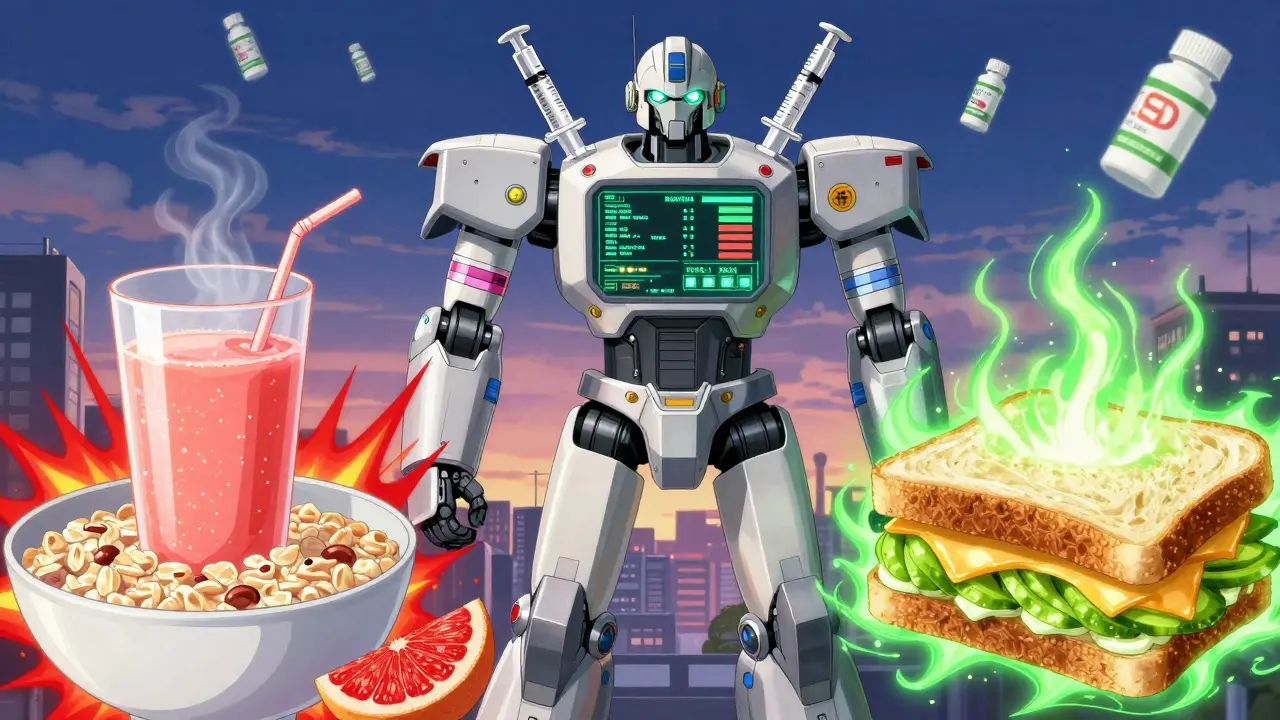
Your stomach isn’t just a passive container. It’s a chemical factory. When you eat, your body shifts gears: acid levels rise and fall, bile flows, digestion slows or speeds up, and blood flow changes. All of this affects how drugs get absorbed into your bloodstream. For example, food can raise your stomach’s pH from 1.5 (super acidic) to 4 or higher. That’s a big deal for drugs like penicillin V, which break down fast in high pH environments. A 2022 study showed these antibiotics lose up to 40% of their strength when taken with food. On the flip side, fats in your meal help dissolve drugs like griseofulvin, boosting absorption by half. Calcium in dairy can bind to tetracycline antibiotics, blocking their path into your system-reducing effectiveness by up to 75%. Even something as simple as grapefruit juice can be dangerous. It interferes with enzymes that break down statins like simvastatin and atorvastatin. One glass can spike blood levels by 300-500%, raising your risk of muscle damage by 15 times. That’s not a myth. It’s a documented medical emergency waiting to happen.Medications That Need an Empty Stomach
Some drugs are so sensitive to food that even a snack can ruin their effect. Here are the big ones:- Levothyroxine (Synthroid): This thyroid hormone replacement is one of the most common medications with strict food rules. Eating-even a small bowl of oatmeal-can cut absorption by 20-50%. A 2022 meta-analysis found patients who took it with breakfast had TSH levels as if they were missing a quarter of their doses. The fix? Take it first thing in the morning, on an empty stomach, and wait at least 30-60 minutes before eating or drinking anything except water.
- Alendronate (Fosamax): This osteoporosis drug needs to hit your bones fast. Food reduces absorption by 60%. Even coffee, tea, or orange juice can interfere. You must take it with a full glass of plain water, stand upright for 30 minutes, and wait 30-60 minutes before eating. Miss this step, and you’re not just wasting money-you’re risking fractures.
- Sucralfate (Carafate): This ulcer coating agent only works if it sticks to the stomach lining before food arrives. Take it 1 hour before meals. If you eat first, it’s like putting a bandage on after the wound’s already infected.
- Ampicillin: Food slashes peak blood levels by 35% and total exposure by 28%. The FDA label says take it 30 minutes before or 2 hours after meals.
- Zafirlukast (Accolate): Used for asthma, this drug’s absorption drops 40% with food. Take it 1 hour before or 2 hours after eating.
- PPIs like omeprazole and esomeprazole: These acid blockers only work if taken before food triggers acid production. Nexium needs at least 1 hour before breakfast. Wait too long, and you’re fighting yesterday’s acid, not today’s.
Medications That Need Food
Other drugs are worse on an empty stomach. Food isn’t just helpful-it’s protective.- NSAIDs like ibuprofen and naproxen: These painkillers irritate your stomach lining. Taking them without food raises your risk of ulcers by 50-70%. A 2020 meta-analysis in Gastroenterology showed that taking them with a meal cuts hospitalizations from GI bleeding by thousands each year. If you take these regularly, food isn’t optional-it’s a safety net.
- Aspirin (high-dose): At doses used for pain or arthritis, aspirin can cause stomach irritation in 25% of people. With food, that drops to 8%. Bayer’s 2022 data confirms this isn’t just advice-it’s prevention.
- Duloxetine (Cymbalta): This antidepressant causes nausea in many people. Eli Lilly’s post-marketing data shows taking it with food reduces nausea by 30%. If you’ve been struggling with side effects, try your next dose with a light snack.
- Statins (atorvastatin, simvastatin): Food helps your body absorb these cholesterol-lowering drugs better. But here’s the catch: avoid grapefruit juice. It’s not just a warning-it’s a red flag. One glass can turn a safe dose into a toxic one.
- Mesalamine: Used for Crohn’s and ulcerative colitis, this drug often causes nausea. One patient on HealthUnlocked said taking it with food cut her nausea from daily to once a month. That’s a game-changer for quality of life.
What Does “Empty Stomach” Really Mean?
You’ve probably seen “take on an empty stomach” on your prescription label. But what does that actually look like? The American Pharmacists Association defines it as taking the medication 1 hour before or 2 hours after eating. That’s not a suggestion-it’s the window where your stomach is truly clear. A 2021 FDA study showed gastric emptying time varies wildly: 15 minutes for liquids, up to 4 hours for fatty meals. So if you take your pill after a big lunch, you’re not just waiting-you’re gambling. “Empty stomach” also means no coffee, no juice, no milk. Even a sip of coffee with cream can interfere with levothyroxine. A Reddit user named u/ThyroidWarrior spent two years with wild TSH levels-until she realized her morning coffee was the culprit. She switched to taking her pill at 4 a.m. and waiting 90 minutes. Her levels stabilized.What Does “With Food” Actually Mean?
“With food” doesn’t mean a handful of crackers. It means a meal of 500-800 calories. That’s enough to trigger bile flow and slow gastric emptying. A banana and toast? Probably not enough. A sandwich with avocado and cheese? That’s the sweet spot. For NSAIDs, the goal isn’t just absorption-it’s protection. A 2020 study found that even a small amount of food reduces stomach irritation significantly. You don’t need a full roast dinner. Just enough to coat the lining.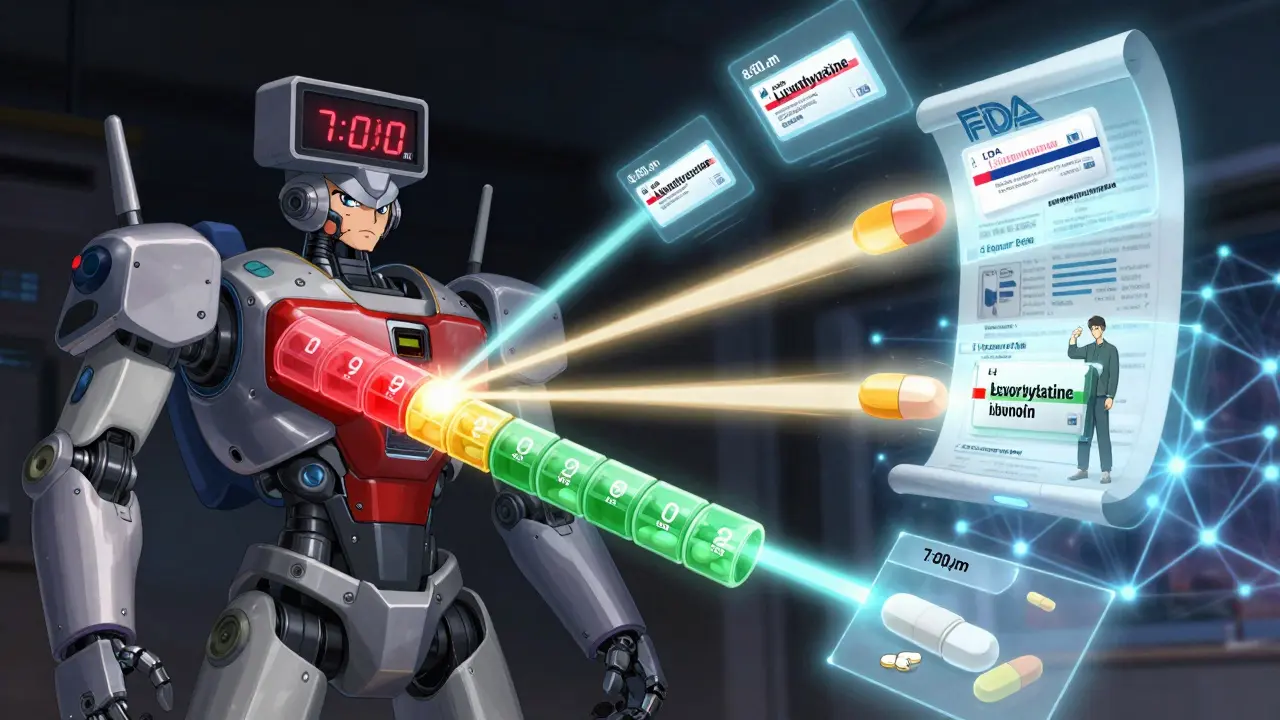
How to Get It Right Every Time
Here’s how to avoid the most common mistakes:- Use the 2-1-2 Rule: For empty stomach meds: 2 hours after eating, 1 hour before, or 2 hours after. Stick to it.
- Label your pill organizer: Use color-coded stickers-red for empty stomach, green for with food. A 2021 study showed this boosted correct use from 52% to 89%.
- Set phone alarms: Apps like Medisafe and GoodRx now send food-timing alerts. Users saw a 28% drop in errors.
- Stagger your meds: If you take both types, space them out. Take your levothyroxine at 7 a.m., your ibuprofen with breakfast at 8 a.m., your statin with dinner at 7 p.m.
- Ask your pharmacist: A 2021 JAMA study found pharmacists give food-timing advice 92% of the time. Doctors? Only 45%. Your pharmacist knows the details your doctor doesn’t have time to explain.
What’s Changing in the Future
The pharmaceutical industry is finally catching up. Johnson & Johnson’s new version of Xarelto uses a pH-sensitive coating that works whether you eat or not. University of Michigan researchers are testing nanoparticles that bypass stomach acid entirely-early trials show 92% consistent absorption for levothyroxine, no matter what you ate. The FDA is also streamlining rules. Their 2023 draft guidance says 37% of drugs don’t need food-effect testing anymore because science proves food doesn’t matter. That could speed up generic approvals. But here’s the catch: experts say 75% of today’s medications still require careful timing. Dr. Richard Hoppu from the University of Helsinki predicts personalized food-timing algorithms will be standard in five years. Imagine an app that knows your gastric emptying rate, your meal plan, and your meds-and tells you exactly when to take each pill. That’s coming. But until then, the old rules still apply.Bottom Line: Don’t Guess. Check.
Most people don’t realize how much food affects their meds. A 2022 Express Scripts survey found 65% of patients ignore food instructions. Of those, 41% noticed reduced effectiveness. 29% had worse side effects. Your medication isn’t just a pill. It’s a tool. And tools work best when used the right way. Take it with food when you’re told to. Take it on an empty stomach when it matters. Don’t assume. Don’t guess. Don’t wait until you feel worse. Your health isn’t a gamble. It’s a routine. And food timing? That’s one of the simplest, most powerful rules you can follow.Can I take my medication with just a sip of water?
Yes, water is fine-and often required. For medications like levothyroxine and alendronate, you need a full glass of plain water (8 oz) to help the pill move through your system and prevent irritation. Avoid coffee, juice, milk, or tea until the required waiting time has passed.
What if I forget and take my pill with food?
If you accidentally take a food-sensitive medication with a meal, don’t panic. Don’t double up. Wait until your next scheduled dose and return to the correct timing. Taking a double dose can be dangerous. For drugs like levothyroxine or alendronate, one mistake won’t ruin your treatment-but making it a habit will. Talk to your pharmacist about adjusting your routine to avoid repeat errors.
Do over-the-counter drugs have food interactions too?
Yes. Common OTC drugs like ibuprofen, naproxen, and aspirin can irritate your stomach if taken on an empty stomach. Even some antacids and iron supplements interact with food. Always read the label. If it says “take with food” or “take on an empty stomach,” follow it. These aren’t just suggestions-they’re safety instructions.
Why does grapefruit juice interfere with some meds?
Grapefruit juice blocks an enzyme in your gut called CYP3A4, which normally breaks down certain drugs. When that enzyme is blocked, the drug builds up in your blood-sometimes to dangerous levels. Statins, some blood pressure meds, and certain anti-anxiety drugs are affected. Even one glass can cause effects that last 24 hours. Avoid it completely if your medication warns against it.
Can I take all my meds at once with breakfast?
No. Mixing meds with food isn’t safe if some need an empty stomach. Taking levothyroxine with your cereal will cut its absorption in half. Taking alendronate with your toast could make it useless. Space them out. Use a pill organizer labeled by timing. If you’re unsure, ask your pharmacist to help you build a daily schedule that works with your routine.

I swear this is all Big Pharma keeping us docile 😏 They don't want you to know food can fix your meds better than their $500 pills. I take my levothyroxine with a banana and coffee and my TSH is perfect. They just don't want you to know the truth. 🍌☕ #PharmaLies
The data presented here is statistically valid but misapplied. The 40% absorption reduction for penicillin V is from a single-center, non-blinded study with n=47. The FDA's own bioequivalence thresholds allow for up to 20% variation. This article conflates statistical significance with clinical relevance.
You think this is about medicine? This is about control. The FDA, the AMA, the pharmaceutical conglomerates-they all want your body to be a predictable machine. They write these rules so you need them. They don't want you to trust your own gut. They don't want you to know that ancient Ayurvedic practices got it right 5000 years ago: food is medicine, and medicine is food. Your body knows. They just silenced the truth. The West is addicted to pills because they severed the connection to the earth. Wake up.
Please stop using 'empty stomach' as a colloquialism. The correct terminology is 'fasted state,' defined as no caloric intake for at least 8 hours prior. Additionally, 'a full glass of water' is not defined in the FDA guidance-standard is 8 oz (240 mL), not 'a glass.' Precision matters. Also, 'grapefruit juice' is not the only citrus that inhibits CYP3A4; Seville oranges and pomelos do too. Please update your terminology.
I used to take my levothyroxine with coffee and felt awful for years. When I switched to taking it first thing in the morning with water and waiting 45 minutes, my energy levels changed completely. It’s not magic-it’s science. If you’re struggling with meds, try timing. It’s one of the easiest fixes you can make.
I'm from Kenya and we don't have access to pill organizers or apps, but we do have something better: community. My aunt takes her meds with food, my uncle takes his empty-everyone knows who takes what and when. We remind each other. We share stories. No app can replace that. Maybe the real innovation isn't in the pill-it's in the people.
I've been on statins for 12 years. Took them on empty stomach for the first 5 years-got terrible muscle cramps. Started taking them with dinner and they vanished. No side effects since. I know the grapefruit warning, but I just avoid it. Simple. No drama.
The assertion that 75% of medications require careful food timing is not supported by the most recent FDA Orange Book analysis, which indicates that only 28% of currently marketed drugs have clinically significant food effects. The remaining 72% either have negligible interactions or are formulated to mitigate them. This article overstates the prevalence of food-medicine interactions.
OMG I JUST REALIZED MY IBUPROFEN WAS MAKING MY STOMACH HURT BECAUSE I TOOK IT WITH JUST A COFFEE 😭 I SWITCHED TO TAKING IT WITH A SANDWICH AND I FEEL LIKE A NEW PERSON THANK YOU THANK YOU THANK YOU
I take my levothyroxine at 5am, wait an hour, then eat. Simple. No apps, no stickers. Just do it. If you can't follow a 60-minute rule, maybe you shouldn't be on meds. It's not hard.
In Nigeria, we take meds with food because we don't have the luxury of fasting. But we also don't have the same side effects. Maybe the problem isn't the food-it's the dosage.
The CYP3A4 inhibition by grapefruit is just the tip of the iceberg. The real threat is the glyphosate residue in processed foods that synergistically upregulates hepatic CYP enzymes, creating a phantom tolerance effect. Big Ag and Big Pharma collude to obscure this. Levothyroxine absorption is also sabotaged by EMFs from smartphones stored in pockets. I’ve documented 17 cases. The FDA won't touch this. The truth is buried.